Energy News Beat
The explosive growth of data centers, driven primarily by artificial intelligence, is reshaping America’s electricity landscape. High-end projections now show data centers potentially consuming up to 20% of total U.S. electricity by 2035 in aggressive scenarios—roughly a four- to five-fold increase from today’s ~4-5% share.
Even as AI model developers announce efficiency gains, the underlying hardware demands continue to surge. Moonshot AI’s Kimi K3 model, released in July 2026, improves computing efficiency but relies on a significantly larger architecture that places heavier demands on memory infrastructure (high-bandwidth memory). This dynamic sustains strong demand for advanced chips and supporting systems from Nvidia, SK Hynix, and TSMC—fueling the very data center expansion that is straining the grid.
Current Trajectory and Projections
Data centers currently account for roughly 4–5% of U.S. electricity consumption. Recent bottom-up analyses show rapid upward revisions:
Lawrence Berkeley National Laboratory (2025 Update): Reference case projects data centers at ~11.8% of U.S. electricity by 2030 (649 TWh), with a sensitivity range of 9.5–15.3%.
Electric Power Research Institute (EPRI, Powering Intelligence 2026): 9–17% by 2030 and 10–20% by 2035 across low-to-high scenarios.
Rhodium Group (high-growth scenario): 14% in 2030 and 18% in 2035.
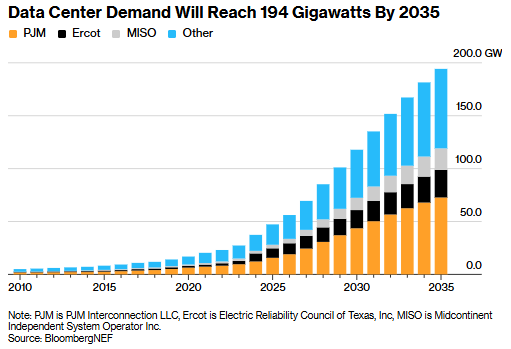
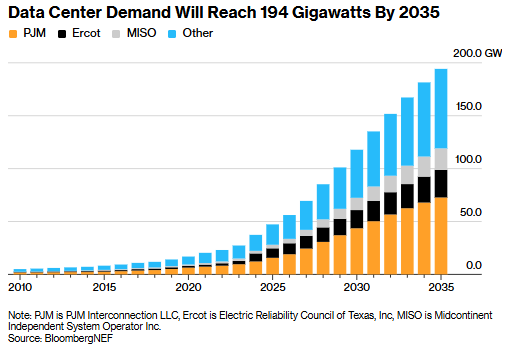
BloombergNEF: U.S. data center power demand reaching 106 GW by 2035 (up 36% from its prior forecast just months earlier), driven by larger facilities—nearly a quarter of new projects exceed 500 MW.
These figures align with the “fifth of U.S. power use by 2035” headline when high-growth assumptions (AI acceleration, hyperscaler buildouts) materialize. Total U.S. electricity demand is also rising (EIA projects continued growth through 2035, with data centers as a major driver), but data centers are the fastest-growing segment.
“Every coal plant, every gas plant, every solar farm in the US — one unit of energy out of five generated by them is going to data centers,” said Lloyd Arnold, an analyst at BNEF and one of the authors of the report. “So that’s the same energy that’s going to be going into powering electric vehicles, powering cities, et cetera.”
Will Growth Plateau Due to Grid Access, Regulations, and Gas Constraints?
Short-term headwinds are real and could slow the pace of new grid-connected capacity, even as underlying demand remains strong.
Grid access and transmission bottlenecks are the biggest near-term constraints. Regional transmission organizations like PJM face massive interconnection queues. BloombergNEF forecasts PJM data center load alone could hit 31 GW by 2030—nearly matching expected new generation additions and leaving little margin. NERC has flagged elevated summer shortfall risks in multiple regions. Transmission upgrades and new lines take years; many projects face multi-year delays.
Natural gas generator supply tightness is compounding the issue. Large gas turbines are largely sold out through 2030. Bank of America analysts note data centers will increasingly rely on on-site gas engines/generators and behind-the-meter solutions. Over 7.5 GW of data center projects with on-site generation are already under construction, with 60+ GW more in pre-construction. Co-location deals (e.g., Chevron-Microsoft’s 2.67 GW gas-powered project in West Texas) are accelerating as a workaround.
Regulatory and political hurdles, particularly in “blue states,” add friction. Strict environmental reviews, emissions rules, local zoning opposition, and occasional moratoria on data centers have delayed or blocked projects. Contested projects and local restrictions have risen sharply. Growth is shifting toward more permissive jurisdictions (Texas/ERCOT, parts of the Midwest, Southeast, and Ohio) with faster permitting and existing industrial infrastructure.
Result: We are likely to see a partial plateau or slowdown in the speed of grid-tied data center additions through the late 2020s, especially for the largest AI training clusters.
Hyperscalers (Amazon, Google, Meta, Microsoft) are adapting by:
- Pursuing behind-the-meter generation.
- Co-locating with existing or new power plants.
- Implementing demand-response and workload shifting.
- Securing dedicated power purchase agreements (PPAs).
Overall capacity additions will likely continue, but timelines will stretch and costs will rise without faster infrastructure solutions.
The Nuclear Imperative: Balancing Growth with Reliable, Clean Power
Data centers—especially AI workloads—require high-reliability, 24/7 baseload power. Intermittent renewables need substantial storage or overbuilding to match this profile. Natural gas fills gaps but faces emissions scrutiny and the turbine supply crunch noted above. Nuclear power offers dispatchable, carbon-free baseload that aligns perfectly with hyperscaler carbon-free energy goals.
Tech giants are already voting with their checkbooks:
- Microsoft: $16 billion, 20-year PPA to restart Three Mile Island Unit 1 (835 MW, targeted 2027).
- Meta: Deals for up to 6.6 GW across Oklo, TerraPower (Natrium), Vistra, and Constellation by 2035.
- Google: 500 MW commitment to Kairos Power fluoride salt-cooled reactors.
- Amazon: Investments in X-energy SMRs and co-location deals.
- Broader pipeline: Hyperscalers have committed to roughly 9.8 GW of nuclear capacity across multiple deals.
Restarts of existing plants, uprates, and emerging small modular reactors (SMRs) and microreactors are the fastest paths. Policy support, streamlined NRC processes (e.g., DOE pilot programs for microreactors), and co-location incentives will be critical. Without accelerated nuclear deployment, the U.S. risks either:
- Slower data center growth (capping AI/compute leadership).
- Greater reliance on gas or coal extensions (raising emissions and prices).
- Higher electricity costs passed to consumers and businesses.
The Balance Sheet: Demand vs. Available Electricity
Demand side: Surging and resilient. AI model improvements (like Kimi K3’s memory emphasis) do not eliminate hardware needs—they evolve them. Hyperscalers continue massive capex.Supply side: Lagging in the near term due to physical and regulatory bottlenecks, but responsive through private-sector innovation (on-site generation, co-location, nuclear PPAs). Utilities are revising load forecasts upward dramatically (e.g., AEP expecting 24 GW new load by 2030, mostly data centers).
By 2035, the high-end 18–20% scenario is achievable if nuclear, gas, transmission, and renewables/storage all scale in parallel. A failure to accelerate firm, low-carbon resources like nuclear would likely force a lower effective growth trajectory or compromise reliability/climate targets.
Bottom line: Data center growth to a fifth of U.S. power use by 2035 is plausible on current trajectories—but only if nuclear power scales meaningfully in the next decade. The technology sector is already moving; policymakers and regulators must match that urgency on permitting, transmission, and advanced nuclear deployment. Otherwise, grid constraints and supply-chain limits will impose their own plateau—potentially at the expense of U.S. technological competitiveness.
Appendix: Sources and Links
Primary Projections
- Lawrence Berkeley National Laboratory – United States Data Center Energy Usage Report: 2025 Update (June 2026): https://eta.lbl.gov/publications/united-states-data-center-energy-2025
- EPRI – Powering Intelligence 2026: Updated Scenarios of U.S. Data Center Electricity Use and Power Strategies (Feb 2026): https://www.epri.com/research/products/000000003002034696
- Rhodium Group – The Impacts of Rising Electricity Demand from Data Centers on US Energy and Emissions (high-growth analysis): https://rhg.com/research/data-centers-electricity-demand/
- BloombergNEF (via Utility Dive) – U.S. data center power demand to 106 GW by 2035 (July 2026): https://www.utilitydive.com/news/us-data-center-power-demand-could-reach-106-gw-by-2035-bloombergnef/806972/
Constraints & Supply Side
- Bank of America analysis (via Utility Dive) on capacity gap and on-site generation (July 2026): https://www.utilitydive.com/news/ai-data-center-growth-utilities-generation-plans/825541/
- Bloomberg article on gas supply and infrastructure challenges (April 2026 context in related reporting).
Nuclear & Hyperscaler Deals
- Summary of hyperscaler nuclear deals (Microsoft TMI, Meta 6.6 GW, Google, Amazon): https://smrintel.com/nuclear-data-center-deals/
- Meta nuclear deals announcement (Utility Dive): https://www.utilitydive.com/news/meta-nuclear-deal-oklo-vistra-terrapower-ai-data-centers/809215/
- Broader nuclear microreactor and deployment updates (2026).
AI Hardware Context
- Bloomberg – Moonshot’s Kimi K3 May Be More About Memory Than Compute (July 20, 2026): https://www.bloomberg.com/news/articles/2026-07-20/moonshot-s-kimi-k3-may-be-more-about-memory-than-compute?srnd=phx-industries
Supporting Context
- EIA Annual Energy Outlook 2026 (electricity demand growth).
- NERC reliability assessments and regional queue data.
- Various Utility Dive and industry reports on PJM/ERCOT constraints and on-site generation trends (2025–2026).
All projections carry uncertainty ranges; actual outcomes will depend on AI adoption rates, efficiency gains, policy, and infrastructure execution.
The post Data Center Growth on Track to Absorb a Fifth of US Power Use by 2035: Nuclear Had Better Be Implemented Before We Get There appeared first on Energy News Beat.