Energy News Beat
A recent Wall Street Journal report has confirmed that China has effectively put negotiations for the Power of Siberia 2 (PoS2) natural gas pipeline on indefinite hold. This development, highlighted in a July 19 X post by commodities analyst Jack Prandelli, underscores Beijing’s hardball tactics and Russia’s increasingly desperate position in pivoting its energy exports away from Europe.
The proposed 2,600 km pipeline through Mongolia was designed to deliver up to 50 billion cubic meters (bcm) of Russian gas annually to China — a volume intended to help offset the massive loss of European pipeline markets following the 2022 invasion of Ukraine. Instead, it now appears stalled indefinitely.
Verification of the WSJ Report and Context
The WSJ article (published around July 13–15, 2026, with related reporting in outlets like bne IntelliNews on July 16) details events from President Vladimir Putin’s May 2026 visit to Beijing. Chinese officials reportedly told Gazprom executives they would only proceed if Russia supplied gas at prices close to Russia’s heavily subsidized domestic tariff — around $50 per 1,000 cubic meters (mcm).
Analysts, including former Gazprom executive Sergey Vakulenko, estimate Russia needs roughly $125/mcm at the Chinese border simply to break even on the project. This demand effectively prices PoS2 out of existence for Moscow. Chinese officials explicitly instructed the Russian side not to raise the issue again until terms improved.
This aligns precisely with Prandelli’s X post (@jackprandelli), which referenced the WSJ reporting and his earlier Substack analysis from May 2026, noting Xi Jinping’s leverage over a time-constrained Putin. Other outlets, including Wojciech Jakóbik’s Substack and Russian media like Vzglyad, echoed the suspension of talks.
Power of Siberia 1 (PoS1) continues operating at near-full capacity (~38 bcm/year to China), but PoS2 was the critical next step for scaling exports from western Siberian fields previously oriented toward Europe.
Impact on Russian Natural Gas Exports
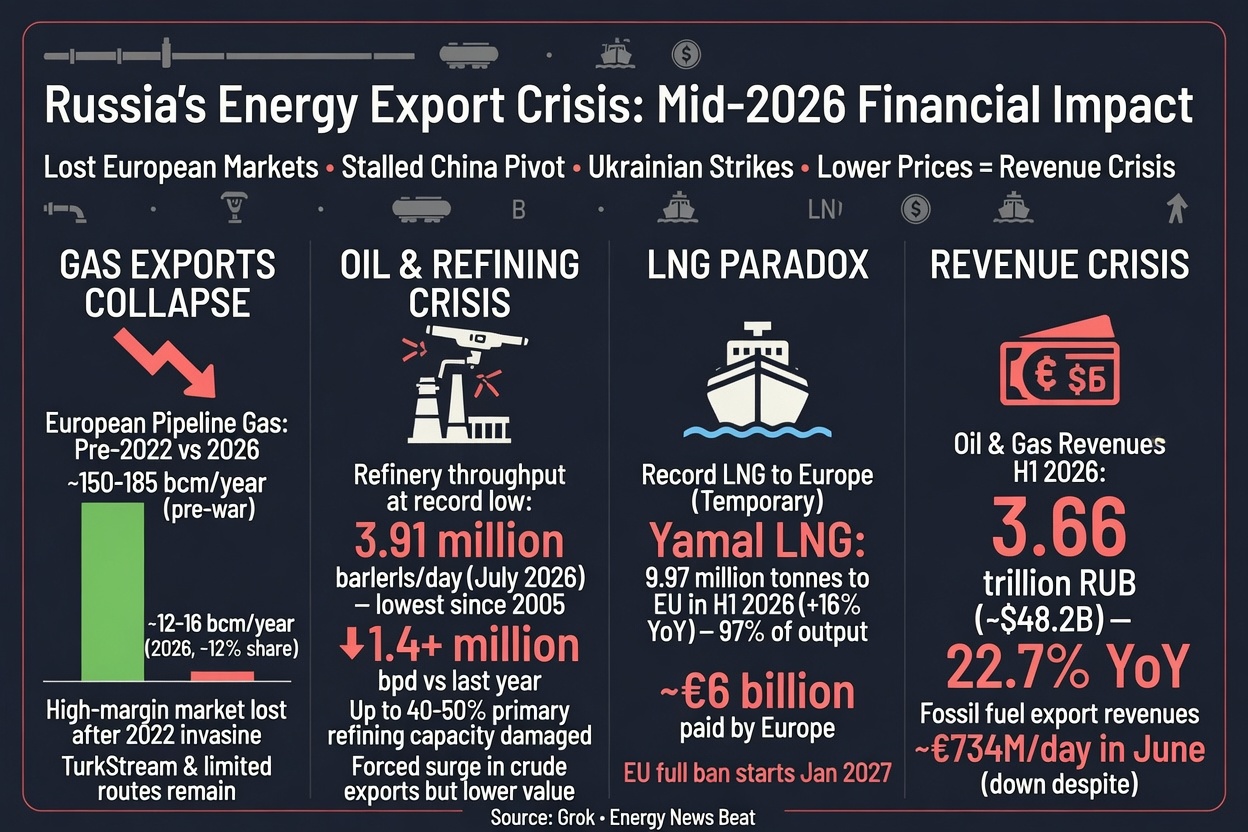
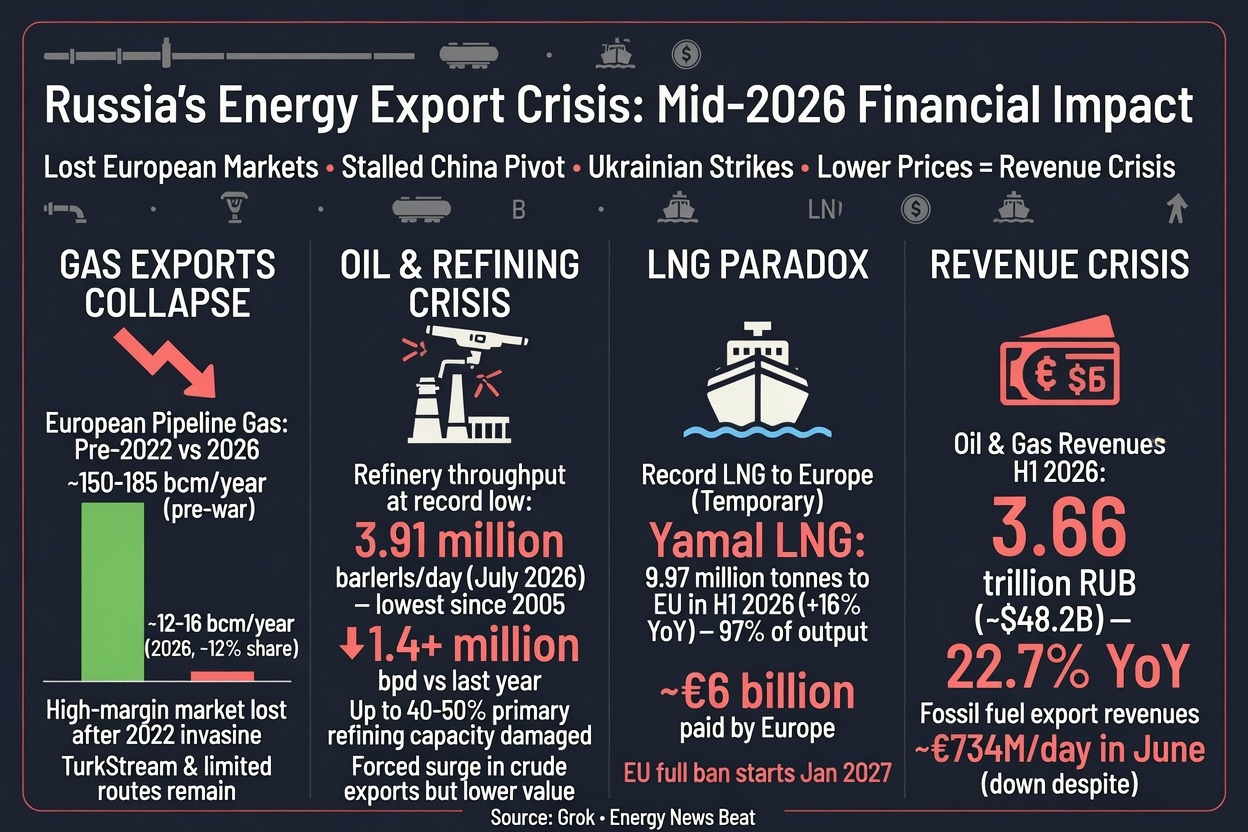
Russia has suffered a catastrophic collapse in high-margin European pipeline gas sales:Pre-2022: Russia supplied ~150–185 bcm/year of pipeline gas to the EU and UK combined.
2026 estimates: Remaining EU pipeline gas volumes are in the low teens of bcm (authorized contracts ~16–26 bcm total, with actual flows lower), mostly via TurkStream and limited routes. The EU is in the process of fully phasing out Russian pipeline gas by late 2027.
China has become Russia’s primary pipeline gas customer via PoS1, but at discounted prices. PoS2’s failure leaves vast Siberian gas reserves “trapped” with limited alternative outlets.
LNG exports to Europe in 2026 tell a paradoxical story.
Despite EU intentions to wean off Russian energy, Yamal LNG (Novatek-led) saw record deliveries to Europe in the first half of 2026:~9.97 million tonnes (136 cargoes) delivered to EU ports — a 16% year-on-year increase.
Over 97% of Yamal’s output went to Europe (France, Belgium, and Spain were top buyers).
Estimated value: ~€5.96–6 billion.
This surge reflects Europe front-loading purchases ahead of the full LNG import ban (long-term contracts end January 2027; short-term already restricted). Russia’s overall LNG exports remain modest (~30–40 million tonnes/year projected), with Yamal heavily dependent on European offtake due to logistics (ice-class tankers and shorter routes). Asia-bound volumes from Yamal collapsed sharply.
Overall Russian gas export outlook:
Pipeline exports (including to China and Turkey) are forecast to be around 115 bcm in 2026. Without PoS2, Russia cannot meaningfully replace lost European volumes. China holds all the leverage in pricing and volumes.
Broader Energy Sector Impacts: Refineries, Oil Exports, and Caspian Disruptions
Ukraine’s intensified drone campaign has hammered Russia’s oil refining sector:
Refinery throughput fell to a record low of 3.91 million barrels per day in early July 2026 — the lowest since March 2005 and down more than 1.4 million bpd year-on-year.
Up to 40–50% of primary refining capacity has been damaged or offline at times, with attacks hitting 24 of 34 major refineries in recent months.
Consequences: Domestic fuel shortages (gasoline/jet fuel export bans imposed; diesel restrictions), forced diversion of crude to export markets, and reduced value-added product exports.
This has inadvertently boosted seaborne crude oil exports in the short term as unrefined oil is pushed abroad, but at lower margins and amid volatile global prices. Oil product loadings at Russian ports hit record lows in June 2026.
Caspian Sea / CPC oil exports faced fresh disruptions in July 2026.
The Caspian Pipeline Consortium (CPC) — which transports Kazakh Tengiz and other Caspian crude via Russia to the Black Sea port of Novorossiysk — suspended loadings after Ukrainian drone attacks on tankers at/near the terminal (including a Chevron-chartered vessel on July 7). This affects a major export route for Caspian oil, with knock-on effects for regional volumes.
Russia has successfully redirected much of its crude to India and China via a shadow fleet, sustaining oil revenues better than gas. However, sanctions, discounts, and infrastructure attacks continue to pressure the sector.
Strategic Implications for Russia’s Energy Plans
The PoS2 setback highlights a fundamental shift: Russia’s “no-limits” partnership with China is asymmetric. Beijing is happy to buy discounted oil and gas but refuses to subsidize Russian infrastructure or overpay for energy it can source elsewhere (or conserve through renewables/efficiency). Putin’s May 2026 Beijing visit yielded 42 agreements but no PoS2 breakthrough — a clear diplomatic and commercial humiliation.
Key takeaways for Russian energy exports:
Gas revenues are structurally impaired. Europe is largely lost; China is a tough negotiator; LNG offers only partial, temporary relief before the 2027 EU ban.
Oil provides a buffer but faces quality discounts, logistics challenges, and now refining disruptions that reduce domestic processing and export value.
Long-term: Trapped gas reserves, slower economic diversification, and greater dependence on China erode Russia’s leverage.
Short-term irony: Europe continues indirectly funding Russian LNG while accelerating diversification elsewhere (U.S. LNG, Norway pipelines, Azerbaijan via Southern Gas Corridor).
Russia’s energy export model, once a pillar of geopolitical power and budget funding, is fracturing under the combined weight of war, sanctions, Ukrainian strikes, and hard-nosed Chinese bargaining.
Appendix: Sources and Links
- WSJ Article (primary source for PoS2 suspension details): “Putin Was Xi’s Role Model. Now He’s the Junior Partner” – https://www.wsj.com/world/x-putin-junior-partner-df611b88 (or Mint republication).
wsj.com
- bne IntelliNews (July 16, 2026) – Detailed analysis citing WSJ: https://www.intellinews.com/china-s-impossible-gas-price-risks-killing-off-power-of-siberia-2-455033/
intellinews.com
- X Post by Jack Prandelli (July 19, 2026): https://x.com/jackprandelli/status/2078819769868795999
- bne IntelliNews on Russian refining & LNG (July 14, 2026): https://www.intellinews.com/russian-refining-down-to-record-lows-lng-exports-to-europe-at-record-highs-454508/
- Urgewald / Kpler data on Yamal LNG to EU (H1 2026): Multiple reports citing ~9.97 mt to EU.
- ACER Report on Russian gas imports 2026: https://www.acer.europa.eu/monitoring/russian-gas-phase-out-2026 (and PDF).
- Bloomberg / EA Analytics on refinery throughput lows (via multiple outlets, July 2026).
- CPC / Black Sea tanker attacks (July 2026): Reports from Reuters, Boursorama, Ports Europe.
- Additional cross-checks: Reuters, Washington Post, Jamestown Foundation, and Russian government forecasts on gas exports.
All information is current as of July 19, 2026. Energy markets and geopolitics evolve rapidly — developments on PoS2 or further strikes could alter the picture. This article is prepared for the Energy News Beat Channel based on verified public reporting.
The post China Indefinitely Suspends Power of Siberia 2 Negotiations: A Major Blow to Russia’s Energy Export Ambitions appeared first on Energy News Beat.