Energy News Beat
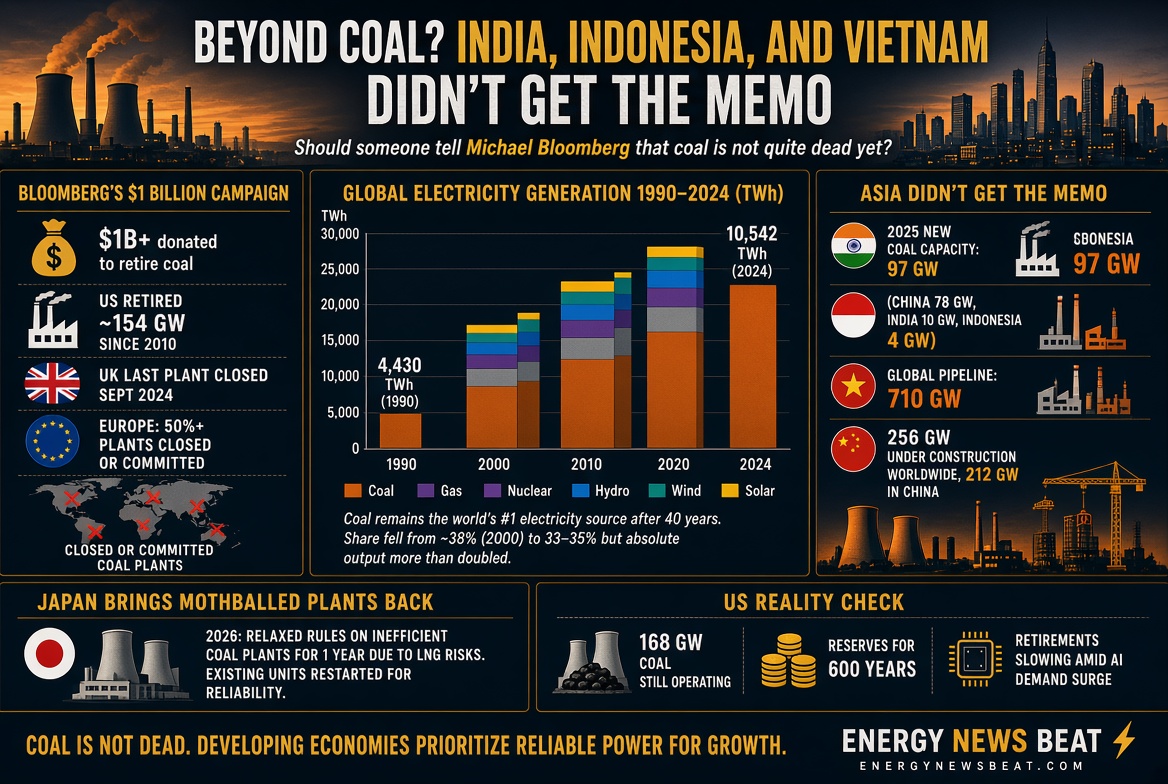
Michael Bloomberg has poured more than $1 billion into campaigns to retire coal plants in the United States and globally. In 2019, his philanthropies committed $500 million to the Beyond Carbon effort. In 2021, he launched a drive to close a quarter of the world’s remaining coal plants and cancel all proposed ones by 2025. In 2023, he added another $500 million aimed at shutting every last U.S. coal plant by 2030. The Sierra Club’s Beyond Coal campaign, heavily funded by Bloomberg, helped retire hundreds of U.S. units. Similar efforts in Europe marked major closures.
Those campaigns succeeded in parts of the OECD. They did not succeed in stopping the countries that actually need the power. India, Indonesia, and Vietnam kept building and running coal plants. China added the bulk of new global capacity. The United States, meanwhile, has in effect exported a portion of its coal use to Asia even as it retired domestic plants. What’s powering rapid construction, rising incomes, and industrial growth in Vietnam, Indonesia, and parts of Southeast Asia? Coal-fired generation.
The Washington Times commentary by Michelle Bloodworth of America’s Power, drawing on the National Coal Council’s July 2026 report “Maximizing the Value of the U.S. Coal Fleet,” makes the domestic case: record U.S. electricity demand in 2025, expected to keep climbing in 2026–2027 because of AI, data centers, and manufacturing, collided with premature retirements. Since 2011, the United States retired enough coal capacity to power 62 million households—roughly New York plus California. About 168 GW still operates across 37 states. The report lists 19 recommendations to keep and modernize that fleet rather than replace it from scratch.
Globally, more than 256 GW of new coal capacity is under construction, 212 GW of it in China. A July Interior Department assessment found U.S. coal reserves sufficient for 600 years at current consumption rates.

Last 40 Years of Electricity by Source: Coal Remains the Largest Single Fuel
Coal has been the world’s largest source of electricity generation for more than three decades. Absolute output more than doubled even as its share of the mix slowly declined.
Using Statista compilation of generation data (TWh):
- 1990: Coal 4,430; natural gas 1,748; hydropower
- 2,191; nuclear 2,013; oil 1,324; wind 4; solar negligible.
- 2000: Coal 5,996; gas 2,772; hydro 2,696; nuclear 2,591; oil 1,189; wind 31; solar 0.8.
- 2010: Coal 8,671; gas 4,844; hydro 3,536; nuclear 2,756; wind 342; solar 32.
- 2024: Coal 10,542; gas 6,892; hydro 4,408; nuclear 2,778; wind 2,503; solar 2,129.
Pew Research analysis of Ember data shows the share picture from 2000 to 2025: coal fell from 38% to 33%, gas rose then stabilized near 22%, nuclear dropped from 17% to 9%, hydropower slipped from 17% to 14%, while wind plus solar jumped from under 0.3% combined to about 17%. Fossil fuels (coal, gas, other) still supplied 57% of global electricity in 2025, down from 65% in 2000. Renewables as a group (including hydro) slightly exceeded coal’s share for the first time in 2025 (34% vs. 33%). Coal generation itself set records or near-records in several recent years even as its percentage share eased. IEA figures put coal at 35% of 2024 generation—the top source for more than 50 years.
Wind and solar grew explosively from a tiny base. They have not displaced coal’s absolute contribution in the places where electricity demand is rising fastest.
Where Plants Were Canceled or Closed—and Where They Were Not.
OECD countries and parts of Europe executed the largest closures. The United Kingdom shut its last coal plant, Ratcliffe-on-Soar, at midnight on 30 September 2024. Ireland, Finland, and others followed. More than a third of OECD countries now generate no coal power. Germany closed numerous lignite and hard-coal units but delayed others for system adequacy after the 2022 energy crisis; some units scheduled for 2024–2025 stayed in reserve or on the grid. Australia has not commissioned a new coal plant since 2009–2012 and has retired several large stations, including Liddell in 2023. Proposed OECD coal capacity collapsed from 111 GW in 2015 to a handful of projects totaling a few gigawatts.
The United States retired or converted nearly 154 GW of coal capacity since 2010—almost 45% of the peak fleet—leaving roughly 168 GW operating. Annual retirements peaked above 20 GW around 2015–2016 under MATS compliance deadlines and cheap gas. They slowed sharply by 2025 (only 2.6 GW retired that year, the lowest in 15 years) as demand rose and some planned closures were postponed by emergency orders or canceled. No new U.S. coal plant has entered commercial operation since 2013.
Outside the OECD, the picture is different. Global Energy Monitor’s Boom and Bust Coal 2026 report recorded 97 GW of new coal capacity commissioned in 2025—the second-highest year on record after 2015. China added 78 GW, India 10 GW, Indonesia 4 GW. The development pipeline grew to 710 GW, with China and India accounting for the large majority. India targets 80–100 GW of additional coal capacity by the early 2030s even as solar capacity has exploded. Indonesia’s growth includes substantial captive (off-grid industrial) coal for nickel and aluminum processing. Vietnam continues to add and import coal to meet demand. New proposals and construction outside China and India fell to a small share of the global total, but the Asian builders more than offset Western retirements in capacity terms.
Cancellations have been large in absolute terms—hundreds of gigawatts shelved in China and India over the past decade—yet both countries still added net capacity and kept large pipelines.
Japan: Mothballed Plants, Relaxed Rules, and Reliability First
Japan illustrates the difference between mothballing and demolition. After Fukushima, it idled most of its nuclear fleet and leaned on LNG and coal. In March 2026, the Ministry of Economy, Trade and Industry announced it would suspend, for one year starting in April, the 50% utilization cap on coal plants with efficiency below 42%. The reason: risks to LNG imports from Middle East tensions. Older, less-efficient units could run harder to reduce LNG consumption by an estimated 0.5 million tons. Officials called it a short-term adjustment that does not change long-term decarbonization policy.
Individual plants show the same pattern. JERA’s Taketoyo station, damaged by fire, restarted in early 2025 on coal only (biomass co-firing delayed) to meet peak demand. J-POWER mothballed units at Matsushima while planning a replacement gasification project; other older units face eventual retirement but remain available in the near term. Japan kept coal capacity in reserve rather than permanently destroying it. When LNG supply looked uncertain, the reserve could be called. Several nuclear restarts are also proceeding, but coal remains part of the immediate reliability toolkit.
Is Coal Making a Comeback?
Not a full reversal in the West, but a pause in the pace of decline and continued growth where demand is exploding. U.S. and EU retirements slowed in 2025; many plants scheduled for closure stayed online because of reliability concerns and rising load. Electricity markets often fail to pay coal plants for on-site fuel storage and dispatchability during winter storms or renewable lulls. The National Coal Council argues modernization of the existing 168 GW fleet is faster and cheaper than building equivalent new capacity and transmission.
In Asia, the numbers are unambiguous. Global coal demand hit a new record in 2025 even as generation from coal plants edged down slightly in some large markets because wind and solar covered incremental demand. Capacity additions, however, continued. IEA projections show India and ASEAN (led by Indonesia and Vietnam) adding substantial coal use through 2030. Captive industrial coal in Indonesia is expanding independently of grid-transition pledges. The geographic concentration is now extreme: a handful of Asian countries account for the overwhelming majority of both operating additions and the remaining pipeline.
Coal’s attributes—dispatchable baseload, on-site fuel inventory, existing infrastructure, and low cost in resource-rich countries—have not disappeared. Developing economies prioritizing growth, manufacturing, and grid stability have not treated Bloomberg’s memo as binding. Developed economies that retired plants fastest now confront higher demand and reliability questions. Japan’s decision to ease operating limits on existing coal units is a practical illustration: when supply risk appears, mothballed or under-utilized capacity can be brought back more quickly than new nuclear or massive renewable-plus-storage builds.
Coal is not dead. In large parts of the world, it is still the workhorse. The question is whether Western policy will keep dismantling domestic capacity while the rest of the planet keeps building it. The Green Movement, funded by people like Michael Bloomberg, has done more harm to the average worker and poorer districts and really helped make the climate agenda a weaponized wealth transfer that was well funded and orchestrated. Only to have them all admit it was overstated.
But don’t take our word for it; just read theirs. UN Climate Panel Quietly Admits Its Doomsday Climate Scenarios Were ‘Implausible’ – How much money has been spent on Net Zero because of lies?
At Energy News Beat, we Make Appendices Great Again.
Appendix: Sources and Links
- Robert Bryce, “Beyond Coal? India, Indonesia, and Vietnam Didn’t Get the Memo,” Substack, 13 Aug 2026: https://robertbryce.substack.com/p/beyond-coal-india-indonesia-and-vietnam
- Michelle Bloodworth, “America cannot afford to leave coal behind,” Washington Times, 31 Aug 2026: https://www.washingtontimes.com/news/2026/aug/31/america-cannot-afford-leave-coal-behind/
- National Coal Council, “Maximizing the Value of the U.S. Coal Fleet,” July 2026 (referenced in Washington Times piece)
- Statista, Global electricity generation by source 1990–2024: https://www.statista.com/statistics/273273/world-electricity-generation-by-energy-source/
- Pew Research Center, “6 facts about how global energy production is changing,” 20 Jul 2026 (Ember data): https://www.pewresearch.org/short-reads/2026/07/20/how-global-energy-production-is-changing-in-6-charts/
- IEA, Electricity – Global Energy Review 2025: https://www.iea.org/reports/global-energy-review-2025/electricity
- IEA, Coal 2025 / Demand and Trade sections: https://www.iea.org/reports/coal-2025
- Global Energy Monitor, Boom and Bust Coal 2026: https://globalenergymonitor.org/research/boom-and-bust-coal-2026 and PDF https://globalenergymonitor.org/sites/default/files/2026-05/GEM-Boom-and-Bust-Coal-2026.pdf
- Ember / Our World in Data electricity mix resources: https://ourworldindata.org/electricity-mix and Ember yearly data
- EIA, U.S. coal retirements 2025: https://www.eia.gov/todayinenergy/detail.php?id=67427
- Reuters, Japan to relax coal plant rules April 2026: https://www.reuters.com/business/energy/japan-considers-increasing-coal-fired-power-war-disrupts-lng-imports-2026-03-27/
- Beyond Coal Japan data and plant status: https://beyond-coal.jp/
- GEM wiki, Matsushima power station: https://www.gem.wiki/Matsushima_power_station
- Bloomberg Philanthropies / Mike Bloomberg announcements on Beyond Coal and Beyond Carbon (2019–2023 campaigns)
- Additional GEM, CREA, Carbon Brief, and IEA reports on India, Indonesia, Vietnam capacity additions and captive coal cited in body.
The post Beyond Coal? India, Indonesia, and Vietnam Didn’t Get the Memo. Should Someone Tell Michael Bloomberg That Coal Is Not Quite Dead Yet? appeared first on Energy News Beat.