Energy News Beat
After coordinated IEA releases during the Iran war and earlier drawdowns that were never fully replaced, SPR crude sits at 286.6 million barrels as of the EIA week ending August 28, 2026 — about 40% of authorized 714-million-barrel capacity and the lowest level since the early 1980s.
That level already sits inside the band most engineers treat as the practical operating floor. Another 39 million barrels still slated under the OECD/IEA plan would take the reserve to about 243 million barrels, below the 250–300 million barrel range where salt-cavern hydraulics, pumps, and draw rates start to degrade.
Markets have spent months trying to look past the Strait of Hormuz. Thin inventories — SPR, Cushing, and distillates — keep reasserting themselves every time they fight flares.
Latest storage snapshot (EIA, week ended Aug. 28, 2026)
|
Category
|
Level (MMbbl)
|
Weekly change
|
vs. year ago
|
|---|---|---|---|
|
SPR crude
|
286.6
|
−3.1
|
−118.1 (−29%)
|
|
Commercial crude (ex-SPR)
|
424.5
|
−4.5
|
+3.8
|
|
Total U.S. crude (incl. SPR)
|
711.1
|
−7.6
|
−114.3
|
|
Cushing, OK
|
22.5
|
+0.08
|
−1.7
|
|
Distillate fuel oil
|
104.2
|
+0.8
|
−11.7 (−10%)
|
|
Total motor gasoline
|
205.7
|
−1.2
|
−12.8
|
Sources: EIA Weekly Petroleum Status Report, Table 4 and weekly series.
Structural bottoms vs. a congressional floor
There is no single “Congress said stop here” inventory target for the whole SPR. What exists is a layered set of physical, operational, and statutory constraints.
Physical / cavern mechanics. Oil in the four Gulf Coast salt-dome sites floats on brine. As oil is withdrawn, the water column rises. DOE has said cavern-mechanics studies imply a conservative system-wide floor near 70 million barrels. Below that, the reserve is more a geological feature than a usable stockpile.
Operational / industry floor. Petroleum engineers and most market analysts treat 250–300 million barrels as the practical minimum for reliable high-rate draws. Texas A&M petroleum engineering professor Siddharth Misra told Reuters: “The core mission of the reserve is to supply the market rapidly during a crisis. But operating below 250 million barrels pushes the infrastructure into a dangerous zone.” Higher water, lower reservoir pressure, and slower effective extraction (historically cited around 1.0–1.4 million bpd when inventories are low versus much higher rates when caverns are full) are the issues.
Statutory floor for limited drawdowns. Under 42 U.S.C. § 6241(h), limited (non-“severe energy supply interruption”) drawdowns cannot take the SPR below 252 million barrels. Full presidential emergency drawdowns under § 6241(d) do not carry that same numeric floor. GAO has repeatedly noted that Congress has never locked in a long-term target size after the original 500-million-barrel goal of the 1970s. Mandated budget-offset sales since 2017, the 2022 emergency sale, and the 2026 IEA release stacked on top of an incomplete refill.
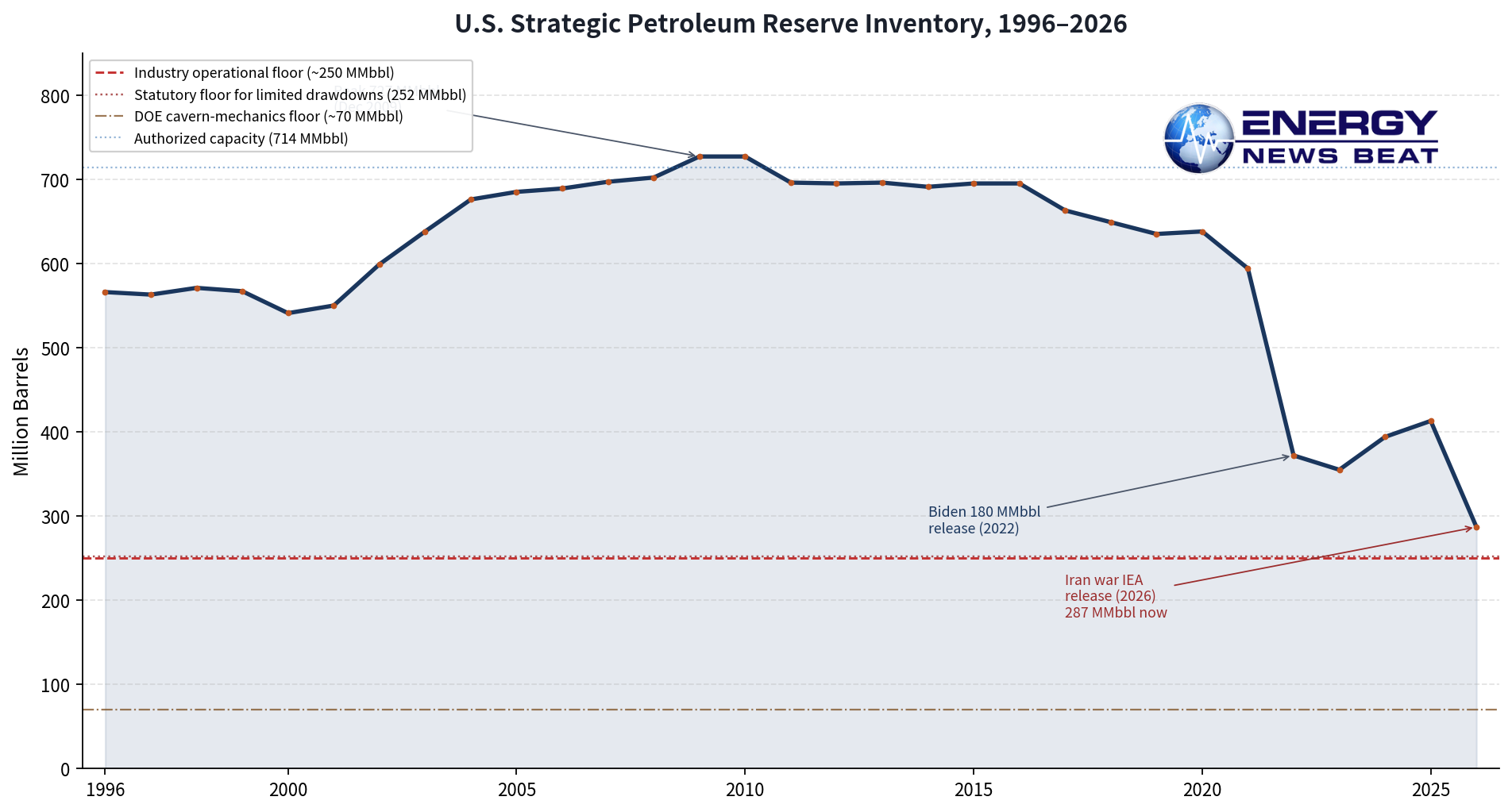
The 30-year picture is the point: the SPR spent most of 1996–2021 between roughly 540 and 727 million barrels. It peaked at 726.6 million barrels in late 2009. The 2022 release dropped year-end stocks to 372 million; 2023 bottomed near 355 million; a partial refill brought year-end 2025 to 413 million. The 2026 war release then cut through that rebuilt layer.
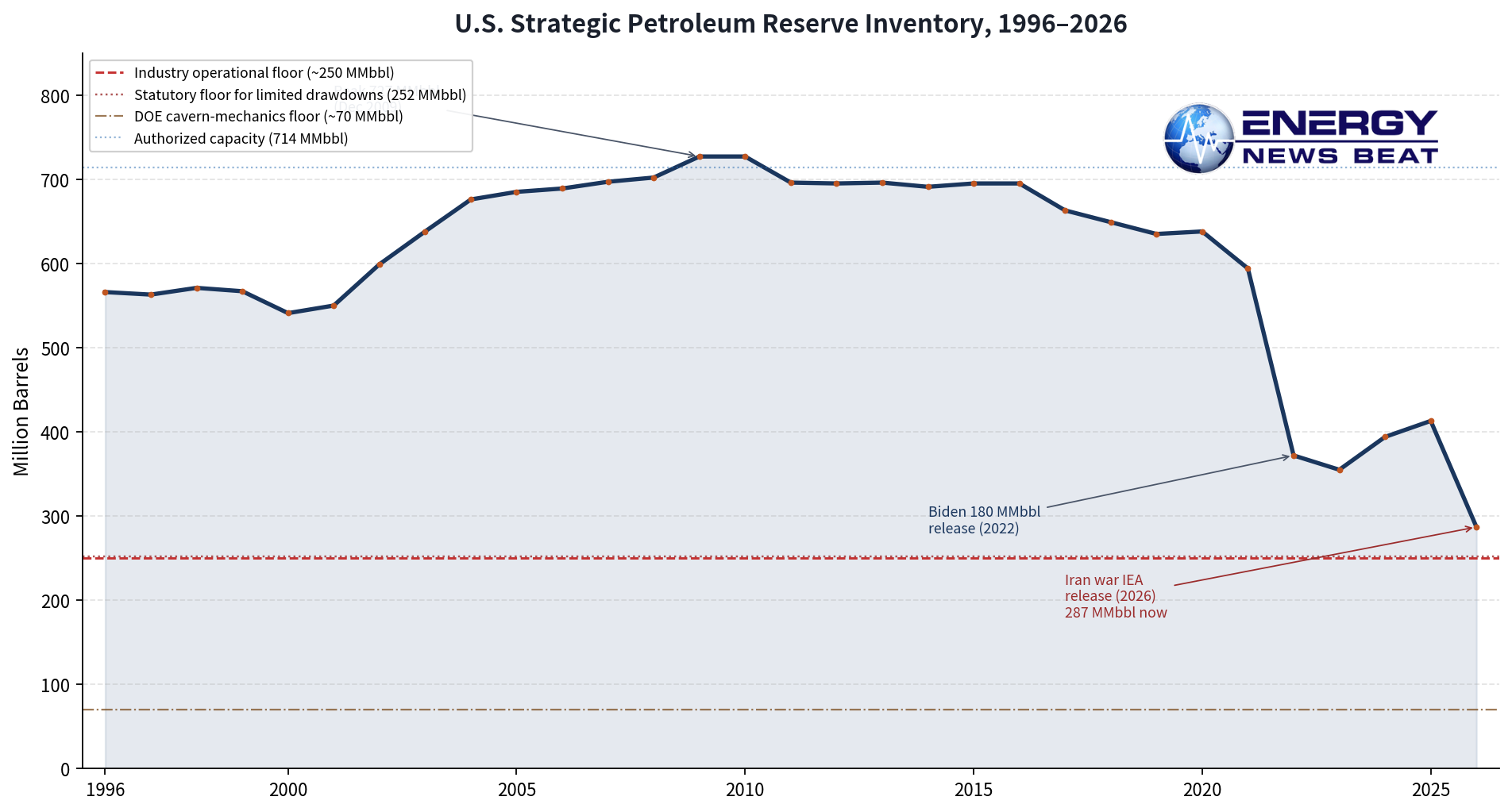
Year-end EIA annual series through 2025; 2026 point is the latest weekly reading (286.6 million barrels). Authorized capacity is 714 million barrels.President Trump has said Venezuelan crude will refill the SPR. Two problems sit on that path. First, SPR caverns and draw systems were designed around lighter, sweeter grades than Venezuela’s extra-heavy barrels. Second, Kevin Book of ClearView Energy Partners has said a sell-heavy / buy-light swap “would take years.” Immediate availability and payment terms remain unresolved. Venezuela’s output is about 1.25 million bpd.
Cushing tank bottoms: the commercial twin of the SPR problem
Cushing, Oklahoma — WTI’s pricing point and the largest commercial tank farm in the United States — is the market’s other structural bottom.Shell capacity at the hub is commonly cited near 80–90 million barrels. Working capacity is lower. Tank bottoms (dead volume needed so floating roofs, mixers, and pump suction still work) mean inventories cannot go to zero. Market convention and operator comments put the operational stress zone around 20 million barrels. Wood Mackenzie has used utilization near 27% of capacity as a proxy for the floor. EIA itself published an explainer after Cushing spent several weeks under 20 million barrels in June–July 2026.
Latest reading: 22.5 million barrels — only a sliver above that zone, and 7% below year-ago. When Cushing briefly dipped under 20 million earlier this summer, WTI at Cushing traded above Brent, a classic “there is no more oil here” signal. NYT reporting in late August put the same tanks at 22 million barrels against a complex that can hold on the order of 90 million. Removing much more risks damaging floating roofs and mixing equipment.
Cushing at tank bottoms does two things at once: it makes the WTI prompt spread violent, and it forces Midcontinent barrels toward the Gulf instead of sitting in storage. That is the commercial-market version of the SPR problem — less optionality, more volatility.
Analysts looking past Hormuz — and why inventories keep pulling prices back
The Strait of Hormuz story has already gone through several “the market is looking through it” phases. After the late-February 2026 outbreak, Brent spiked above $126. Talk of memoranda of understanding and partial reopenings in June prompted a wave of forecast cuts:
- Reuters poll (June 30): 2026 Brent average cut to $84.50 from $90.44 the month before.
- Goldman Sachs: 2027 Brent around $75, with Q4 2026 near $80 if Gulf exports normalize.
- Morgan Stanley: Q3 Dated Brent cut by $15 at one point on faster-than-expected tanker traffic.
- Citi: more aggressive, with Q3/Q4 2026 Brent at $75/$70 in a normalization case.
- UBS: 2026 average cut to the low $80s, 2027 to $75, with a $70–$100 range depending on Hormuz durability.
Those cuts assumed a durable reopening and a market that could lean on inventories one more time. Inventories did the work — OECD coordinated 400 million barrels, the U.S. share was 172 million from the SPR, China drew its own stocks from over 1 billion barrels earlier in the year — but the buffer is now spent.
The latest flare-up into early September 2026 pushed Brent back into the mid-$90s (settlements near $95–$96, WTI near $91). That is still below the April peak, but it is not a market that has “looked past” the chokepoint. Lutz Kilian of the Dallas Fed put the inventory logic cleanly: as the reserve approaches the bottom of the barrel, participants worry more, and they may question whether whatever oil is left can still calm the market. Once inventories are effectively exhausted, demand destruction is the only remaining adjustment.
The structural setup is therefore two-sided. If Hormuz flows normalize toward 11–12 million bpd and U.S. production plus exports stay high, banks’ $70–$80 2027 numbers can still be right. If another disruption hits while SPR is near 240–290 million, Cushing is on tank bottoms, and distillates are 10% below last year, the same analysts’ upside scenarios ($100–$130) become the base case again. A shrunken SPR is one less stabilizer. China’s stocks are also lower than at the start of 2026. That is the definition of a thinner shock absorber.
Irina Slav’s September 2 Oilprice.com piece framed the same conclusion: crude is rising on Gulf hostilities and because U.S. inventories and the SPR are down again. The next 39 million barrels of planned SPR oil would take the reserve through the industry operating floor. After that, policy flexibility is mostly gone.
Refill talk — Venezuelan barrels, future appropriations, canceled mandated sales — does not change the next two quarters. The SPR that contained the first months of this war is not the SPR that will be available for the next shock.
- EIA Weekly Petroleum Status Report (week ended Aug. 28, 2026; released Sept. 2, 2026): https://www.eia.gov/petroleum/supply/weekly/
- EIA Table 4 (stocks by PAD and product): https://www.eia.gov/petroleum/supply/weekly/pdf/table4.pdf
- EIA weekly stocks series: https://www.eia.gov/dnav/pet/pet_stoc_wstk_dcu_NUS_W.htm
- EIA annual SPR ending stocks: https://www.eia.gov/dnav/pet/hist/LeafHandler.ashx?n=PET&s=MCSSTUS1&f=A
- DOE SPR Quick Facts: https://www.energy.gov/hgeo/opr/spr-quick-facts
Oilprice / Reuters core coverage
- Irina Slav, “U.S. SPR Depletion Threatens Further Oil Price Volatility,” Oilprice.com, Sept. 2, 2026: https://oilprice.com/Energy/Crude-Oil/US-SPR-Depletion-Threatens-Further-Oil-Price-Volatility.html
- Reuters, “Depleted US oil stash loses potency as Iran war grinds on,” Aug. 31, 2026: https://www.reuters.com/business/energy/depleted-us-oil-stash-loses-potency-iran-war-grinds-2026-08-31/
- Reuters, EIA inventory wrap, Sept. 2, 2026: https://www.reuters.com/business/energy/us-crude-gasoline-inventories-fell-last-week-distillates-rose-eia-says-2026-09-02/
- Oilprice.com, “U.S. Crude Inventories Drop amid Continued SPR Draws,” Sept. 1, 2026: https://oilprice.com/Latest-Energy-News/World-News/US-Crude-Inventories-Drop-amid-Continued-SPR-Draws.html
SPR floors, statute, and GAO
- GAO-26-106918, Energy Security / SPR planning: https://files.gao.gov/reports/GAO-26-106918/index.html
- 42 U.S.C. § 6241(h) limited-drawdown floor (summarized in GAO and CRS)
- CRS, SPR inventory outlook: https://www.congress.gov/crs-product/IN12542
- MarketWatch / DOE on 70 million barrel cavern floor: https://www.morningstar.com/news/marketwatch/20260715301/the-us-oil-reserve-is-at-a-40-year-low-but-the-government-says-theres-still-plenty-of-breathing-room
- Bipartisan Policy Center explainer: https://bipartisanpolicy.org/explainer/how-the-u-s-strategic-petroleum-reserve-works/
Cushing tank bottoms
- EIA / Energy News Beat, “What are tank bottoms?”: https://energynewsbeat.co/eia/what-are-tank-bottoms/
- New York Times, Cushing tanks near empty, Aug. 28, 2026: https://www.nytimes.com/2026/08/28/business/energy-environment/oil-storage-iran-war.html
- KOSU, Cushing near operational minimum: https://www.kosu.org/cushing-oil-hub-low-levels
- Wood Mackenzie / Oilfield Technology on operational floor: https://www.oilfieldtechnology.com/product-news/15062026/cushing-crude-stocks-sit-less-than-2-million-bbls-above-operational-floor-amid-global-supply-crisis/
- Midland Reporter-Telegram: https://www.mrt.com/business/oil/article/cushing-ok-crude-oil-storage-22367191.php
Analyst price views (Hormuz “look-through”)
- Reuters poll, June 30, 2026: https://www.reuters.com/business/energy/poll-analysts-dial-down-oil-forecasts-hormuz-reopening-eases-supply-concerns-2026-06-30/
- Goldman Sachs Research interview: https://www.goldmansachs.com/insights/goldman-sachs-exchanges/how-the-us-iran-deal-could-affect-oil-prices
- Morgan Stanley via Yahoo/Bloomberg: https://finance.yahoo.com/energy/articles/morgan-stanley-cuts-oil-forecasts-001028066.html
- UBS forecast cut: https://www.reuters.com/business/energy/ubs-lowers-2026-2027-oil-price-forecasts-hormuz-flows-recover-2026-07-02/
- Citi forecast cut: https://www.reuters.com/business/citi-cuts-brent-forecasts-us-iran-mou-points-strait-hormuz-flow-normalization-2026-06-15/
- Live benchmarks around Sept. 3, 2026 (mid-$90s Brent / ~$91 WTI): market data summaries via Reuters, CNBC-TV18, and Hormuz Monitor
Context inventories and production
- Trading Economics SPR and stocks change: https://tradingeconomics.com/united-states/strategic-petroleum-reserve-crude-oil-stocks
- YCharts SPR weekly: https://ycharts.com/indicators/us_ending_stocks_of_crude_oil_in_the_strategic_petroleum_reserve
- Wikipedia SPR page (release chronology): https://en.wikipedia.org/wiki/Strategic_Petroleum_Reserve_(United_States)
Chart constructed from EIA annual ending-stocks series (MCSSTUS1) for 1996–2025 and the EIA weekly reading for late August 2026.
The post The U.S. Strategic Petroleum Reserve is no longer a deep cushion appeared first on Energy News Beat.