Energy News Beat
The United Arab Emirates is accelerating an ambitious strategy to achieve zero dependency on the Strait of Hormuz, one of the world’s most critical oil chokepoints. This comes amid recent regional tensions and a temporary closure of the strait following the Iran-US conflict earlier in 2026.
Bloomberg reports, citing an interview with UAE Minister of Foreign Trade Thani Al Zeyoudi, that the country is “moving toward having zero Hormuz dependency.” He emphasized: “We’re moving toward having zero Hormuz dependency and that’s regardless of whether it’s open or not. It’s going to open, and we hope that will happen quickly, but we will not stop the new plan.”
The UAE has had enough of vulnerability to geopolitical leverage and is building permanent infrastructure to reroute crude, refined products, and other energy flows away from the narrow waterway between Iran and Oman.
UAE’s Specific Plans: Ports, Pipelines, and Connectivity
The centerpiece is a major expansion of eastern ports on the Gulf of Oman (outside the Strait of Hormuz): Dibba, Fujairah, and Khor Fakkan. The UAE also plans to build at least one new harbor on its eastern coast.
Supporting this are:
- New pipelines connecting oil and gas fields to these ports.
- Expanded rail and road networks for better inland connectivity to petroleum facilities.
- Feasibility studies for consistent exports of petrochemicals, LNG, and other energy products.
In May 2026, Abu Dhabi Crown Prince Sheikh Khaled bin Mohamed bin Zayed directed ADNOC to fast-track the West-East Pipeline project. This new pipeline will double crude export capacity through Fujairah by 2027.
The existing Abu Dhabi Crude Oil Pipeline (ADCOP / Habshan–Fujairah pipeline) — roughly 380–406 km long with a capacity of about 1.5–1.8 million barrels per day (mb/d) — has run at full capacity during recent disruptions. The new line will bring total bypass capacity through Fujairah to approximately 3.6 mb/d.
ADNOC is also evaluating a multi-fuel pipeline for refined products (gasoline, diesel, jet fuel) to further reduce reliance on tanker traffic through the strait.
These moves align with ADNOC’s broader goal of boosting production capacity while securing export routes.
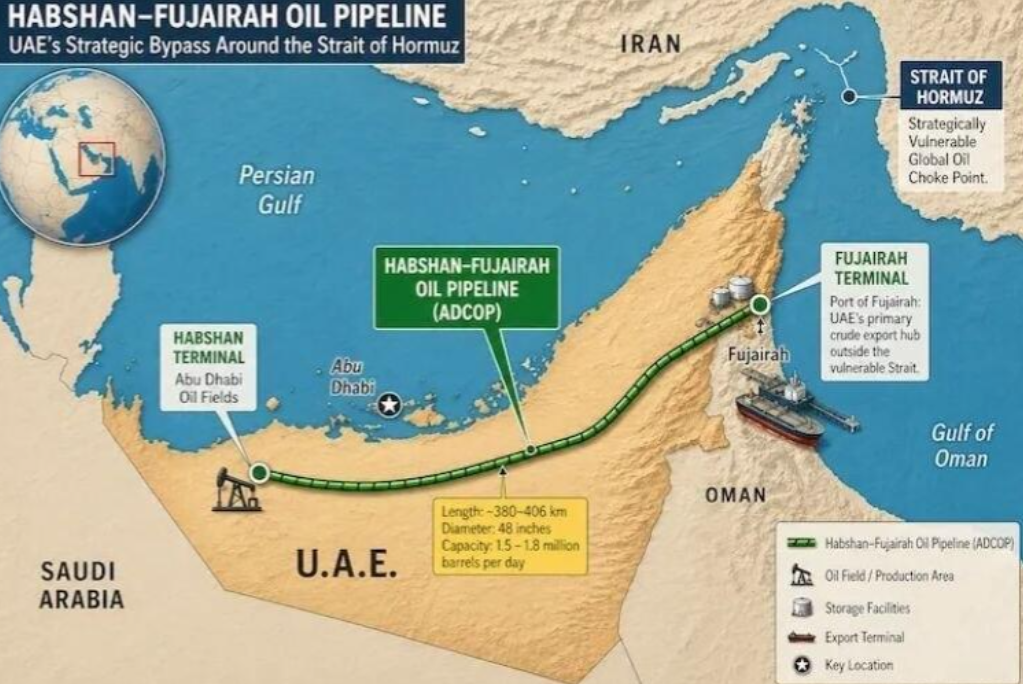
UAE’s Habshan–Fujairah (ADCOP) pipeline provides a direct bypass from Abu Dhabi fields to Fujairah on the Gulf of Oman.
Regional Bypass Efforts: How Many Other Gulf Countries Are Involved?
While the UAE is the most vocal about achieving “zero dependency,” several neighbors are also advancing bypass infrastructure, though at different speeds and scales. The main active players are Saudi Arabia, the UAE, and Iraq. Kuwait, Qatar, and Bahrain remain heavily dependent on the strait with limited near-term alternatives.
Saudi Arabia
The kingdom operates the massive East-West Pipeline (Petroline / Abqaiq–Yanbu), a ~1,200 km route across the Arabian Peninsula to the Red Sea port of Yanbu. Design capacity: Up to 7 mb/d (after expansions and conversion of parallel NGL lines).
Recently restored to full pumping capacity during tensions, crude exports via Yanbu reached ~5 mb/d.
This is the largest existing bypass and has been a key resilience tool.
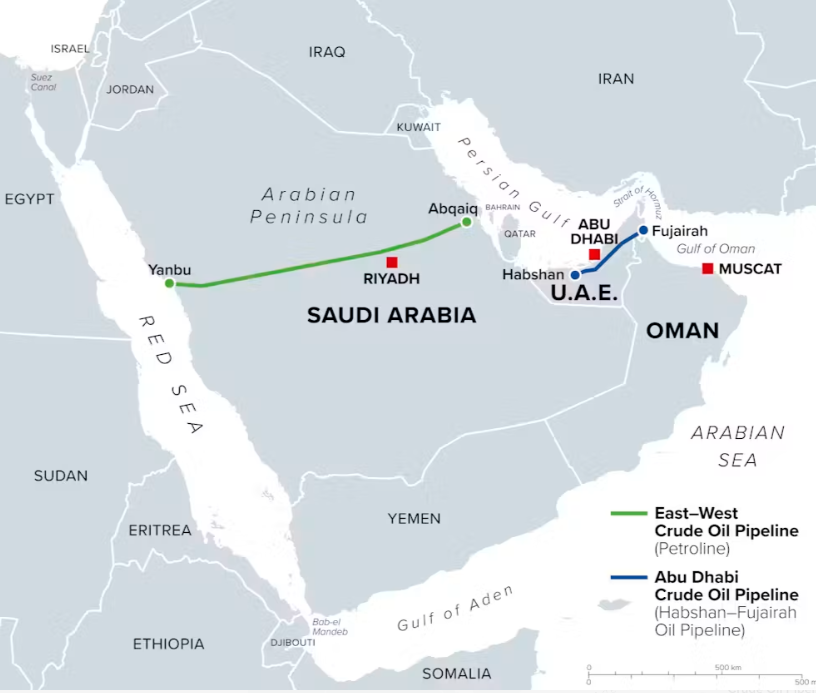
Saudi East-West Pipeline (Petroline) and UAE Habshan–Fujairah pipeline on a regional map.
Iraq
Iraq is fast-tracking alternatives for its southern oil (the bulk of exports, normally routed through the Strait via Basra). Key projects include: Basra–Haditha crude pipeline (target ~2.25–2.5 mb/d capacity) to link southern fields northward.
Expansion of the Kirkuk–Ceyhan pipeline to Turkey (Mediterranean), with plans to increase flows significantly.
Exploration of routes to Aqaba (Jordan, Red Sea) and Baniyas (Syria, Mediterranean).
Iraq has also accelerated exports via the Kurdistan–Turkey network. These efforts aim to create inland connections that bypass the southern maritime route.
Other Gulf states, Kuwait, Qatar, and Bahrain, currently have almost no major bypass infrastructure and depend almost entirely on the Strait of Hormuz. Some early discussions or long-term considerations exist (e.g., Kuwait in preliminary talks), but new pipelines would take years and billions of dollars.
Oman: Benefits from ports like Duqm on the Arabian Sea (outside the strait) and has natural geographic advantages for some flows.
Overall, a clear Gulf-wide push for resilience is underway, driven by recent strait disruptions. Combined bypass capacity from existing and planned Saudi/UAE/Iraqi routes is significant but still falls short of fully replacing the ~20 mb/d that typically transits the strait. Expansions are permanent infrastructure investments that will grow over time.
Iran’s Leverage and Long-Term Global Market Impact
Iran has historically used threats to close or disrupt the Strait of Hormuz as leverage in conflicts. The recent temporary closure (linked to the early 2026 tensions) did cause price spikes and supply concerns. However, several factors limit its long-term effectiveness on global markets:Bypass infrastructure is scaling rapidly — Saudi and UAE pipelines alone handled substantial volumes during disruptions. UAE’s doubling of Fujairah capacity and Saudi’s 7 mb/d route provide meaningful alternatives.
Global supply diversification — The US, Russia, other OPEC+ members, and non-OPEC producers can ramp up output. Strategic petroleum reserves (especially in the US and IEA countries) provide buffers.
Economic self-harm for Iran — Closing the strait also blocks Iran’s own oil exports and disrupts its economy, making sustained action costly.
Market adaptation — Recent events showed quick rerouting, higher utilization of bypasses, and price stabilization once partial flows resumed or alternatives kicked in. An interim Iran-US deal is already paving the way for reopening after mine clearance.
As UAE Minister Al Zeyoudi noted, the new plans continue “regardless of whether the Strait is open or not.” These investments make future Iranian threats less impactful because Gulf producers are structurally reducing vulnerability. Global oil markets have proven resilient; while short-term volatility remains possible, the era of easy chokepoint leverage is eroding as infrastructure diversifies.
Appendix: Sources and Links
- Bloomberg: “UAE Moves to Cut Dependency on Strait of Hormuz to ‘Zero’” (June 17, 2026) — https://www.bloomberg.com/news/articles/2026-06-17/uae-moves-to-cut-dependency-on-strait-of-hormuz-to-zero
- The National: UAE aims to cut dependency… with major ports expansion plan (June 17, 2026) — https://www.thenationalnews.com/business/energy/2026/06/17/uae-aims-to-cut-dependency-on-strait-of-hormuz-to-zero-with-major-ports-expansion-plan/
- Reuters / Al Jazeera: UAE accelerates West-East Pipeline (May 2026)
- Nikkei Asia & CNBC: UAE and Iraq bolster pipelines (May–June 2026)
- Wikipedia & industry reports: East-West Pipeline (Petroline) capacities
- Enerdata & other energy outlets for Iraq Basra–Haditha pipeline details
These developments mark a strategic shift in Gulf energy geopolitics. The UAE’s “zero Hormuz” vision, combined with regional efforts, is reshaping how Middle East oil reaches the world — making supply chains more resilient for the long term. For the latest updates on energy infrastructure and geopolitics, stay tuned to Energy News Beat Channel.
The post UAE is moving on plans to never use the Strait of Hormuz appeared first on Energy News Beat.