Energy News Beat
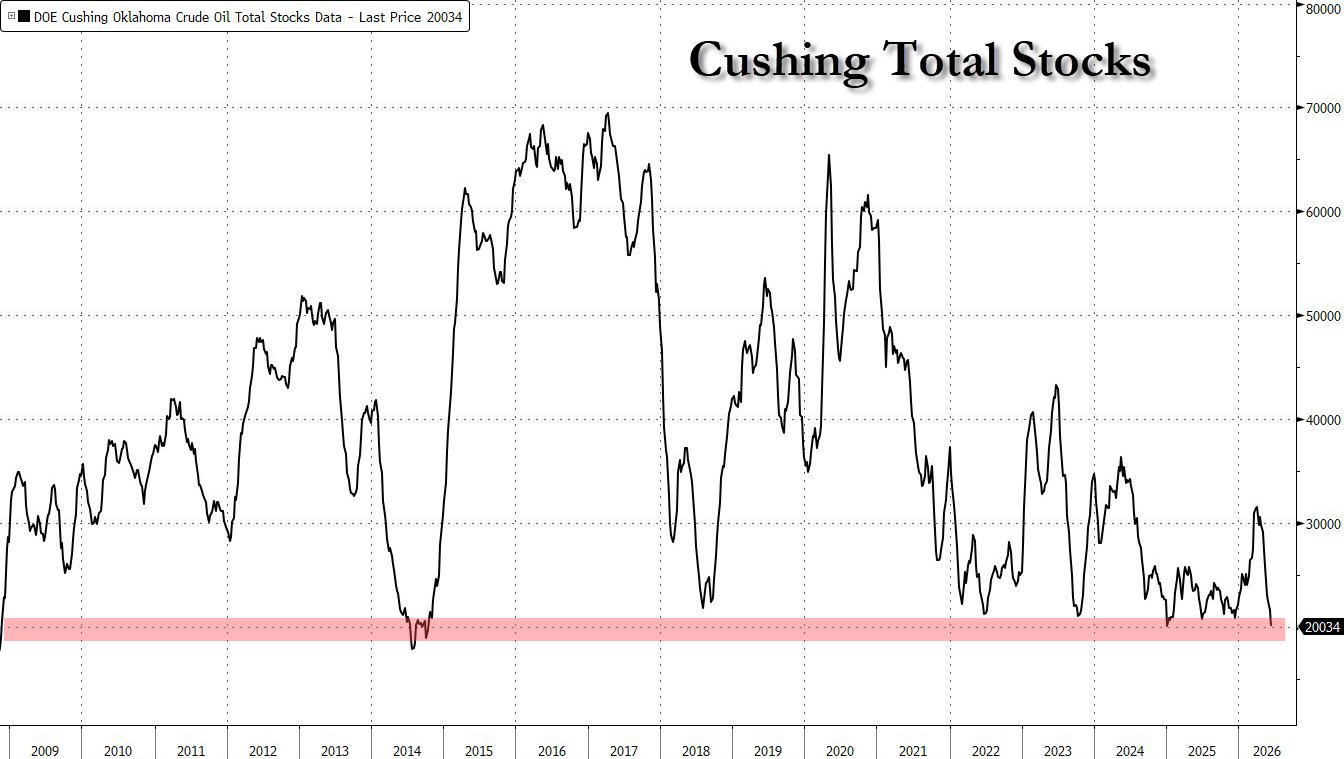
Cushing, Oklahoma — often called the “Pipeline Crossroads of the World” — is facing critically low crude oil storage levels, with inventories hovering near operational “tank bottoms.” As of the week ending June 5, 2026, Cushing held approximately 21.64 million barrels of crude oil (excluding the Strategic Petroleum Reserve), according to U.S. Energy Information Administration (EIA) data.
This is just above the roughly 20 million barrel operational minimum and represents only about 28–30% of the hub’s total storage capacity (estimated shell capacity around 75–91 million barrels, with working capacity lower).
The situation stems from record U.S. crude exports amid Middle East supply disruptions from the Iran conflict and the closure of the Strait of Hormuz. The U.S. has stepped in as a global supplier of last resort, rapidly drawing down domestic inventories, including at Cushing.
What “Hitting Tank Bottom” Means Operationally
In oil storage tanks, “tank bottoms” refer to the unusable layer of sludge, sediment, water, paraffin, and other residues that settle at the base. These cannot be easily pumped or processed without operational issues.
At the Cushing hub level, the operational stress threshold is around 20 million barrels. Below this, pipelines lose pressure, blending and transfers between tanks become difficult or impossible, and outbound flows to refineries or export terminals can be curtailed or delayed.
Experts note that much of the remaining volume at current levels (potentially only 1–1.6 million barrels truly usable) consists of this sludgy material.
This is not a complete physical depletion of oil in the U.S. — domestic production continues — but a localized operational constraint at the key trading and logistics hub.
Cushing’s Central Role in Mixing, Blending, and Pricing
Cushing is far more than just storage. It serves as:
The primary delivery and pricing point for West Texas Intermediate (WTI) crude oil futures on the NYMEX. WTI is the main U.S. benchmark, and physical settlement/delivery occurs at Cushing.
A major blending and mixing hub. Different grades of crude from various U.S. basins are blended here to meet pipeline quality specifications, refinery requirements, or export standards. Low inventory levels complicate these blending operations.
The heart of the U.S. pipeline network connects Permian, Bakken, and other production areas to Midwest and Gulf Coast refineries and export terminals.
Low stocks at Cushing tighten physical supply signals, influence regional price differentials (e.g., WTI vs. Brent spreads), and affect the futures curve structure (contango or backwardation). This can curb record exports as arbitrage opportunities narrow and operational constraints bite.
kpler.com
Implications for Consumers
Short-term volatility with upside risk for prices. Hopes for a U.S.-Iran deal (potentially reopening the Strait of Hormuz) have already contributed to some easing or stabilization in prices. However, if inventories remain constrained and supply disruptions persist:Crude price spikes could translate directly into higher gasoline, diesel, and jet fuel costs at the pump.
Analysts warn of potential moves toward $90+/barrel (or much higher in prolonged scenarios), pushing U.S. gas prices significantly upward and creating broader inflationary pressures.
This would pressure household budgets, increase transportation and manufacturing costs, and complicate Federal Reserve interest rate decisions.
Even without running out of oil nationally, localized tightness at Cushing signals tighter overall market conditions that consumers ultimately feel at the pump.
Implications for Investors
Bullish for energy sector exposure, but with high volatility.
Upstream producers (E&P companies) and those with strong export capabilities stand to benefit from higher realized prices.
Midstream operators (pipelines and storage) face mixed signals — higher utilization potential but operational constraints at key hubs.
Energy stocks, ETFs, and oil futures are likely to see amplified moves tied to weekly EIA/API inventory reports and geopolitical headlines.
Low Cushing inventories are a classic bullish inventory signal for WTI, but resolution of the Iran situation could trigger a sharp reversal.
Investors should monitor:
Weekly EIA Cushing and national inventory data.
API weekly reports.
Geopolitical developments around the Middle East.
WTI-Brent spreads and futures curve shape.
Outlook
The trajectory depends heavily on whether a diplomatic resolution restores Middle East flows or if export dynamics and domestic production adjust naturally. Restocking Cushing to comfortable levels would take time even under favorable conditions.Natural market forces (tighter spreads reducing export incentives) may help prevent a full operational crisis, but the situation highlights the fragility of global supply chains and the outsized role of a single U.S. hub.Cushing’s low inventories are a clear warning sign of tight physical markets — one that energy participants, policymakers, and consumers should watch closely in the weeks ahead.
Appendix: Sources and Links
- EIA Weekly Cushing Crude Oil Stocks: https://www.eia.gov/dnav/pet/hist/LeafHandler.ashx?n=PET&s=W_EPC0_SAX_YCUOK_MBBL&f=W (data as of June 5, 2026: 21,640 thousand barrels)
- CNN Business: “The tanks in Cushing, Oklahoma, are hitting bottom” (June 2026) — https://www.cnn.com/2026/06/12/business/cushing-oil-inventory
- KOCO 5 News: “Cushing’s oil supply hits critical lows” (includes expert comments from Steve Agee) — https://www.koco.com/article/cushing-oil-reserves-gas-prices-oklahoma/71594297
- Kpler analysis on Cushing inventories and exports — https://www.kpler.com/blog/cushing-inventories-to-test-tank-bottoms-curbing-record-us-crude-exports
- Jensen’s Substack (API data context) — https://jensendavid.substack.com/p/new-api-data-show-cushing-tank-bottoms
- Historical context and capacity discussions from RBN Energy and EIA reports (various dates)
- General Cushing/WTI background: Investopedia and industry sources on delivery point and blending role.
Data current as of mid-June 2026. Energy markets move quickly; always verify latest EIA/API releases for real-time figures. This article is prepared for the Energy News Beat Channel.
The post Cushing, Oklahoma Oil Storage Hits Tank Bottom: Implications for Energy Markets, Consumers, and Investors appeared first on Energy News Beat.