Energy News Beat
Data Centers Done Right are a good thing – Done Wrong and we get problems.
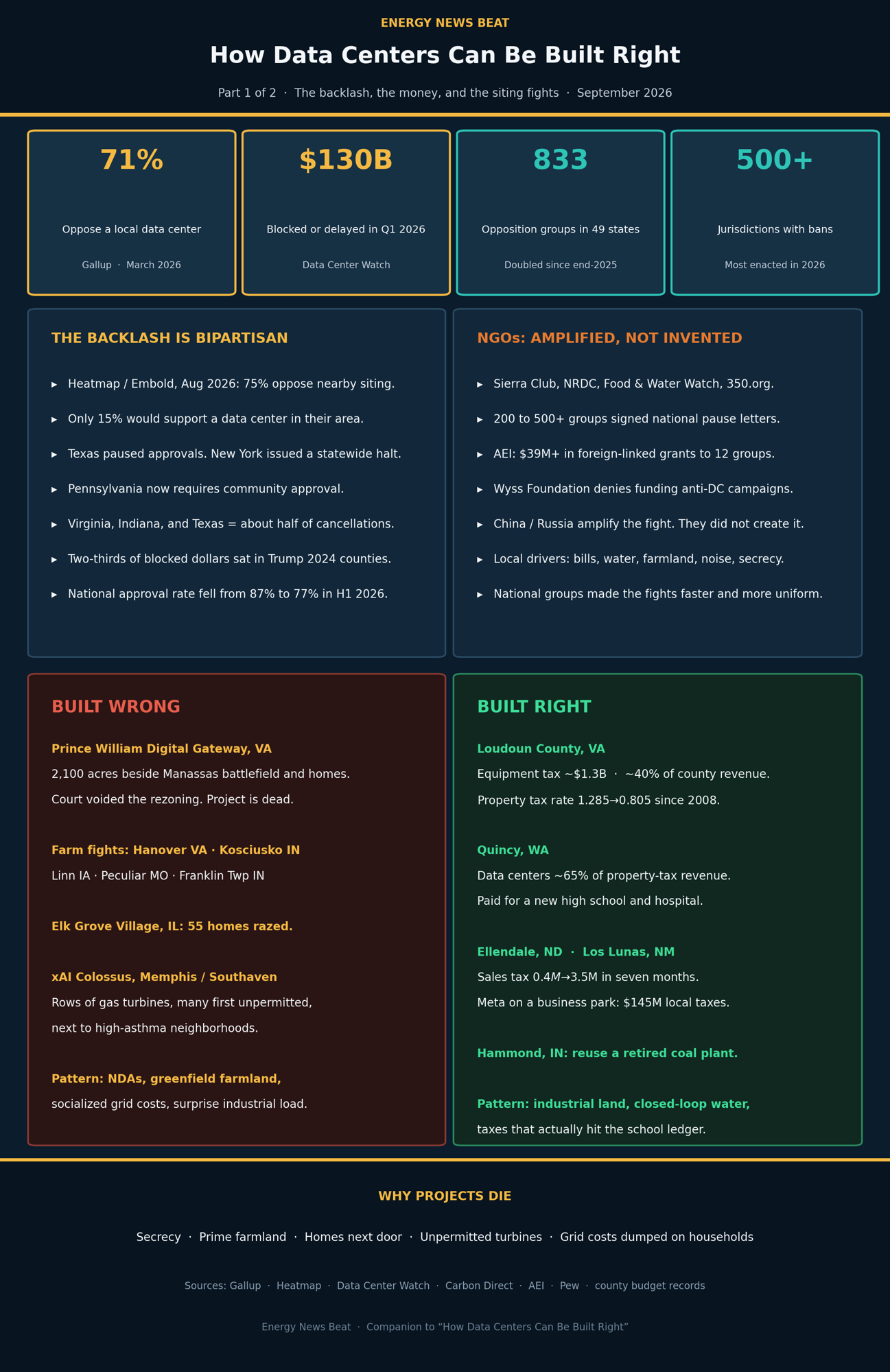
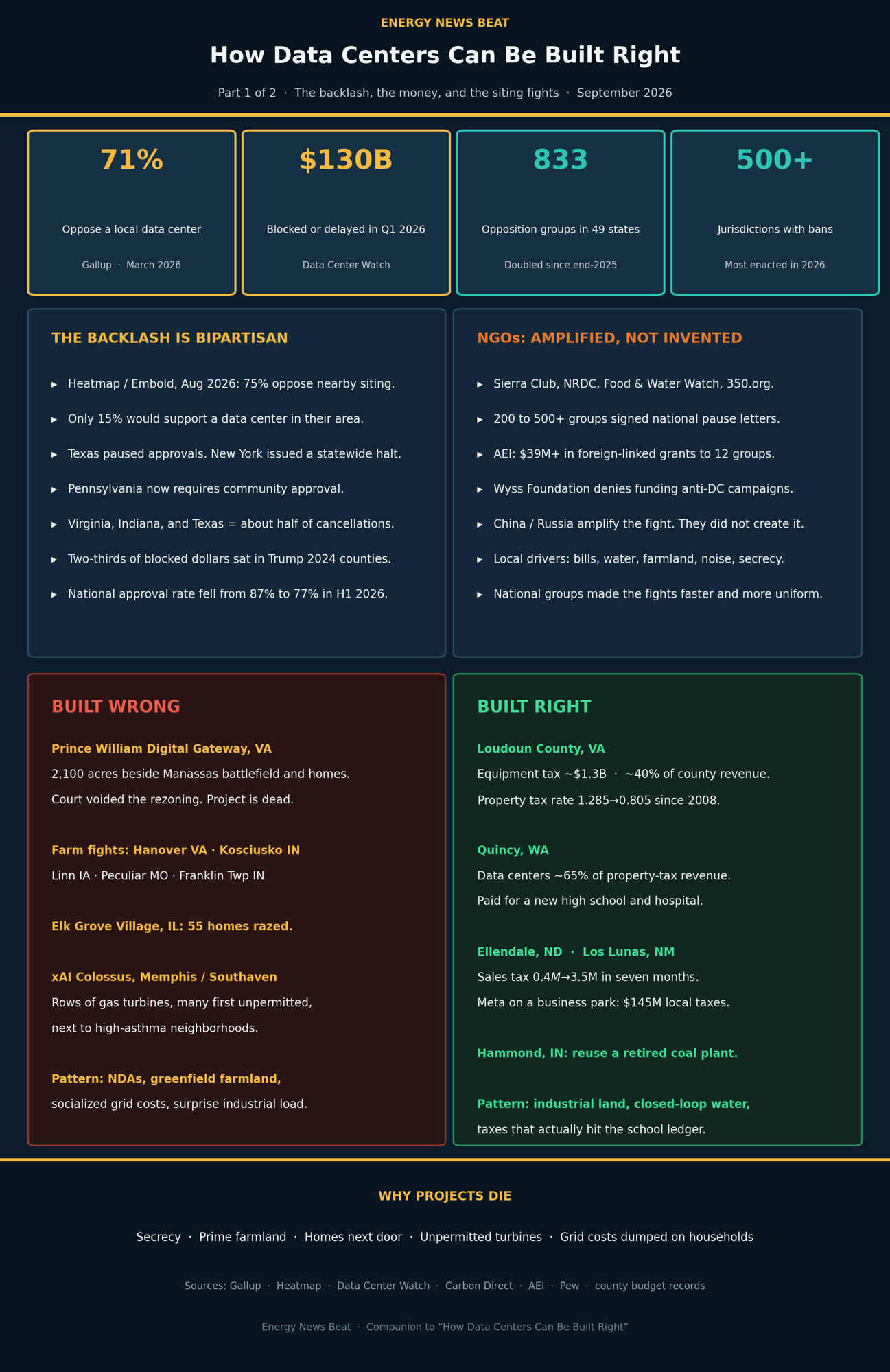
This is not a fringe NIMBY story. Polling flipped with unusual speed. A March 2026 Gallup survey found 71 percent of Americans opposed a data center in their area, including 48 percent who were strongly opposed — higher than opposition to a local nuclear plant.
Tomorrow, we are releasing a fun podcast with Jon Brewton of Data2 and Kyle Koss, President of ATCO Ventures, who share insights on Data Centers Done Right. This is critical as we look at the overall impact on the U.S. grid and power infrastructure.
A Heatmap Pro/Embold survey in August found support for a nearby data center at just 15 percent, with 75 percent opposed, down from roughly a year earlier, when the poll was roughly split.
The political class has noticed. Democrats and Republicans are running ads against the warehouses. Texas Gov. Greg Abbott paused new approvals while the state audits tax breaks, ownership, and water use. Pennsylvania Gov. Josh Shapiro imposed community-approval and energy-cost standards after previously courting the industry. New York issued the first statewide pause on large new facilities. Michigan Senate candidate Mike Rogers called for a one-year moratorium. The issue is now in midterm ads from Ohio to Wisconsin.
The project-level damage is measurable. Data Center Watch reported that opponents blocked or delayed at least 75 projects worth about $130 billion in the first quarter of 2026 alone — roughly matching all of 2025. Active opposition groups more than doubled to 833 across 49 states. More than 300 state bills landed in the first six weeks of 2026 as legislatures shifted from tax incentives to oversight. Heatmap has counted more than 500 jurisdictions with severe constraints or bans, most of them enacted this year.
Carbon Direct’s project-level review found more than $170 billion in announced AI data-center investment blocked, withdrawn, or stalled across 20 states since January 2024, with Virginia, Indiana, and Texas accounting for about half the cancellations. Nearly two-thirds of the blocked investment sat in counties that voted for Donald Trump in 2024. This is not a blue-city phenomenon.
Green organizations have adopted data centers as a new organizing and fundraising cause after a lean period. Sierra Club, NRDC, Earthjustice, Food & Water Watch, 350.org, and others have supplied model ordinances, lawyers, and national letters. Food & Water Watch’s moratorium letter drew more than 200 signatories in December 2025 and later claims of 500-plus groups. Sen. Bernie Sanders and Rep. Alexandria Ocasio-Cortez introduced a federal pause. POLITICO reported that environmental groups see the issue as a way to stay relevant with voters who are focused on bills and water, not abstract climate targets.
Conservative and energy-aligned researchers argue the campaign is more coordinated than it looks. An April 2026 American Energy Institute report said 12 organizations opposing U.S. data-center expansion had collectively received more than $39 million from foreign donors, including Swiss billionaire Hansjörg Wyss’s network, U.K. climate philanthropies, and other European foundations. Power the Future and the Bitcoin Policy Institute have made similar claims, pointing to shared talking points, identical ordinance language, and donors such as the Sixteen Thirty Fund and, in some cases, groups linked to Neville Roy Singham.
Fox News and industry allies describe a “playbook” they say resembles pipeline fights. I reluctantly quote Fox here after they showed their true colors yesterday. Maria is a fighter and was fired for standing up for America First. Do not trust the MSM, and do your own research.
Those claims should be handled carefully. The Wyss Foundation says it does not fund campaigns to block data centers. Groups named in the reports say only a sliver of their budgets touches the issue. The Washington Post and New York Times have noted that the foreign-funding papers generally show grants to broad environmental organizations, not a dedicated anti-AI slush fund, and that China and Russia have amplified the controversy in state media without having to invent the anger.
The honest read: national NGOs, progressive philanthropies, and some foreign-linked donors are professionalizing a movement that already had local fuel. Electricity bills, water, secrecy, farmland, and noise would have produced fights even if every national group stayed home. The organizers made those fights faster, more uniform, and more successful.
How demand is being held up
Interconnection queues were already years long. Now add:Local moratoria and “special exception” hearings where projects used to be by-right. Loudoun County, the original Data Center Alley, ended easy by-right siting.
Statewide pauses or audits in New York and Texas, plus new Pennsylvania rules requiring community buy-in.
Litigation over notice, zoning, and battlefield or farmland protection. Prince William County’s Digital Gateway — 2,100 acres and 37 buildings next to Manassas National Battlefield — was voided in court over hearing-notice defects; the developer dropped its Virginia Supreme Court appeal in July 2026.
Grid operators and PUCs forcing large-load tariffs, minimum bills, and “bring your own power” conditions before they will interconnect.
Spark’s mid-2026 tracker recorded 870 data-center permits in the first half of the year, up 58 percent year over year, but the national approval rate fell from 87 percent in H1 2025 to 77 percent. Ohio dropped in the rankings as moratoria spread across nearly a quarter of its counties. Demand is not disappearing. It is stacking up behind local governments that no longer trust the first offer.
Built the wrong way: farmland, neighborhoods, and historic ground
Prime farmland is exactly the land that looks cheap on a site-selection spreadsheet — and that is why so many of the worst fights look like this.
Prince William Digital Gateway, Virginia. A proposed gigawatt-scale campus on 2,100 acres of rural land beside a Civil War battlefield and existing homes. After a 27-hour hearing, lawsuits from homeowners and the American Battlefield Trust, and a court ruling that voided the rezoning, the “world’s largest” campus collapsed. The land reverts to rural zoning. That is the cost of putting industrial load next to heritage ground and neighborhoods.
Hanover County, Virginia. Protesters used the slogan “Grow Tomatoes, Not Data Centers.” Commissioners rejected the Mountain Road Technology Park. Kosciusko County, Indiana, unanimously rejected a Prologis project in a county that is nearly 90 percent farmland. Linn County, Iowa, restricted data centers in unincorporated areas where almost three-fourths of the land is in agriculture. Franklin Township, Indiana’s Project Flo (a Google-linked vehicle) withdrew after fights over NDAs, farmland, water, and power. Peculiar, Missouri, banned a $1.5 billion Diode Ventures project.
Elk Grove Village, Illinois. Stream Data Centers bought and razed 55 homes for a three-building campus — the blunt version of “next to homes.” In Ashburn, Virginia, developers have offered homeowners on the order of $4.4 million an acre to assemble sites, pricing housing land out of the market. Microsoft’s Granger, Indiana, campus sits on nearly 1,000 acres of historic St. Joe Farm.
xAI Colossus, Memphis / Southaven. This is the cautionary tale on power, not just land. The campus was built at speed with rows of mobile gas turbines, many of them initially unpermitted, on the Tennessee-Mississippi line. Residents in nearby majority-Black neighborhoods, already living with poor ozone scores and high pediatric asthma rates, became the national face of “bring your own power” done without community consent. Behind-the-meter generation does not automatically mean “no local impact.” It can mean the pollution stays in one ZIP code while the compute is sold worldwide.
Those projects share a pattern: secrecy (LLC names and NDAs), greenfield farmland or residential edges, grid or water demands dumped onto existing customers, and a promise of “jobs” that turns out to be a construction spike plus a few dozen permanent technicians.
Built the better way: industrial land, existing industry, and a check that clears
That is the point.
Loudoun County, Virginia — the mature cluster. Data Center Alley is now a political headache because it worked too well.
Computer-equipment taxes are expected to generate about $1.3 billion next year, around 40 percent of county tax revenue. The real-property tax rate has fallen from $1.285 per $100 of assessed value in 2008 to $0.805 in 2025. County analysis has put the benefit-to-cost ratio for services at roughly 26-to-1. New schools, fire stations, and a recreation center followed the tax base. The lesson is double-edged: cluster the load on industrial land and fiber corridors, harvest the tax base, and stop treating every remaining cornfield as the next campus. Loudoun itself has now tightened rules.
Quincy, Washington — a farm town that got the tax base. Microsoft and others came for Columbia River hydropower and cheap land two decades ago. A Washington Department of Revenue workgroup found data centers now supply about 65 percent of Quincy’s property-tax revenue; residential rates are about 70 percent lower than before the industry arrived. The money built a high school, hospital, fire station, city hall, and an aquatic center. Permanent employment at a given hall is modest — often on the order of 50 people after construction — but the fiscal transfer to a small farm town is real. That is the model Microsoft now cites when the national mood turns hostile.
Los Lunas, New Mexico — Meta on a business-park site. Since 2016, the campus has generated about $145 million in local tax revenue and helped lift village population by 15 percent from 2020 to 2024, with a new hospital breaking ground. Industry advocates also credit watershed restoration that returns more than 170 million gallons of water a year. New Mexico’s industrial-revenue-bond structure is aggressive — schools can lose property-tax base if payments in lieu of taxes are weak — so “success” here depends on the deal terms, not the press release. The siting itself, on a business park rather than a subdivision, is the part other counties can copy.
Ellendale, North Dakota — Applied Digital and a dying Main Street. Pre-project sales-tax collections were about $400,000 a year. In the first seven months of 2026, the town took in $3.5 million. Taxable property value is expected to jump from $3.5 million to $35 million. The developer used closed-loop cooling, asked to be annexed into town so the tax base stayed local, and the state structure shares some utility revenue with ratepayers — an expected drop of about $250 on the average household bill. Streets, a senior center, public safety, and an opera house are on the list. That is what “helping the local community” looks like when the load is not parked against someone’s kitchen window.
Richland Parish, Louisiana — construction taxes before the servers hum. Meta’s build produced a reported 2,000 percent jump in local sales-tax collections and teacher bonuses of $17,000 to $50,000 in a parish where roughly one in four residents lives below the poverty line. Construction is not a permanent payroll. It is a bridge if the operating-year deal is written to keep paying schools after the cranes leave.
Reuse, not greenfield. Hammond, Indiana’s Digital Crossroad expansion sits on a retired coal plant. Former mills, generating stations, and industrial parks are the sites that do not require a county to choose between corn and compute. Cassville, Wisconsin’s proposal on a closed power-plant site offered a minimum $5.5 million a year in property taxes to a village that had lost two generating stations and a hundred jobs. Those are the conversations that should happen first.
A Brookings look at 93 counties that received their first data center between 2008 and 2024 found private employment up 4 to 5 percent and wages up 3 to 4 percent over five to six years, with much larger gains in counties that took four or more facilities. The jobs are real. They are also easy to oversell if a developer counts every traveling electrician as a local career.
How to build them right
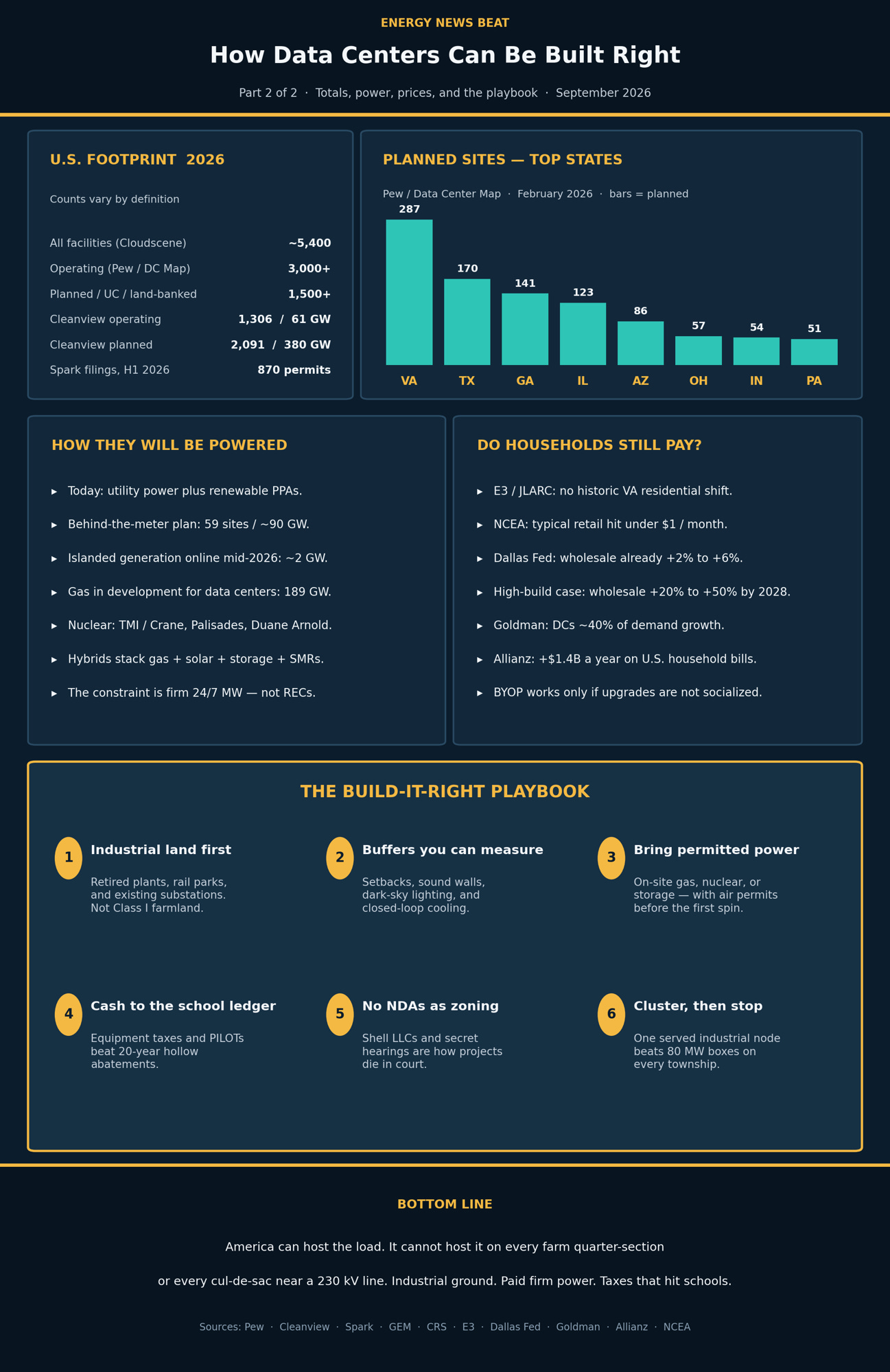
- Industrial land first. Retired plants, rail-served parks, existing substations, mine lands, and military reuse. Not prime soils. Not battlefield viewsheds. Not the lot behind a subdivision.
- Buffers that a neighbor can measure. Setbacks, sound walls, dark-sky lighting, and closed-loop or air cooling in water-stressed basins. If the only way the project works is a 24-hour rooftop farm of fans 400 feet from bedrooms, it is the wrong site.
- Bring the power — and the permits. Behind-the-meter gas, nuclear, geothermal, or solar-plus-storage can protect retail customers if the plant is fully permitted; the backup arrangement with the utility is priced so households are not the shock absorber, and local air impacts are disclosed before the first turbine arrives. Memphis is the anti-model.
- Cash that hits the school ledger. Payments in lieu of taxes, equipment taxes, and direct school contracts beat 20-year abatements that leave a county with a warehouse and a thin operating payroll. Loudoun’s equipment tax and Amazon’s multi-year school payments in Ohio are the template; hollow IRBs are not.
- No NDAs as a land-use strategy. Carbon Direct found process and secrecy, more than megawatts alone, drive the fastest opposition. If residents learn about a 500-MW hall from a shell LLC sign on a farm gate, the project is already in trouble.
- Cluster, then stop. One well-served industrial node with shared transmission beats a scatter of 80-MW boxes across every township. Virginia proved both the upside of clustering and the political cost of never drawing a line.
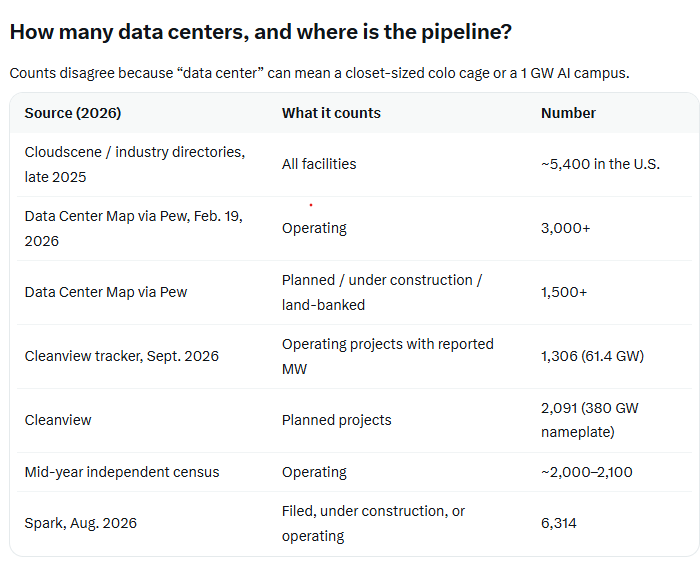
Treat the 5,000-facility figure as the broad industry census and Cleanview’s 1,300 / 61 GW as the large-load footprint that actually moves the grid. The planned 300-plus gigawatts will not all be built; interconnection, capital, and politics will cut the list. But even a third of that pipeline is a new industrial load the size of a large regional grid.
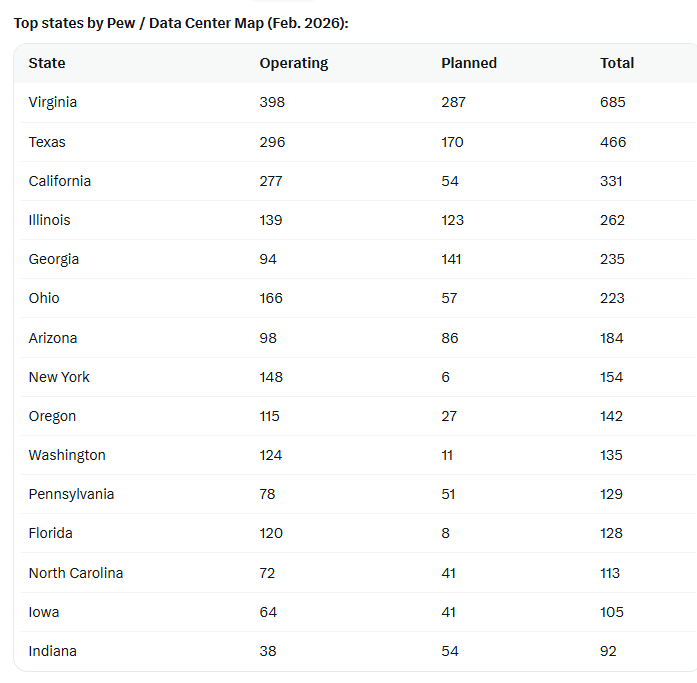
Pew’s regional split is the strategic map: 75 percent of planned sites are in the South and Midwest. The South alone has 754 planned facilities. That is why farm-county fights in Indiana, Iowa, Georgia, and Texas now outnumber Silicon Valley hearings.
By power rather than building count, mid-2026 pipeline trackers put Texas first at roughly 85 GW of published construction-and-planned load, then Virginia (~30 GW), Pennsylvania (~20 GW), Utah (~19 GW), and Georgia (~14 GW). Texas is where the next wave is trying to go. It is also where Abbott just hit the brakes.
Spark logged 870 permit filings in H1 2026. That is the closest public proxy for “applications,” and it is rising even as approval rates fall.
How they will be powered
On the grid: utilities and ISOs are adding solar, batteries, some wind, and a politically revived gas fleet. EIA’s 2026 capacity-addition mix is still heavy on solar, wind, and storage, with a smaller slice of gas. That paper mix does not match what hyperscalers will sign for 24/7 load. They need firm megawatts.
Behind-the-meter / “bring your own power”: Cleanview identified 59 data centers totaling about 90 GW that plan on-site generation — more than a quarter of planned U.S. capacity, almost all announced since the start of 2025. Only about 2 GW of that islanded generation was online by mid-2026, most of it from xAI’s Memphis-area turbines. By year-end 2026, operating behind-the-meter capacity may reach 2.8–3.2 GW. The rest is a bid, not a plant.
Gas: Global Energy Monitor’s mid-2026 update put more than 189 GW of gas projects in development for data centers, up from 97 GW at the end of 2025 and 4 GW in early 2024. Combined-cycle machines have multi-year lead times, so developers are buying aeroderivative and mobile turbines that look a lot like a power plant bolted to a parking lot. That is the Memphis problem at national scale.
Nuclear: Microsoft’s 20-year deal to restart Three Mile Island Unit 1 as the Crane Clean Energy Center, Holtec’s Palisades restart, NextEra/Google at Duane Arnold, Amazon’s nuclear-adjacent Pennsylvania campus, Meta’s deals with Constellation and Vistra, and a wave of SMR offtake (Kairos, X-energy, TerraPower) are the clean firm-power strategy. They will not solve 2026–2028. They can solve the 2030s if licensing and supply chains hold.
Hybrids: Texas projects such as Fermi America’s HyperGrid and other “energy parks” stack gas, solar, storage, and eventually nuclear on one site so the data hall never waits on a 2,000-page interconnection study. That is the industrial-park model applied to electrons.
A Congressional Research Service FAQ puts the choice in three buckets: buy from the utility, sign a PPA, or self-supply behind the meter. There is still no complete public inventory of which planned hall uses which bucket. The filings we do have say gas first, nuclear second, fuel cells and geothermal as niche firm power, renewables as energy (not capacity) hedges.
Will consumers still pay — even if the center brings its own plant?
The “not the main driver, historically” camp. E3, in work funded by the Data Center Coalition, reviewed 11 studies and found the link between load growth and retail rates is mixed. Texas and Virginia — the biggest load-growth states — saw some of the smallest rate increases; California and New York, with weak data-center growth, saw some of the largest. An E3 study for Virginia’s JLARC found no historical cost shift from data centers onto residential areas in the world’s largest market. A separate E3 look at Amazon sites found each facility generated about $3.4 million a year in net surplus revenue for the host utility.
An EPRI/Watershed working paper using instrumental variables estimated that a doubling of state data-center capacity was associated with lower residential rates from 2015 to 2024, about 3.5 percent, because new load spread fixed T&D costs. The National Center for Energy Analytics put the typical household effect of doubling a utility’s data-center capacity at under $1 a month, and found no statistically significant effect at investor-owned utilities that serve 68 percent of customers. USAFacts, summarizing federal work through 2025, said data centers were “unlikely to have caused large increases in residential electricity prices at the national level.”
The “already in the wholesale market” camp. A Dallas Fed dispatch model estimated existing data centers have already lifted nationwide wholesale prices 2 to 6 percent, with much larger effects in data-center corridors. If the proposed buildout runs at high utilization through 2028, wholesale prices could rise on the order of 20 percent in a moderate case and 50 percent in a high-use case.
Goldman Sachs expects data centers to account for about 40 percent of U.S. power-demand growth over five years and sees consumer electricity inflation around 6 percent in 2026–2027 before easing. If non-AI customers bear half of incremental capex instead of a third, Goldman’s 2026–27 price path rises to about 8 percent. Allianz estimated U.S. households are already paying $1.4 billion more per year because of data-center demand, concentrated in a handful of utilities in Northern Virginia, the Pacific Northwest, and Arizona.
In PJM, the independent market monitor has repeatedly named data-center load as the primary driver of record capacity-auction prices; one accounting put data centers at $6.3 billion, or 38 percent, of a $16.4 billion auction. Those capacity charges do show up in retail riders.
Behind-the-meter does not automatically zero out the household bill. A truly islanded campus with its own generation, no firm transmission reservation, and a fat stranded-asset deposit can keep most costs off other customers.
Three leaks remain:
Capacity markets and reserve margins. Even an islanded load changes the region’s planning number if the operator assumes the campus will lean on the grid in a polar vortex. PJM-style capacity prices are a regional tax.
Fuel and pollution externalities. A parking lot of gas turbines can spare the ratebase and still impose health costs on the nearest census tract. That is not a line item on a bill. It is why Memphis organized.
The policy answer is already visible in Virginia’s new GS-5 large-load class, minimum-bill and collateral rules, Texas’s audit-before-interconnect pause, and “beneficiary pays” tariffs spreading through PUCs. If regulators force data centers to pay the incremental generation, transmission, and backup they cause, the consumer impact can stay small. If utilities rate-base speculative 800 MW substations for tenants who can walk away, households will finance the AI boom whether the servers are “behind the meter” or not.
The energy reality
The projects that die will look like Digital Gateway and the Indiana farm rezonings: secrecy, greenfield farmland, and a promise that the grid and the aquifer will sort themselves out later.
Build the first kind. Stop proposing the second. That is how data centers get built right.
Let’s get involved and help do things right. Let me know your thoughts, and we appreciate all of our great subscribers, patrons, and sponsors!
Tomorrow is the podcast with Jon and Kyle on how they are looking at data centers. We also have Doomberg and the CEO of Jackery next week. We also have the Electric Grandma rolling through production!
Buckle up, and give your neighbor a hug. The world is healing.
Check out the World’s Greatest Podcast Show Notes at EnergyNewsBeat.co or EnergyNewsBeat.com.
At Energy News Beat, we Make Appendices Great Again.
Backlash, politics, and polling
- New York Times, “The Data Center Backlash Bursts Into the Midterms,” Aug. 23, 2026: https://www.nytimes.com/2026/08/23/us/politics/data-centers-midterm-elections.html
- NBC News, “Data center opposition is sharply rising in 2026,” June 12, 2026: https://www.nbcnews.com/tech/tech-news/data-center-opposition-sharply-rising-2026-study-finds-rcna349728
- Vox, “Why the data center backlash won’t stop the AI buildout,” Sept. 1, 2026: https://www.vox.com/politics/501146/data-centers-bans-polls-ai
- WIRED, “How Data Centers Broke American Politics,” Aug. 4, 2026: https://www.wired.com/story/how-data-centers-broke-american-politics/
- POLITICO, “Data centers’ ‘oh s–t’ moment,” Aug. 24, 2026: https://www.politico.com/news/2026/08/24/data-centers-oh-s-t-moment-01046465
- POLITICO, “Everyone is making a U-turn on data centers,” Aug. 26, 2026: https://www.politico.com/news/2026/08/26/data-centers-midterms-politicians-voters-sour-01050143
- Newsweek, “Rage Against the Data Centers,” Aug. 21, 2026: https://www.newsweek.com/ai-data-center-pushback-republicans-democrats-12348522
- Carbon Direct, “Why AI data centers are being blocked,” Aug. 11, 2026: https://www.carbon-direct.com/insights/why-ai-data-centers-are-being-blocked
- Data Center Watch: https://www.datacenterwatch.org/report
- Axis Intelligence opposition statistics: https://axis-intelligence.com/ai-data-center-community-opposition-statistics/
- Brookings, “Data center backlash signals a fight over AI power,” July 7, 2026: https://www.brookings.edu/articles/data-center-backlash-signals-a-fight-over-ai-power/
NGOs, funding, and organizing
- American Energy Institute, “Foreign-Funded Opposition to U.S. Data Center Expansion,” April 2026: https://americanenergyinstitute.com/docs/aei_data-center_report_v2.pdf
- POLITICO, “Greens embrace data center fight,” July 19, 2026: https://www.politico.com/news/2026/07/19/a-better-way-to-be-relevant-greens-embrace-data-center-fight-01000250
- Fox News, “Left-wing groups fund data center opposition,” Sept. 2, 2026: https://www.foxnews.com/politics/inside-far-lefts-anti-data-center-push-what-experts-say-driving-it-playbook-weve-seen-before
- Food & Water Watch coalition: https://www.foodandwaterwatch.org/2026/06/12/stop-data-centers-coalition/
- Inside Climate News, environmental groups’ freeze letter, Dec. 8, 2025: https://insideclimatenews.org/news/08122025/environmental-groups-demand-data-center-construction-freeze/
- Washington Post / Yahoo recap of foreign-funding claims: https://www.yahoo.com/news/politics/articles/amid-data-center-protests-a-billionaire-and-the-trump-administration-see-a-foreign-plot-124603263.html
- New York Times, “China, Russia and Others Seek to Inflame Debate Over A.I. Data Centers,” July 9, 2026: https://www.nytimes.com/2026/07/09/business/china-russia-ai-data-centers.html
- City Journal, “The Left-Wing Anti-Data Center Movement,” July 14, 2026: https://www.city-journal.org/article/the-left-wing-anti-data-center-movement
Siting fights and farmland
- Heatmap, “Data Centers Have a Farmland Problem, Too,” June 26, 2026: https://heatmap.news/plus/the-fight/spotlight/data-centers-have-a-farmland-problem-too
- NAHB, “AI Data Centers Are Outbidding Home Builders,” July 2026: https://www.nahb.org/blog/2026/07/servers-over-shelter-ai-data-centers-outbidding-home-builders-for-land
- TechTimes on Digital Gateway collapse: https://www.techtimes.com/articles/319715/20260704/ai-data-center-backlash-zoning-notice-rule-kills-worlds-largest-planned-campus.htm
- Programs.com moratorium tracker: https://programs.com/resources/data-center-moratoriums-tracker/
- Indiana historic-site siting: https://www.thestatehousefile.com/politics/data-centers-with-their-sprawling-campuses-are-closing-in-on-historic-areas-of-the-state/article_31e183da-1014-460a-af2f-f3920782b830.html
Community-benefit cases
- New York Times on Loudoun County, Aug. 19, 2026: https://www.nytimes.com/2026/08/19/technology/data-centers-backlash-loudoun-virginia.html
- Beale Infrastructure, “Four Communities, Four Data Center Stories”: https://bealeinfra.com/community/four-communities-four-data-center-stories/
- Fox News on Quincy, Wash., Aug. 31, 2026: https://www.foxnews.com/politics/tiny-farming-town-helping-microsoft-sell-america-data-centers
- American Edge Project, “The Data Center Dividend”: https://americanedgeproject.org/the-data-center-dividend-how-americas-ai-infrastructure-is-paying-off-for-working-families/
- NetChoice community-infrastructure brief: https://netchoice.org/wp-content/uploads/2026/07/How-are-Data-Centers-Updating-Community-Infrastructure.pdf
- SF Chronicle on Ellendale, N.D.: https://www.sfchronicle.com/opinion/article/data-centers-artificial-intelligence-dakotas-22362642.php
- Santa Fe New Mexican on Los Lunas: https://www.santafenewmexican.com/news/local_news/similar-to-los-alamos-in-1940s-los-lunas-getting-transformed-by-tech/article_d2a3ca02-4f80-49b6-8af2-e2da8bc378e9.html
- Brookings, rural implications: https://www.brookings.edu/articles/local-implications-data-centers-rural-communities-us/
- Badger Institute on Wisconsin projects: https://www.badgerinstitute.org/data-centers-could-be-a-godsend-if-communities-let-them/
Counts, pipeline, and geography
- Pew Research, “Most new data centers in the U.S. are coming to rural areas,” April 13, 2026: https://www.pewresearch.org/short-reads/2026/04/13/most-new-data-centers-in-the-us-are-coming-to-rural-areas/
- Cleanview U.S. map (Sept. 2026 update): https://cleanview.co/data-centers/us
- Cleanview pipeline insight: https://dcmap.us/insights/pipeline/
- Spark state rankings: https://www.sparkhq.ai/data-center-rankings-by-state
- Statista operational DCs by state: https://www.statista.com/statistics/1661029/number-of-data-centers-united-states-by-state/
- Mid-year census: https://myprivacy.blog/us-data-center-census-mid-year-2026/
- Synergy Research inland shift: https://www.srgresearch.com/articles/focus-of-us-hyperscale-investment-shifts-dramatically-inland
- CBRE H1 2026 market update: https://www.cbre.com/press-releases/north-american-data-center-demand-continues-to-outpace-supply-despite-record-construction-activity
Power supply and behind-the-meter
- Cleanview, “Bypassing the Grid”: https://cleanview.co/reports/behind-the-meter-data-centers
- CRS, “Data Centers and the Electricity Grid: FAQ,” R49326: https://www.congress.gov/crs-product/R49326
- WIRED on the gas buildout, Aug. 25, 2026: https://www.wired.com/story/us-data-centers-drive-gas-power-expansion/
- CSIS, electricity-supply bottleneck: https://www.csis.org/analysis/electricity-supply-bottleneck-us-ai-dominance
- Reuters on xAI turbines, July 14, 2026: https://www.reuters.com/world/americas/pollution-musks-unpermitted-xai-power-project-hits-hardest-black-communities-2026-07-14/
- SELC study on proposed xAI gas plant: https://www.selc.org/press-release/new-study-finds-proposed-xai-gas-plant-could-worsen-regional-air-pollution-cause-millions-of-dollars-in-annual-health-damages/
Rates and consumer-price analysis
- E3 white paper on rate drivers: https://www.ethree.com/electricity-rate-drivers-data-center-role-2026/
- Goldman Sachs, “The Macroeconomic Spillovers From AI Electricity Demand”: https://www.gspublishing.com/content/research/en/reports/2026/02/11/cefdda9f-3b7c-4a53-9950-dfcfa3c6bbc2.html
- USAFacts deep dive: https://usafacts.org/articles/are-ai-data-centers-driving-up-your-electric-bill/
- NCEA, “Don’t Blame the Data Centers,” Sept. 3, 2026: https://energyanalytics.org/research/dont-blame-the-data-centers
- Dallas Fed working paper WP2606: https://www.dallasfed.org/~/media/documents/research/papers/2026/wp2606.pdf
- Columbia CGEP literature review: https://www.energypolicy.columbia.edu/publications/the-effects-of-load-growth-on-electricity-prices-in-the-united-states-a-literature-review/
- arXiv / EPRI-Watershed paper, “Have Data Centers Raised Your Electric Bill?”: https://arxiv.org/html/2606.19777v1
- Allianz, “Thinking fast, building slow,” May 12, 2026: https://www.allianz.com/en/economic_research/insights/publications/specials_fmo/260512-energy-US-ai.html
- PolitiFact on electricity costs: https://politifact.com/factchecks/2026/jun/12/elizabeth-warren/data-centers-rising-electricity-costs/
- Consumer Reports, energy-affordability investigation: https://www.consumerreports.org/data-centers/affordability-crisis-utility-bills-rate-hikes-profits-a6567329925/
- NetChoice summary of the rate-decrease paper: https://netchoice.org/new-study-confirms-what-weve-been-saying-data-centers-are-lowering-your-electric-bill/
The post The backlash is real, bipartisan, and already killing projects appeared first on Energy News Beat.