Energy News Beat
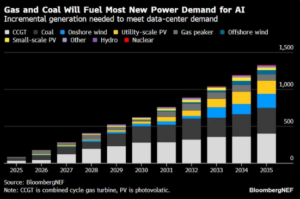
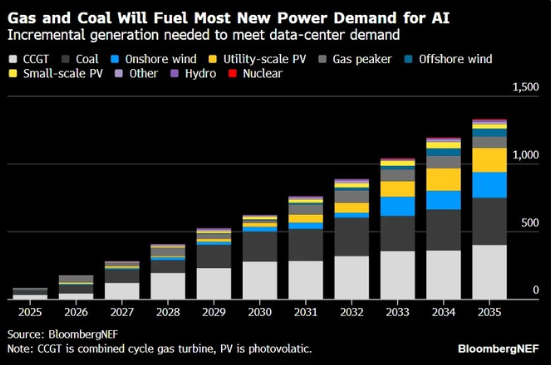
The AI boom is rewriting the rules of U.S. electricity demand, and the numbers don’t lie. BloombergNEF’s latest analysis, highlighted in a widely shared post by energy analyst David Blackmon (@EnergyAbsurdity), projects that data centers will drive massive incremental power needs through 2035. The stacked bar chart from BNEF is crystal clear: combined-cycle gas turbines (CCGT) and coal dominate the new generation required to meet data-center demand, with renewables and nuclear contributing far less in the near term.
No green fairy dust here—just hard reality. Hyperscalers and AI developers are racing for compute power, but the U.S. grid is struggling to keep up. Interconnection queues are backlogged for years, supply chains for turbines are slammed, and permitting remains a nightmare for new fossil generation. Meanwhile, behind-the-meter (BTM) solutions—on-site gas-fired generation—are surging as developers bypass the grid entirely.
The Grid Reality: Queues, Delays, and Exploding Demand
U.S. data centers already consumed roughly 4-5% of national electricity pre-AI surge. Projections now put demand at 6-12% by 2028-2030, with total U.S. data-center capacity potentially hitting 50+ GW operational by end-2025 and far higher planned.
The Lawrence Berkeley National Lab’s “Queued Up” report (through end-2024) shows ~10,300 active interconnection projects totaling ~1,400 GW of generation and 890 GW of storage—nearly double current U.S. installed capacity. Median wait times from request to commercial operation have doubled to over 4 years (up to 5-8 years in regions like PJM). Only about 19% of projects from 2000-2019 actually reached operation.
Data centers are loads, not generators, so they hit separate large-load interconnection queues at utilities and ISOs. These are exploding:Texas (ERCOT): The large-load queue ballooned from ~63 GW (end-2024) to 226 GW by late 2025 and reports of ~410 GW by early 2026, with 73-87% from data centers. Texas’s all-time peak demand is ~85 GW—meaning queued load is 2.6-4.8x current peak. ERCOT has streamlined processes (e.g., updated Large Load Interconnection Study rules in 2025), but volume is overwhelming. Many requests target the connection by 2030.
Virginia (PJM region, “Data Center Alley”): Northern Virginia dominates with hundreds of facilities. PJM (serving VA and 12 other states/DC) faces ~30 GW+ of projected data-center load growth by 2030. Queue times average 5+ years (up to 7-8 in high-demand zones). PJM is actively reforming rules for co-located loads and large-load integration, including new transmission service options and backstop procurement proposals (e.g., 14.9 GW targeted).
Georgia: Rapid growth with ~163 operational data centers and plans for massive expansion (potentially quadrupling). Emerging as a hotspot alongside utilities like Georgia Power, new generation (mostly gas/nuclear) is being planned specifically for data-center load.
Other top states (by operational/planned data centers): Illinois, Arizona, Ohio, Pennsylvania, North Carolina. Nationally, sites like interconnection.
fyi track thousands of data-center records (2,561+ operational, hundreds proposed/under construction).
Front-of-the-meter (grid-connected) requests dominate queues but face multi-year delays due to transmission upgrades, studies, and costs. Behind-the-meter (BTM) or co-located generation is the workaround: at least 46 data centers (~56 GW combined) are pursuing on-site power, primarily gas turbines, reciprocating engines, or fuel cells.
Examples include xAI’s Colossus in Memphis (mobile gas turbines), Meta/Williams gas plants, and hyperscalers paying deposits years ahead for turbines amid 4-5+ year manufacturer backlogs (GE Vernova ~100 GW).
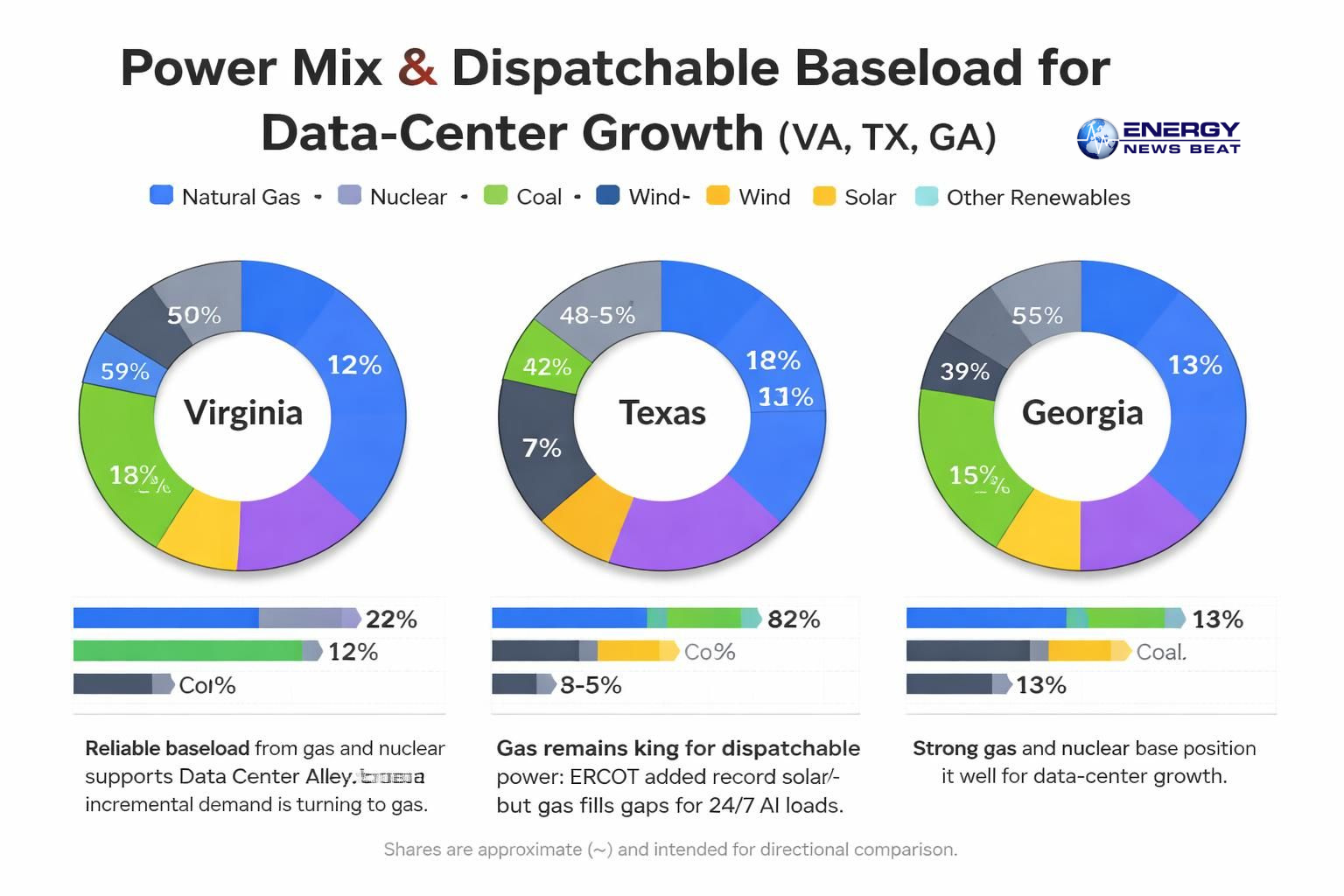
Energy Mix in Top Data-Center States: Gas and Coal Are Already Central
These states’ current mixes show why gas (and remaining coal) will shoulder the load:
Virginia: Natural gas ~59%, nuclear 28%, renewables (mostly solar/biomass) 12%, coal ~2%. Reliable baseload from gas and nuclear supports Data Center Alley, but new incremental demand is turning to gas.
Texas: Natural gas ~48-51%, wind 22%, coal ~12%, solar ~8%, nuclear ~7%. Gas remains king for dispatchable power; ERCOT added record solar/wind but gas fills gaps for 24/7 AI loads.
Georgia: Natural gas ~39%, nuclear 35%, coal ~14%, renewables ~13%. Strong gas and nuclear base positions it well for data-center growth.
Nationally, IEA and BNEF data confirm natural gas and coal will meet over 40% of additional data-center electricity demand through 2030 (higher utilization of existing plants + new builds), with gas turbines and coal filling the reliability gap that intermittent renewables and slow nuclear deployment can’t.
The Bottlenecks and the Path Forward
Turbine backlogs, transformer shortages (5-year waits), EPA rules, lawsuits, and local opposition make new coal nearly impossible and gas challenging in the U.S.—while China added the equivalent of the entire U.S. grid in four years with rapid approvals. Without permitting reform, the U.S. risks ceding AI supremacy.
Data centers are already voting with their wallets: BTM gas, co-location with existing plants (FERC is clarifying rules in PJM), and flexible demand response. Gas and coal aren’t just bridging—they’re powering the race.
I am hopeful about nuclear, but it seems to be moving too slowly in the United States to make the substantive impact we need. As more data and nuclear firms roll out, we can hope they can turn the corner.
Energy reality trumps rhetoric. AI compute runs 24/7. The grid must deliver, and the data says gas and coal will carry the heaviest load.
Appendix: Sources and Links
- BloombergNEF analysis via
@EnergyAbsurdity
X post (May 2, 2026): https://x.com/EnergyAbsurdity/status/2050542825821831191
- LBNL “Queued Up: 2025 Edition” (data through 2024): https://emp.lbl.gov/queues
- ERCOT Large Load Queue updates (2025-2026): https://www.ercot.com/files/docs/2025/12/02/16.2-System-Planning-and-Weatherization-Update_Revised.pdf and April 2026 hearing materials
- EIA State Electricity Profiles (2024-2025 data): Virginia
eia.gov
, Texas (https://www.eia.gov/states/TX/overview), Georgia
eia.gov - Interconnection.fyi data-center tracker: https://www.interconnection.fyi/data-center
- IEA “Energy Supply for AI” report: https://www.iea.org/reports/energy-and-ai/energy-supply-for-ai
- PJM large-load and co-location reforms: PJM Board letters and FERC orders (2025-2026)
- Additional context: Cleanview BTM analysis, Grid Strategies load growth report, FERC State of the Markets 2025.
All data current as of early 2026 reporting. The AI race is an energy race—and gas and coal are on the starting line.
The post Gas and Coal Will Be Powering the AI Race appeared first on Energy News Beat.