Energy News Beat
In a decisive step to safeguard Florida’s electric grid amid rising electricity demand, the U.S. Department of Energy (DOE) issued a 90-day emergency order on June 4, 2026, directing the Orlando Utilities Commission (OUC) to keep its 465-MW coal-fired Stanton Unit 1 at the Stanton Energy Center running instead of moving it into cold shutdown.
The order, issued under Section 202(c) of the Federal Power Act, cites an ongoing energy emergency driven by increasing demand and potential electricity shortages that could lead to outages affecting homes and businesses. DOE Secretary Chris Wright emphasized: “The conditions resulting from the combination of increasing demand and [electricity] shortage will continue on in the near term and are also likely to continue in subsequent years. This could lead to the loss of power to homes and local businesses in the areas affected by curtailments or power outages, presenting a risk to public health and safety.”
OUC, which serves approximately 288,000 electric and water customers in the Orlando area and provides wholesale power to nearby cities, stated it will fully comply and delay the cold shutdown. The utility must file tariff revisions with the Federal Energy Regulatory Commission (FERC) to recover any additional costs. This marks the latest in a series of similar DOE actions affecting multiple coal-fired plants nationwide.
Florida’s Energy Mix: Coal’s Shrinking but Critical Role
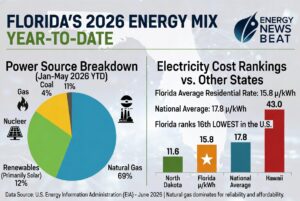
Florida’s electricity generation is dominated by natural gas, which accounted for roughly 68-70% of in-state net generation in 2025, according to U.S. Energy Information Administration (EIA) data. Nuclear power contributes about 11%, while renewables—primarily solar—make up around 12% (with solar alone at ~11%, ranking Florida third nationally in solar capacity). Coal-fired generation has declined sharply, supplying only about 4% of the state’s electricity in 2025, down from 18% in 2015 and higher shares in prior decades.
Stanton Unit 1’s output reflected this trend: it produced 296,856 MWh in Q1 2026, down 32% from Q1 2025. OUC has long planned to convert its coal units to gas (Stanton Unit 2 targeted for the end of 2027) while pursuing a net-zero carbon goal by 2050, with an interim target of a 50% reduction by 2030. However, rapid load growth—fueled by data centers, manufacturing, and population increases—has outpaced resource and transmission additions, prompting federal intervention to retain reliable, dispatchable capacity like coal.
While coal is only 4%, it is a critical 4% of load balancing for the grid system. Which hospital or house would like not to be working during the heat of the summer?
While 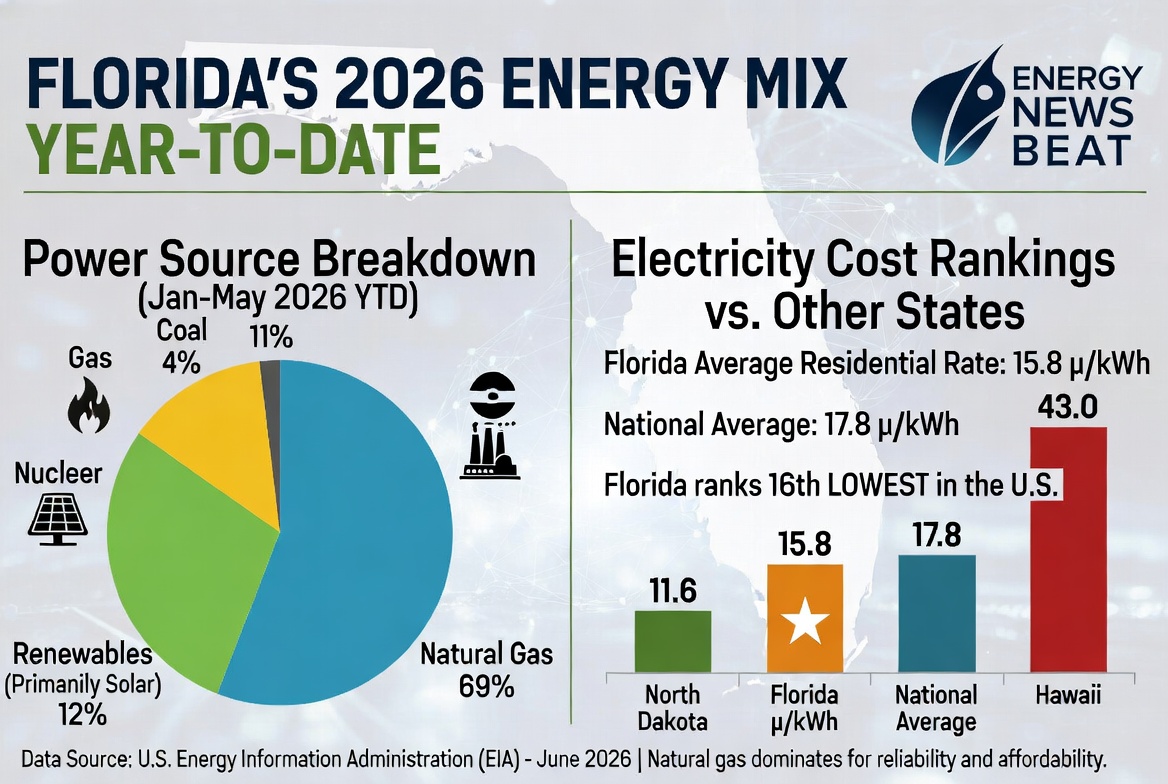
Electricity Pricing: Florida Remains Competitive
Florida’s residential electricity rates are below the national average, providing a buffer for consumers even as demand pressures mount. As of March 2026 EIA data, Florida’s average residential rate stood at 14.86 ¢/kWh (down slightly year-over-year), ranking it around 16th nationally. Recent June 2026 estimates place it at approximately 15.80 ¢/kWh. By comparison, the U.S. average residential rate ranges from 17.65 ¢/kWh to 18.83 ¢/kWh depending on the reporting period.
Rates vary widely across states: as low as 11.64 ¢/kWh in North Dakota and as high as 43.00 ¢/kWh in Hawaii. Florida’s heavy reliance on low-cost natural gas and growing solar have helped keep prices competitive, but the retention of coal capacity like Stanton Unit 1 provides insurance against volatility in gas prices or intermittent renewable output.
Impacts on Consumers and Investors
For Consumers: The order prioritizes short-term reliability, reducing the immediate risk of blackouts during peak demand or extreme weather—issues OUC has faced before, including during Winter Storm Fern. While OUC will seek cost recovery through FERC-approved tariffs, any incremental expenses from continued coal operation are expected to be modest and spread across ratepayers. Critics of similar federal mandates argue that keeping older coal units online can raise bills nationally by billions annually due to higher operating and maintenance costs compared to newer gas or renewable alternatives. However, in Florida’s context, the trade-off favors uninterrupted service for homes and businesses over potential outages that could impose far greater economic and safety costs.
For Investors: The decision is broadly positive for energy infrastructure investors, particularly those in coal and utility sectors. It signals strong federal backing for maintaining dispatchable generation amid surging demand from AI data centers and manufacturing. OUC’s ability to recover costs mitigates financial risk for the municipal utility. Nationally, this aligns with broader policy support that bolsters coal asset values, delays retirements, and creates opportunities in upgrades and modernization.
Ties to Trump Administration Coal and Grid Resiliency Initiatives
This DOE order directly supports President Trump’s aggressive push to strengthen America’s coal industry and electric grid reliability. On or around the same timeframe (with related announcements on June 4-5, 2026), the administration advanced roughly $700-850 million in federal funding—channeled through the Defense Production Act—to build or upgrade coal-fired plants and establish a dedicated U.S. coal export terminal. The initiative aims to expand domestic generation, boost exports, and address power needs for AI data centers, manufacturing resurgence, and national security.
Yes, the Stanton Unit 1 order explicitly falls under Trump’s broader initiatives for grid resiliency. These include executive orders such as “Reinvigorating America’s Beautiful Clean Coal Industry” (April 2025) and “Strengthening the Reliability and Security of the United States Electric Grid,” which direct the DOE to use emergency authorities like Section 202(c) to prevent premature plant retirements when reliability is at risk. The policy emphasizes utilizing all available resources—especially those with secure fuel supplies—for baseload power to meet exploding demand while lowering long-term costs and supporting jobs. This Florida action is part of a pattern that has already preserved gigawatts of coal capacity nationwide.
OUC spokesman Mike Codichini confirmed compliance, underscoring the utility’s focus on reliable service as it balances its long-term decarbonization goals with immediate grid needs.
Appendix: Sources and Links
- Utility Dive: “DOE orders OUC’s 465-MW coal unit in Florida to continue running” (June 5, 2026) – https://www.utilitydive.com/news/doe-orlando-coal-florida-stanton-emergency-202/822119/
- Energy News Beat: “Trump Plans $700 Million Push to Build Coal Plants, Export Site” – https://energynewsbeat.com/coal/trump-plans-700-million-push-to-build-coal-plants-export-site/
- U.S. Energy Information Administration (EIA) – Florida Electricity Profile and State Analysis (2025/2026 data): https://www.eia.gov/states/FL/analysis and https://www.eia.gov/electricity/state/florida/
- EIA Electric Power Monthly (March 2026 prices): https://www.eia.gov/electricity/monthly/epm_table_grapher.php?t=epmt_5_6_a
- Electricity Rates by State (June 2026): https://www.electricchoice.com/electricity-prices-by-state/ and https://www.chooseenergy.com/electricity-rates-by-state/
- White House Executive Orders and Fact Sheets on Coal and Grid Reliability (2025-2026): Multiple references including https://www.whitehouse.gov/presidential-actions/2025/04/reinvigorating-americas-beautiful-clean-coal-industry-and-amending-executive-order-14241/ and related DOE announcements.
All data and analysis drawn directly from these public sources as of June 7, 2026.
The post DOE Orders OUC’s 465-MW Coal Unit in Florida to Continue Running – What does this mean for Consumers and Investors? appeared first on Energy News Beat.