Energy News Beat
China is moving fast to solve one of the biggest bottlenecks in the global AI race: powering data centers quickly and cheaply. According to state broadcaster CCTV, the country has just launched its first prefabricated computing power hub in the eastern city of Qingdao, Shandong province. This modular power solution promises to slash construction time to as little as five months, cut overall costs by about 20%, and reduce land use by more than 30%.
It’s a clever engineering play designed specifically for the explosive growth of data centers that AI demands. By prefabricating the power infrastructure, China aims to get these facilities online faster and at lower cost than traditional builds—critical as Beijing pushes to dominate the next generation of computing.
But while China innovates on speed and cost, a different—and arguably smarter—model for winning the AI data center race is quietly emerging in the United States, particularly in West Texas. This approach prioritizes three non-negotiable best practices: siting data centers near abundant energy sources, tapping great water resources that don’t compete with communities or agriculture, and avoiding farmland or populated areas altogether. The result? Projects that address activist concerns head-on, deliver real economic benefits, and position the U.S. to lead sustainably.
The Texas Model: Energy, Water, and Land Done Right
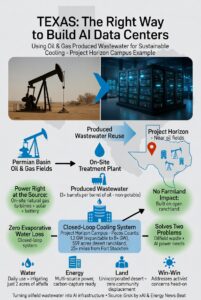
Look no further than Project Horizon, a massive 1.2 GW AI data center campus (with potential to scale to over 8 GW) being developed by Poolside Infrastructure Company in unincorporated Pecos County, more than 25 miles outside Fort Stockton in the Permian Basin. The 559-acre site sits in open desert ranchland adjacent to the historic Longfellow Ranch—nowhere near prime farmland, suburban neighborhoods, or municipal water systems.

Here’s why this matters for the AI race:
Proximity to energy sources: The Permian is a natural gas powerhouse. Project Horizon will start with an on-site power plant using aero-derivative gas turbines (with low-emission SCR systems and carbon capture capability). It has a multi-source architecture that can blend natural gas, solar, grid power, and battery storage. Developers already have partnerships lined up to deliver turbines in just over a year. No waiting for distant transmission lines or fighting grid congestion—power is right there where the fuel is produced.
Great water resources without straining supplies: Cooling is handled through a closed-loop liquid system that flows directly over the chips and rejects heat at higher temperatures to an outdoor chiller plant—no evaporative water loss. Daily water use for the entire campus is roughly equivalent to irrigating two acres of West Texas alfalfa. Toilets in the facility will actually use more water than the cooling systems. All water comes from non-potable groundwater within existing permitted allocations.
Not building on farmlands: The entire project is deliberately isolated on ranchland in the desert. No displacement of agriculture, no impact on local land prices, and minimal traffic or noise for nearby communities. CEO Robert Bonar put it bluntly: “Public resistance to data centers in other areas like Ohio and Pennsylvania is real… We believe there’s a better solution here.”
This isn’t a one-off. Across the Permian, oil producers are turning their biggest headache—produced water—into a solution for data centers. The basin generates roughly three barrels of wastewater for every barrel of oil produced, and injection disposal is running out of room (earthquakes, leaking wells, and toxic geysers have regulators worried). Treated produced water is now being positioned as a reliable, non-potable source for data center cooling.
Texas Pacific Land Corp. just closed a $43 million land deal for a power plant tied to data centers and is in talks to supply treated produced water. Multiple projects totaling over 10,000 MW of capacity are in discussion. As one energy executive noted, “If you go to West Texas, you can get your power source from natural gas and your cooling source from produced water.” It’s a perfect industrial marriage: oil fields solve their wastewater problem while powering the AI boom.
Why This Is the Right Way—and How It Wins the AI Race
China’s prefabricated power hub shows one path: modular speed. Texas shows the complete playbook—modular power + local energy abundance + sustainable water + smart land use. By co-locating with existing oil and gas infrastructure, these projects avoid the grid bottlenecks, water wars, and NIMBY fights plaguing data centers elsewhere. They turn activist concerns into non-issues by design.
Good for Consumers, Great for Investors
For consumers: Faster, cheaper data center deployment means AI services (cloud computing, training models, inference) can scale without driving up electricity rates or competing for water. Excess power can even flow back to the grid. Local economic activity in places like Fort Stockton—jobs, training programs with Midland College, subsidized housing—helps keep regional costs stable and supports broader energy affordability.For investors: This is a multi-trillion-dollar opportunity. Energy producers in the Permian gain new revenue streams from power sales and produced-water reuse. Data center developers who follow this model get faster permitting, lower risk, and reliable margins. Suppliers of gas turbines, modular components, closed-loop cooling tech, carbon capture, and battery storage stand to win big. Public markets and private capital are already flowing toward projects that solve—not create—environmental and community problems. The Texas approach de-risks the entire AI infrastructure buildout.
As the AI arms race intensifies, the winners won’t just be the ones who build the biggest campuses fastest. They’ll be the ones who build them smartest—right next to the energy, using the water nobody else wants, on land that doesn’t displace food or people.
China just proved that prefabrication works for power delivery. Texas is proving the full sustainable model works even better. The right way to do data centers isn’t coming—it’s already here.
- Bloomberg: “China Starts Prefabricated Power Hub for Data Centers, CCTV Says” (June 7, 2026)
https://www.bloomberg.com/news/articles/2026-06-07/china-starts-prefabricated-power-hub-for-data-centers-cctv-says?srnd=phx-industries-energy - Forbes (David Blackmon): “West Texas Data Center Project Addresses Activist Concerns Head-On” (June 2, 2026)
https://www.forbes.com/sites/davidblackmon/2026/06/02/west-texas-data-center-project-addresses-activist-concerns-head-on/ - Houston Chronicle: “Data centers need water. Texas oil companies think they have the solution.”
https://www.houstonchronicle.com/business/energy/article/data-centers-permian-oil-texas-produced-water-22255099.php
Article prepared for Energy News Beat Channel.
The post China Starts Prefabricated Power Hub for Data Centers, CCTV Says. – There is a right way to do Data Centers Emerging appeared first on Energy News Beat.