Energy News Beat
The California High-Speed Rail (CAHSR) project, once sold to voters as a transformative $33 billion bullet train connecting San Francisco to Los Angeles in under three hours by 2020, now carries eye-watering cost estimates that have ballooned dramatically. The latest figures from the California High-Speed Rail Authority’s (CHSRA) 2026 Draft Business Plan put the full original Phase 1 scope at approximately $231.3 billion in today’s dollars under legacy assumptions. Even an “optimized” version is pegged at around $126 billion, with full service potentially arriving around 2040.
After nearly two decades, billions spent, and minimal operational progress, the project stands as one of the most expensive and delayed infrastructure endeavors in U.S. history.
History: From Voter Approval to Endless Delays
Voters approved Proposition 1A in November 2008, authorizing $9.95 billion in state bonds for a high-speed rail system. The promise was clear: a dedicated high-speed network linking major population centers, with nonstop San Francisco–Los Angeles service in no more than 2 hours and 40 minutes. Total project cost was estimated at roughly $33–45 billion, with significant private and federal investment expected.
Construction finally began in the Central Valley in 2015, focusing on the Initial Operating Segment (IOS) between Merced and Bakersfield (about 171 miles). The route faced intense opposition over environmental impacts, farmland disruption, and alignment choices. Lawsuits, extensive environmental reviews under CEQA/NEPA, land acquisition battles, and repeated design changes have plagued progress.
The project has shifted toward “blended” operations, sharing tracks with existing commuter and freight rail in the Bay Area (via Caltrain electrification) and Southern California rather than building fully dedicated high-speed corridors everywhere.
Funding: A Patchwork of Bonds, Cap-and-Trade, and Federal Grants
Funding has come from multiple sources:
- Proposition 1A bonds: Core state commitment (~$9+ billion allocated to HSR).
- Cap-and-trade revenues: Extended through 2045 at a fixed ~$1 billion annually.
- Federal grants: Historically, several billion (including ARRA stimulus funds), though recent federal reviews led to termination of roughly $4 billion in grants in 2025 due to compliance issues, funding gaps, and missed deadlines.
As of mid-2025/early 2026 reports, the Authority had received around $23 billion in combined state and federal funding commitments and spent approximately $13.8–15 billion. Significant funding gaps remain for completing even the Central Valley segment or full Phase 1.
Accomplishments So Far
Despite the controversies, tangible work has occurred:
- Environmental clearances have been completed for much of the Phase 1 route.
- Substantial construction in the Central Valley, including viaducts, bridges, and elevated structures.
- Contributions to blended corridor improvements, such as funding part of Caltrain’s electrification (completed 2024).
- Project development and planning for stations and maintenance facilities.
However, no dedicated high-speed rail track is fully operational, and no revenue service exists on any HSR segment. The Merced–Bakersfield IOS remains the near-term focus, with revenue service now targeted for the early 2030s or later under revised plans.
Central Valley construction progress on elevated structures and viaducts (examples of ongoing work).
Massive Cost Overruns
The original ~$33 billion estimate has exploded due to:
- Regulatory and environmental compliance costs.
- Lengthy litigation and public opposition.
- Land acquisition challenges and eminent domain issues.
- Scope changes, inflation, and evolving design standards.
- Political decisions on routing and “Buy America” requirements.
By the 2026 Business Plan, the Authority’s bottom-up re-estimate for the full original Phase 1 scope reached $231.3 billion. Their preferred optimized plan (with adjustments to scope, design, and sequencing, including elements like single-tracking in places) lowers this to approximately $126.2 billion, with a target for initial service around 2040.
Critics argue the higher figure reflects the cost of delivering what voters were originally promised (dedicated high-speed infrastructure), while the lower number involves significant compromises.SNCF:

Success in Morocco, Frustration in California
A striking contrast comes from SNCF (Société nationale des chemins de fer français), France’s national railway operator. SNCF was involved in early planning for California’s project in the 2000s, offering expertise from its world-class TGV network. However, the company grew frustrated with political interference, route changes driven by local politics (“politically gerrymandered”), excessively high capital costs, and what it saw as an attempt to “design and build a Boeing 747 instead of going out and buying one.”SNCF ultimately withdrew around 2011. Project manager Dan McNamara told The New York Times: “There were so many things that went wrong. SNCF was very angry. They told the state they were leaving for North Africa, which was less politically dysfunctional. They went to Morocco and helped them build a rail system.”
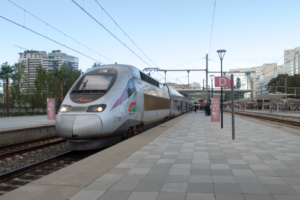
In Morocco, SNCF provided design, construction, and operational expertise for the Al Boraq high-speed line (Africa’s first). The ~350 km (Tangier–Rabat–Casablanca) line opened in November 2018 after roughly a decade of planning and construction. It cut travel times dramatically (e.g., Tangier to Casablanca from ~5 hours to ~2 hours 10 minutes) at speeds up to 320 km/h. Costs were among the lowest globally for high-speed rail at roughly €9 million per km. While not perfectly on the original schedule or budget, it was successfully completed and has been operating reliably.
Al Boraq high-speed train at a station in Morocco — a completed, operational system built with SNCF involvement.
This comparison highlights how differing regulatory environments, political processes, and project management approaches can dramatically affect outcomes.
Current Status and Outlook (2026 Business Plan)The 2026 plan presents multiple scenarios but emphasizes an optimized ~$126 billion path for Phase 1 with revenue service targeted around 2040. Funding remains a major challenge, with ongoing reliance on state cap-and-trade and uncertainty around additional federal support.
Ridership and revenue projections vary by scenario, but the project continues to face scrutiny over long-term viability, especially for segments serving lower-density areas.hsr.ca.gov
Example project alignment map (San Jose to Merced area).

Conclusion
California’s high-speed rail project has transformed from an ambitious vision into a cautionary tale of cost escalation, delays, and implementation challenges. With estimates now ranging from $126 billion (optimized) to $231 billion (full original scope), and only partial construction visible after nearly 18 years and over $14 billion spent, the project continues to divide opinions.The contrast with Morocco’s successful Al Boraq line — built with input from the same French expertise that walked away from California — underscores broader questions about regulatory efficiency, political consensus, and project delivery in the U.S. context.As the 2026 Business Plan moves forward amid funding uncertainties and federal reviews, Californians and taxpayers nationwide will be watching closely to see whether the “bullet train” can finally deliver meaningful results or remain an expensive work in progress.
Appendix: Sources and Links
- California High-Speed Rail Authority 2026 Business Plan materials and summaries: hsr.ca.gov (search “2026 Business Plan”)
- Wikipedia: California High-Speed Rail (comprehensive overview with citations)
- Fresno Bee / multiple outlets on 2026 cost estimates: e.g., articles citing $126B optimized vs. $231B full scope (April–May 2026)
- Reason.org commentary on cost estimates and transparency (May 2026)
- New York Times (Oct 2022): “How California’s Bullet Train Went Off the Rails” – SNCF quotes and history
- SNCF Group resources on the Morocco Al Boraq project
- U.S. Department of Transportation / FRA announcements on federal funding reviews (2025)
- Various news reports on spending totals (~$13.8–15B as of 2025–2026)
All information drawn from publicly available reports, news articles, and official statements as of June 2026. Cost figures and timelines are subject to ongoing updates by the Authority.
The post California High-Speed Rail project soars to $231 Billion – “We left to work in Morocco as it is a better work enviornment” appeared first on Energy News Beat.