Energy News Beat
The global energy landscape remains highly volatile in early August 2026, shaped by overlapping geopolitical, security, and climate pressures. Disruptions centered on Russia’s refined product exports, ongoing uncertainty over the Strait of Hormuz, escalating risks in the Bab el-Mandab Strait, and a severe drought across Europe are tightening supplies of crude oil, petroleum products, LNG, and natural gas. These factors are interacting in ways that amplify price volatility, force trade-route rerouting, and raise risks for import-dependent economies—particularly in Asia—while complicating efforts to stabilize markets ahead of winter.
Strait of Hormuz: Fragile Hopes for Reopening
Negotiations involving the United States, Iran, and Oman appear close to an interim arrangement that could restore more normal shipping through the Strait of Hormuz, a waterway that normally carries about one-fifth of global oil and a significant share of LNG. Reports indicate a potential 60-day framework with designated northern (Iranian waters) and southern (Omani waters) lanes, no initial transit fees, mine clearance, and space for broader talks on nuclear issues and ceasefires. U.S. officials have expressed optimism about progress, while Iranian statements emphasize technical and political discussions with Oman.
Past agreements, including the mid-June 2026 memorandum of understanding, have proven fragile, collapsing amid renewed hostilities, attacks on vessels, and disputes over control, fees, and sovereignty. Any deal this week faces the same risks of rapid reversal by hardline elements or external triggers. Even partial reopening would ease immediate pressure on oil and LNG flows from the Persian Gulf (including Qatar), but sustained IRGC or proxy resistance could keep risk premiums elevated and volumes well below pre-crisis levels of roughly 20 million barrels per day of oil-related traffic.
Impacts on markets: Prolonged constraints have already shut in substantial production, driven oil prices higher at times into triple digits before partial retreats, and removed roughly 20% of global LNG supply at peak disruption. Asia, which takes the majority of Hormuz-bound cargoes, has faced feedstock shortages, higher import costs, and emergency demand measures. Full or lasting reopening would allow inventory rebuilds and price relief; failure would intensify competition for alternative supplies and raise the odds of demand destruction.
Russia’s Product Export Collapse and Domestic Strain
Russia’s seaborne petroleum product exports have fallen sharply, reaching multi-year or record lows near or below 1.6 million barrels per day in recent months (with charts showing further declines into July 2026), driven primarily by Ukrainian drone strikes on refineries. These attacks reduced refining runs significantly (at times by hundreds of thousands of barrels per day), prompting export bans on diesel, gasoil, gasoline, and jet fuel to prioritize domestic needs. Russia has even explored or begun importing gasoline and other fuels. Crude exports have sometimes risen as unprocessed oil is diverted to ports, but overall product availability for global markets has tightened.
While broader U.S. and Western policy (sanctions, secondary pressure) forms the backdrop, the acute drop aligns closely with the intensity and targeting of Ukrainian strikes on processing infrastructure rather than a purely diplomatic shift. Domestic fuel shortages inside Russia have compounded the issue.
Market effects: Reduced Russian diesel and gasoline exports remove a traditional source of Atlantic Basin and emerging-market supply just as Middle East product flows are constrained. This supports higher product cracks and contributes to elevated gasoline and diesel prices in consuming regions, including the U.S. LNG and natural gas markets feel secondary effects through higher oil-linked pricing and competition for alternative energy sources.
Bab el-Mandab Strait and Aramco Resilience Under Pressure
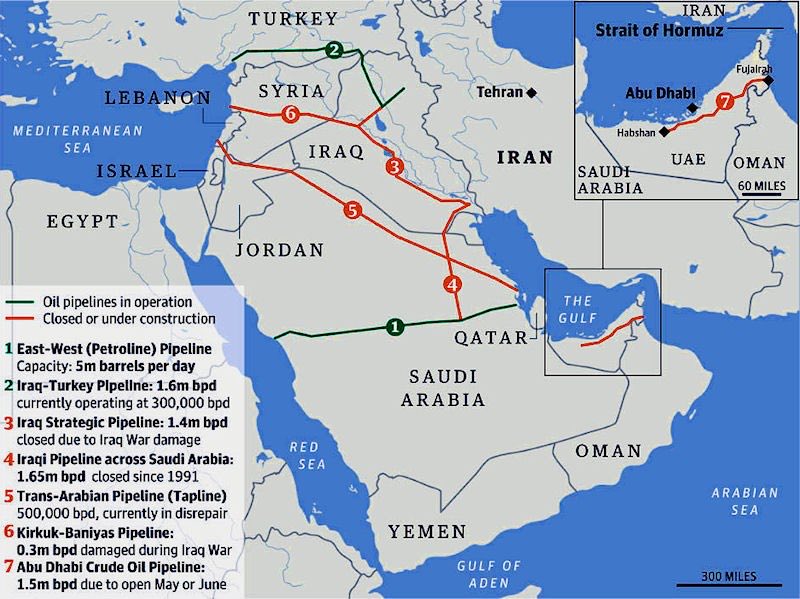
Houthi declarations of a maritime blockade on Saudi ports and attacks on vessels and facilities have severely restricted traffic through the Bab el-Mandab Strait, the southern gateway to the Red Sea. This threatens the workaround Saudi Arabia has used since Hormuz disruptions began: ramping the East-West Pipeline to near or at maximum capacity (around 7 million barrels per day) to move crude to Red Sea terminals such as Yanbu for export. Asian-bound volumes that previously transited Bab el-Mandab have been forced north via the Suez Canal/SUMED pipeline or longer routes around Africa, adding time and cost.
Recent attacks claimed on Aramco facilities (including sites linked to Yanbu and Jizan) add operational risk, though the company has reported that production, exports, and domestic supplies remain intact and that Q2 2026 profits rose substantially (net income around $32–33 billion, up sharply year-on-year) thanks to higher prices offsetting any volume constraints and the flexibility of the East-West system plus storage.
Impacts: Dual chokepoint pressure (Hormuz + Bab el-Mandab) affects a large share of Middle East oil exports to Asia and complicates LNG routing. Higher freight, insurance, and longer voyages raise delivered costs. Aramco’s second-half 2026 profitability will depend on whether the pipeline and alternative Mediterranean outlets (via Egypt) can fully compensate and whether further attacks escalate. Global oil balances tighten further if Saudi volumes are constrained; LNG faces parallel logistics strain.
Europe’s Drought: Cascading Strain on Energy and Transport
A severe drought has driven the Rhine and Danube to record or multi-decade low water levels (Rhine at Kaub near or below 24–40 cm in early August; Danube similarly critical). This restricts barge traffic—Europe’s key inland artery for fuels, chemicals, and bulk goods—forcing reduced loads, higher freight rates (diesel barge rates from Rotterdam inland have spiked), and shifts to costlier road/rail. Nuclear plants (e.g., Romania’s Cernavoda, Hungary’s Paks) face cooling-water shortages, with output cuts or shutdown risks; hydropower generation has also declined.
These disruptions hit an already tight European energy system still competing for LNG amid Middle East shortfalls. Higher inland transport costs for oil products and potential power shortfalls increase demand for seaborne LNG and alternative fuels, transmitting tightness into global natural gas and oil product markets.
Broader Ripples: Syria, Asia, U.S. Policy Debates, Egypt’s LNG Shift, and China’s Resource Strategy
Syria’s reported willingness to drastically cut Russian oil imports (currently ~60,000 b/d after a 75% rise) as part of discussions on removing its State Sponsor of Terrorism designation involves small volumes relative to global trade. It signals political realignment more than market-moving supply change, though it could free marginal Russian barrels or force Syria to seek costlier alternatives.
For Asia’s developing economies, prolonged Hormuz (and now Bab el-Mandab) shortages risk cascading effects: elevated energy and fertilizer costs, industrial slowdowns, power rationing, and in extreme scenarios heightened pressures around migration, food security, or social instability. Import dependence remains high; emergency measures (work-from-home, rationing) have already been used.
In the United States, high gasoline prices (averaging over $4/gallon) have prompted debates over restricting petroleum product exports versus criticizing oil company profits. Export limits could offer temporary domestic relief but risk reducing refinery runs (many are configured for export markets), fracturing global product balances, and raising prices elsewhere—especially for Latin America and Atlantic Basin buyers already hit by Russian and Middle East shortfalls. Jones Act waivers and other measures remain in play.
Egypt emerged as a leading destination for U.S. LNG cargoes in July (or among the top), reflecting its own production shortfalls and the broader scramble for non-Gulf supply amid Middle East disruptions. This underscores shifting trade patterns: U.S. LNG is filling gaps left by constrained Qatari and UAE volumes, with Europe and Asia competing intensely.
China’s aggressive battery and critical-metal recycling targets toward 2030 are framed by Beijing as enhancing resource security and reducing import dependence on lithium, nickel, cobalt, and other materials—priorities that blend industrial policy, supply-chain resilience, and national security alongside climate goals.
Outlook for Oil, LNG, and Natural Gas Markets
Collectively, these pressures keep oil markets tight: product shortfalls from Russia, dual-strait risks for Middle East crude, and European inland logistics constraints support elevated prices and crack spreads. LNG and natural gas face the sharpest structural hit from lost Gulf volumes (up to ~20% of global LNG at peaks), with Europe’s drought adding demand-side stress via power generation shortfalls. Prices have seen sharp spikes; winter storage targets in Europe and Asia look more challenging without sustained Hormuz normalization. Demand destruction, fuel switching to coal where possible, and accelerated non-Gulf supply (U.S., new projects elsewhere) are the primary balancing mechanisms.
Any durable Hormuz deal would provide the single largest near-term relief; continued flux across all four fronts points to persistent volatility through the remainder of 2026.
We will be covering this and more on the Energy News Beat Stand Up later today. The key point is that there is a huge global shortage of refining capacity, and it will be a bottleneck for lower oil prices, but higher gasoline, jet fuel, and diesel until demand destruction and global economic collapse roll in.
Appendix: Sources and Links
- Anas Alhajji X post with questions: https://x.com/anasalhajji/status/2084706977716863398
- Al Jazeera on Hormuz deal talks: https://www.aljazeera.com/news/2026/8/5/iran-oman-us-close-to-hormuz-deal-what-do-they-all-want
- Deccan Chronicle / Axios-related Hormuz reporting: https://www.deccanchronicle.com/west-asia/us-nears-interim-deal-with-iran-oman-to-reopen-strait-of-hormuz-1976707
- The Guardian on US-Qatar progress: https://www.theguardian.com/world/2026/aug/04/us-qatar-progress-iran-ceasefire-hormuz-strait
- Bloomberg on Russian oil exports/refinery impacts: https://www.bloomberg.com/news/articles/2026-08-04/russia-s-oil-exports-slip-as-lull-in-drone-strikes-boosts-refining
- Kyiv School of Economics Russian Oil Tracker July 2026: https://kse.ua/about-the-school/news/russian-oil-tracker-july-2026-refinery-strikes-drove-oil-product-exports-to-a-record-low-while-the-diesel-and-gasoil-export-ban-could-put-up-to-36-of-total-oil-product-export-volumes-at-ri/
- Oxford Institute for Energy Studies on Ukraine attacks impact: https://www.oxfordenergy.org/wpcms/wp-content/uploads/2026/07/Comment-The-Impact-of-Ukraine-attacks-on-Russian-energy-infrastructure.pdf
- Reuters on Syria Russian oil imports: https://www.reuters.com/business/energy/syria-tells-us-it-is-willing-drastically-drop-russian-oil-imports-sources-say-2026-08-04/
- IEA on Southeast Asia/Hormuz vulnerabilities: https://www.iea.org/news/strait-of-hormuz-crisis-reinforces-need-for-southeast-asia-to-tackle-major-energy-vulnerabilities
- Brookings on Asia economic security: https://www.brookings.edu/articles/iran-war-reverberations-a-nadir-for-asias-economic-security/
- Business Standard on Asia energy shortages: https://www.business-standard.com/world-news/asia-s-energy-starved-nations-go-dark-as-hormuz-strait-tensions-drag-on-126080400159_1.html
- The National on Aramco Q2 profits and East-West pipeline: https://www.thenationalnews.com/business/energy/2026/08/04/aramco-posts-42-jump-in-q2-profit-despite-supply-disruptions/
- Arab News on Aramco results: https://www.arabnews.com/node/2653315/business-economy
- Kpler-related Bab el-Mandab analysis (via MarineTraffic and others): https://www.marinetraffic.com/en/maritime-news/34/risk-and%20compliance/2026/13110/two-straits-one-shock-houthi-blockade-threat-puts-bab-el-man
- CNBC on Europe drought: https://www.cnbc.com/2026/08/05/drought-rhine-danube-water-levels-economy.html
- Bloomberg on Europe energy strain: https://www.bloomberg.com/news/newsletters/2026-08-04/europe-s-hot-dry-summer-is-straining-its-energy-system
- WSJ on ships and power plants: https://www.wsj.com/world/europe/ships-cant-move-and-power-plants-shut-down-as-drought-saps-europes-rivers-8b083c62
- Hellenic Shipping News / S&P on Egypt US LNG: https://www.hellenicshippingnews.com/egypt-leads-us-lng-cargo-destinations-in-july-amid-cross-basin-competition-for-supply/
- Reuters on Egypt multi-year LNG talks: https://www.reuters.com/business/energy/egypt-talks-with-energy-majors-multi-year-lng-supply-deal-sources-say-2026-07-21/
- Rest of World / SCMP on China battery recycling: https://restofworld.org/2026/ev-battery-recycling-china-us/ and https://www.scmp.com/economy/china-economy/article/3359357/china-unveils-recycling-push-bolster-resource-security-and-shore-green-transition
- Reuters on Jones Act / gasoline prices: https://www.reuters.com/business/energy/white-house-set-extend-jones-act-waiver-trump-hunts-cheaper-gasoline-2026-08-04/
- IEA Gas Market Report Q2-2026 references and related analyses: https://www.iea.org/reports/gas-market-report-q2-2026/executive-summary
- Wood Mackenzie and Kpler market commentaries on dual-strait and LNG impacts (various 2026 publications).
- Additional supporting coverage from S&P Global, Argus, Energy Intelligence, Carnegie, and national outlets on Russian exports, Aramco operations, and European river levels as cited in the body.
The post Global Energy Market In Flux with Russia, Strait of Hormuz, Bab el-Mandab Strait and drought in the EU all in play appeared first on Energy News Beat.