Energy News Beat
China’s State Council approved the construction of eight new nuclear reactor units on July 31, 2026, during an executive meeting chaired by Premier Li Qiang. The projects, spanning four provinces, represent a total investment exceeding 170 billion yuan (approximately $25 billion) and continue the country’s aggressive expansion of nuclear capacity as a cornerstone of its energy security and low-carbon transition strategy.
The approved units consist of three pairs of Hualong One (HPR1000) reactors at the Jinqimen site in Zhejiang Province (Phase II, units 3 and 4, China National Nuclear Corporation/CNNC), the Taipingling site in Guangdong Province (Phase III, units 5 and 6, China General Nuclear/CGN), and the Zhuanghe site in Liaoning Province (Phase I, CNNC), along with two Guohe One (CAP1400) reactors at the Laiyang site in Shandong Province (Phase I, State Power Investment Corporation/SPIC). Each reactor is rated at approximately 1,127 MW.
Notably, the Jinqimen Phase II and Taipingling Phase III units have been designated as demonstration projects for Hualong One 2.0 technology. Hualong One 2.0 is described as an advanced pressurized water reactor (PWR) that builds on third-generation technology through independent innovation, incorporating operational feedback from existing Hualong One units. It features optimized active and passive safety systems, Chinese standards and software, intelligent controls, and modular construction techniques aimed at improving safety, technical performance, construction efficiency, and economics.
As of the latest data, 10 Hualong One units are in commercial operation domestically and internationally, with 37 more approved for construction. Each Hualong One unit is designed to generate nearly 10 billion kWh annually—enough to power a city of over one million people—while reducing standard coal consumption by more than 3 million tons and CO2 emissions by over 9 million tons per year. The technology has also fostered a complete industrial supply chain supporting nearly 6,000 upstream and downstream enterprises.
The State Council emphasized that all units must adhere to the highest global safety standards, with strengthened supervision across the full supply chain.
China’s Current Energy Mix
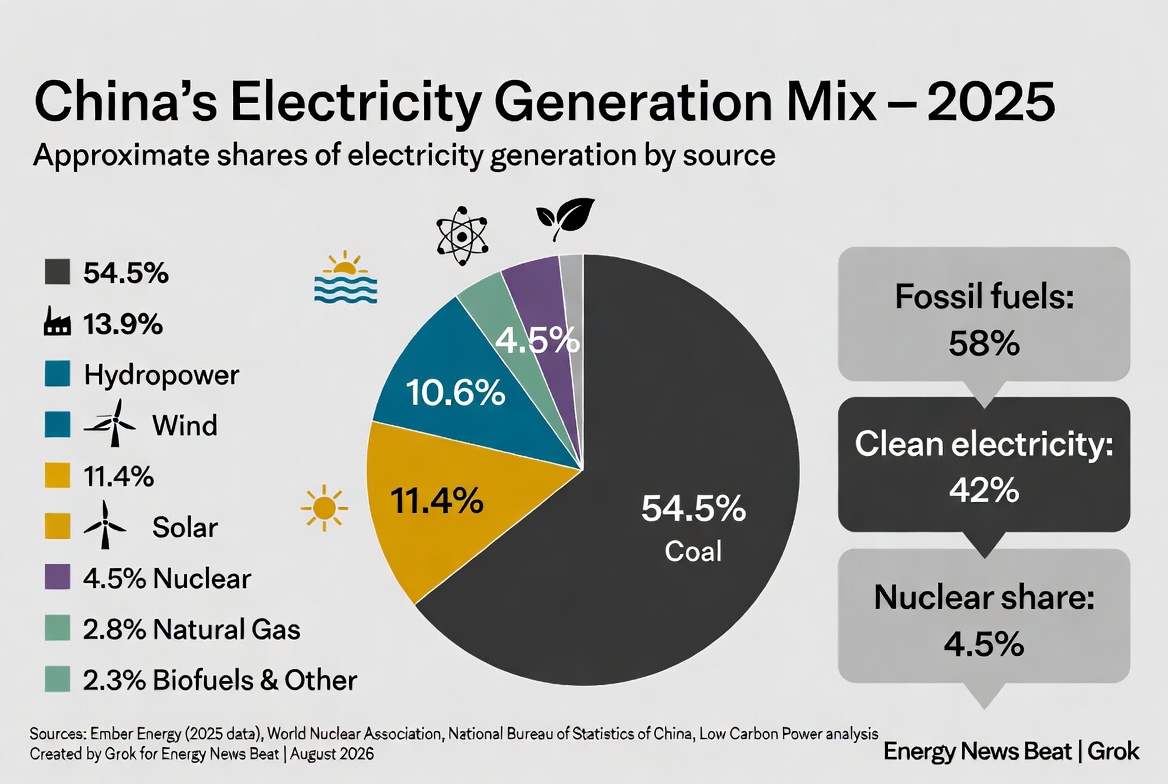
China’s electricity generation remains dominated by fossil fuels, though the clean energy share continues to rise. In 2025, fossil fuels (primarily coal) accounted for about 58% of electricity generation, down from roughly 62% in 2024, marking the first absolute decline in coal-fired output since 2015. Clean sources reached 42% of generation, in line with the global average. Hydropower contributed approximately 13–14%, while wind and solar combined reached 22% (with solar alone showing strong growth, including a reported 40% year-on-year increase in some datasets to around 336 TWh). Nuclear power contributed in the range of roughly 4.5–5%.
Primary energy consumption still relies heavily on coal (around 50–55% in recent years), underscoring nuclear’s role as reliable, dispatchable low-carbon baseload to complement variable renewables and support the shift away from coal while meeting soaring electricity demand.
Active Nuclear Fleet and Expansion Plans
As of early August 2026, China has 64 operable nuclear reactors with a combined capacity of approximately 63,985 MWe (about 64 GW). An additional 37 reactors are under construction, totaling roughly 38,578 MWe.
China leads the world in nuclear construction and has been approving 8–11 new units annually in recent years. The 15th Five-Year Plan (2026–2030) targets 110 GWe of nuclear capacity by 2030. Longer-term ambitions include substantially higher capacity by 2035 and beyond, positioning nuclear as a key non-fossil source alongside wind, solar, and hydro to help peak emissions before 2030 and achieve carbon neutrality by 2060. The newly approved units will add nearly 9 GW once completed and will feed into the under-construction pipeline.
Why Hualong One (and 2.0) Technology Is Critical
Hualong One represents China’s flagship indigenous Generation III reactor design, developed jointly by CNNC and CGN with full independent intellectual property rights. It draws on decades of domestic experience while incorporating proven safety features (including a mix of active and passive systems), a 60-year design life, and high localization of components (around 90%).
The 2.0 upgrade is particularly significant because it incorporates real-world construction and operating feedback from the first wave of units. This iterative improvement enhances safety performance, reduces construction workload through modular methods, boosts economic competitiveness (potentially lowering costs and build times), and strengthens technical sophistication with intelligent systems.
Strategically, Hualong technology advances China’s goals of energy self-sufficiency and technological sovereignty. It reduces reliance on foreign designs, supports a closed fuel cycle policy, builds a robust domestic supply chain, and positions China as a major nuclear exporter (already deployed or selected in countries such as Pakistan). In the broader energy transition, it provides firm, low-carbon power that complements intermittent renewables, helps displace coal (critical for air quality and climate targets), and enhances grid reliability and national energy security amid rapid demand growth.
China’s continued batch deployment of standardized designs like Hualong One and CAP1400 (an enlarged evolution of AP1000-derived technology) enables economies of scale unmatched elsewhere, reinforcing its position as the primary driver of global nuclear capacity growth.
This latest approval underscores Beijing’s determination to scale nuclear power rapidly as part of a diversified, resilient, and lower-carbon energy system.
- World Nuclear News: “China approves construction of eight more reactors”
- NucNet: “China Approves Eight New Nuclear Plants, Including Four With Hualong One 2.0 Technology” (https://www.nucnet.org/news/china-approves-eight-new-nuclear-plants-including-four-with-hualong-one-2-0-technology-8-2-2026)
- Global Times: “China’s Hualong One 2.0 demonstration projects approved at State Council executive meeting”
- Reuters: “China approves eight new nuclear power units”
- Yahoo/News coverage summarizing filings and details (https://www.yahoo.com/news/science/articles/chinese-government-approves-eight-nuclear-162833734.html)
- World Nuclear Association: Nuclear Power in China
— operable reactors, capacity, under construction, and technology details (data as of early August 2026)
- Ember Energy: China electricity trends and 2025 mix
- Low Carbon Power / related generation mix data for recent percentages
- CSIS and related analyses on 15th Five-Year Plan nuclear targets (e.g., https://www.csis.org/analysis/chinas-nuclear-energy-priorities-under-its-15th-five-year-plan)
- Bloomberg and Innovation News Network references confirming investment figures (~170 billion yuan / $25 billion)
All figures and details are drawn from the above publicly reported sources as of early August 2026. Nuclear statistics can evolve with grid connections and construction starts; readers should consult primary sources such as the World Nuclear Association or IAEA PRIS for the absolute latest counts.
The post China Approves Eight New Nuclear Plants, Including Four With Hualong One 2.0 Tech appeared first on Energy News Beat.