Energy News Beat
New Yorkers woke up to a major milestone in the state’s green energy transition on June 1, 2026: the Champlain Hudson Power Express (CHPE) transmission line began flowing hydroelectric power from Quebec, Canada, directly into Queens. This $6 billion underground and underwater project, developed in partnership with Hydro-Québec, delivers up to 1,250 MW of carbon-free baseload power—enough to meet roughly 20% of New York City’s annual electricity needs under long-term contracts.
On paper, it’s a win for New York’s aggressive climate goals. The state’s Climate Leadership and Community Protection Act (CLCPA), signed in 2019, mandates 70% renewable electricity by 2030 and 100% zero-emission electricity by 2040, alongside an 85% reduction in greenhouse gas emissions from 1990 levels by 2050 (with a 40% interim cut by 2030). The CHPE project helps plug a growing gap as electricity demand surges from data centers, electrification, and EVs—while offshore wind projects face delays and cost overruns.
But here’s the uncomfortable reality for energy security: New York is doubling down on foreign imports at a time when political tensions with Canada have already boiled over into explicit threats to flip the switch. And the state’s own energy mix and sky-high electricity prices raise a bigger question: Why are governors betting the grid on power sources controlled by another country?
New York’s Energy Mix: Still Fossil-Heavy at Home, Increasingly Foreign for “Clean”
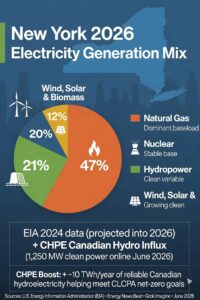
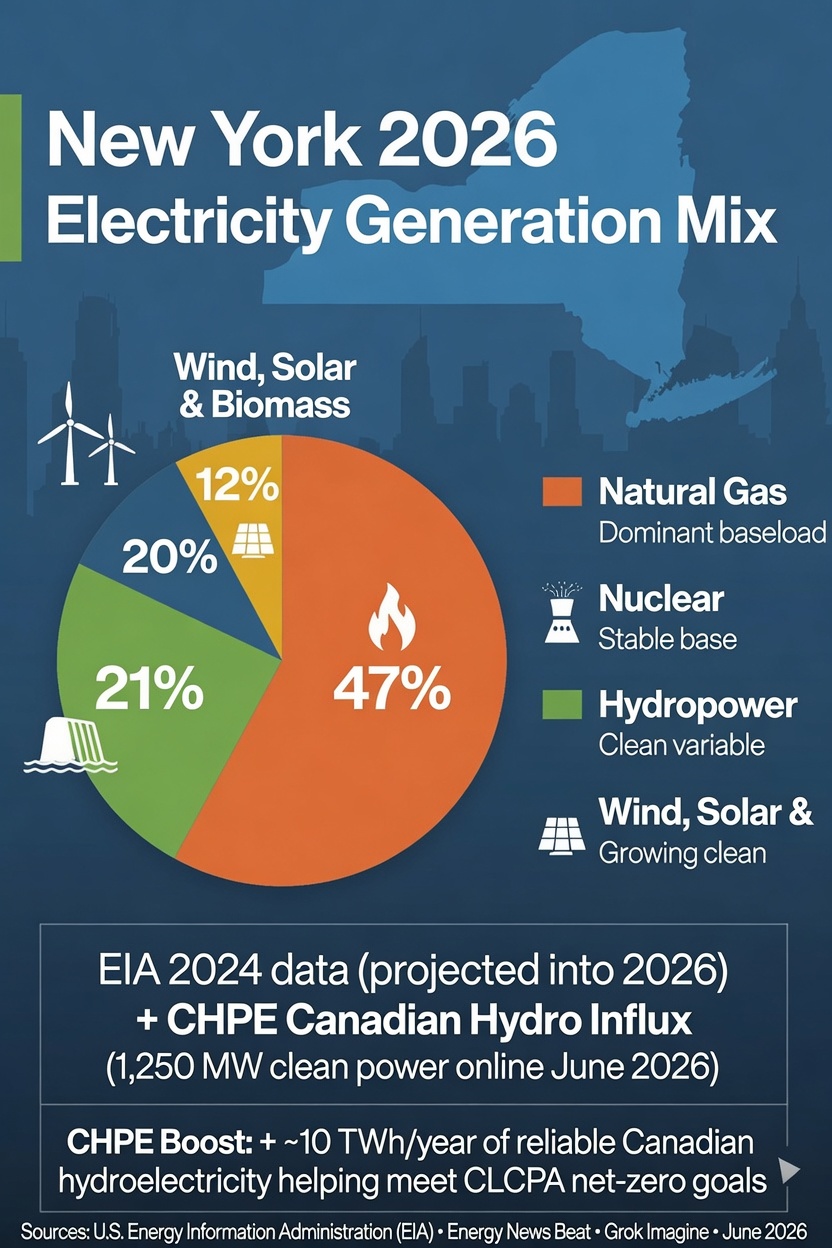
In-state generation tells only part of the story. According to the U.S. Energy Information Administration (EIA) data for 2024–2025:
Natural gas dominates at ~38–47% of net generation.
Nuclear provides ~18–20%.
In-state hydropower contributes ~15–21%.
Wind, solar, and biomass make up the rest of the ~10%+ renewables slice.
Yet New York already imports significant hydropower from Canada, and the CHPE line supercharges that reliance. Quebec’s Hydro-Québec has long been a key supplier, though net flows have fluctuated with water levels and economics. The new line locks in a massive, consistent baseload import—exactly what the CLCPA demands to hit its targets.
The state is phasing out coal (last plant closed in 2020) and leaning on aging fossil fleets while renewables scale slowly. Officials have quietly admitted the 70% renewable target by 2030 is out of reach, putting the entire net-zero timeline at risk.
Electricity Costs: Among the Nation’s Highest—and Rising
New Yorkers are already paying the price—literally. As of early 2026 data:
Residential rates averaged 28.55–29.99 ¢/kWh, ranking New York 6th-highest in the U.S. and roughly 70% above the national average (~16–18 ¢/kWh).
Commercial and industrial rates are also elevated compared to most states.
These prices reflect the cost of aggressive mandates, grid upgrades, and imported power contracts. Critics argue the CLCPA’s rushed timeline has accelerated reliance on whatever clean megawatts are available—domestic or foreign—without enough baseload or dispatchable backup. The result? Higher bills for families and businesses, even as the state celebrates “clean” imports.Energy Security Risk: Canada Has Already Threatened the PlugThis isn’t hypothetical. In early 2025, amid President Trump’s proposed tariffs on Canadian goods, Ontario Premier Doug Ford explicitly threatened to impose a 25% surcharge on electricity exports to New York, Michigan, and Minnesota—or cut them off entirely “with a smile on my face.” Ford framed it as retaliation: “If they want to try to annihilate Ontario, I will do everything—including cut off their energy.”
While the CHPE line sources power from Quebec (not Ontario), the episode underscores the vulnerability. Canada’s provinces coordinate on energy, and Hydro-Québec exports have faced their own pressures from low water levels and domestic needs. Foreign supply—especially hydro from a single neighboring country—gives Ottawa and provincial leaders political leverage during trade disputes, tariffs, or policy disagreements with a Trump administration.
New York is not alone in the Northeast; New England also imports Canadian hydro. But the scale of New York’s bet is unique. Why voluntarily hand over grid stability to a foreign sovereign that can weaponize energy in a trade war? California is the poster child for becoming energy dependent on foreign energy sources.
Why State Governors Are Choosing Foreign Dependency
The CLCPA’s rigid timeline leaves little room for domestic solutions like new natural gas plants (with carbon capture), expanded nuclear, or even more in-state hydro and onshore wind. Permitting delays, local opposition, and “green-only” ideology have made Canadian hydro the path of least resistance—cheap, dispatchable, and “carbon-free” on paper.
Governors and regulators appear willing to accept geopolitical risk for short-term compliance checkboxes. But energy security experts warn this is shortsighted. Domestic supply chains, U.S.-based generation, and diversified portfolios (gas + nuclear + renewables + storage) provide resilience that foreign contracts cannot guarantee when politics intervene.
The CHPE line is operational today and will deliver clean power. The question for New York—and every state eyeing similar imports—is whether the next tariff fight, water shortage in Quebec, or policy spat turns those megawatts into a bargaining chip. Energy independence isn’t just about “clean”; it’s about control.
- Bloomberg original article: “New York Just Got a Huge Influx of Clean Power. It Still Needs More” (June 8, 2026) – https://www.bloomberg.com/news/articles/2026-06-08/new-york-just-got-a-huge-influx-of-clean-power-it-still-needs-more?srnd=phx-industries-energy
- EIA New York State Energy Profile (2024 data): https://www.eia.gov/states/NY/analysis
- Lowcarbonpower.org New York Electricity Mix 2025: https://lowcarbonpower.org/region/New_York
- Urban Green Council NYC Grid Analysis (CHPE impact): https://www.urbangreencouncil.org/nyc-grid-in-transition/
- New York CLCPA official site and Wikipedia: https://climate.ny.gov/ and https://en.wikipedia.org/wiki/Climate_Leadership_and_Community_Protection_Act
- City & State NY on CLCPA progress (April 2026): https://www.cityandstateny.com/policy/2026/04/what-happened-new-yorks-climate-goals/412959/
- Electricity rates data (ElectricChoice, EIA, Empire Center – March/February 2026): https://www.electricchoice.com/electricity-prices-by-state/ ; https://www.eia.gov/electricity/monthly/epm_table_grapher.php?t=epmt_5_6_a ; https://www.empirecenter.org/energydata/
- Ontario Premier Doug Ford threats coverage (NY Post, CNN, Recharge, Fox News – 2025): Multiple reports including https://nypost.com/2025/03/04/us-news/canadian-leader-threatens-to-cut-off-us-power-as-trade-war-rages/ and https://www.rechargenews.com/policy/canadian-premiers-threat-to-cut-off-us-power-as-trump-starts-trade-war/2-1-1787947
- Hydro-Québec trade and CHPE background: CER profiles, NYISO reports, BNEF (2023–2026 updates)
All data current as of June 2026 reporting. Energy News Beat will continue tracking this critical intersection of climate policy, costs, and national security.
The post New York Just Got a Huge Influx of Clean Power From Canada. It Still Needs More, and Will Canada Cut the Power if They Don’t Agree with Trump? appeared first on Energy News Beat.