Energy News Beat
Virginia’s Northern Virginia region, often called “Data Center Alley,” is the epicenter of the world’s largest concentration of data centers. These massive facilities power everything from cloud computing to AI training, routing up to 70% of global internet traffic. But the boom comes with trade-offs that are increasingly visible to nearby residents: thousands of diesel backup generators that kick on during tests, outages, or grid strain, releasing exhaust and noise into communities.
A May 28, 2026, Washington Post investigation highlights the scale: more than 10,500 diesel generators (totaling roughly 27 GW of backup capacity) are permitted at data centers across Virginia. Even when used sparingly—less than an hour per week on average—these units produce enough nitrogen oxides (NOx), fine particulate matter (PM2.5), and other pollutants to cause respiratory symptoms and contribute to an estimated three premature deaths annually in the region. If run at full permitted levels, the health impacts could multiply several times over.
Who Owns the Data Centers—and How Long Have They Been Here?
The facilities are overwhelmingly private, operated by hyperscale tech giants and colocation providers. Amazon Web Services leads with roughly 150 sites in Northern Virginia, followed by Microsoft, Google, Digital Realty, and others. Government data centers exist but represent a small fraction of the total.
The boom isn’t entirely new. Roots trace back to the 1960s with early fiber-optic experiments near Dulles Airport, but the modern explosion began in the early 2000s and accelerated dramatically in the 2010s–2020s with cloud computing. Loudoun County alone now hosts over 160–250 active facilities (depending on exact counting methodology), with hundreds more in Fairfax, Prince William, and beyond. The AI surge since 2023 has supercharged growth—Northern Virginia’s data center capacity is projected to grow from ~16 GW in 2025 to over 20 GW in 2026 and potentially 43 GW by 2031.
Exhaust, Noise, and the Backup Power Reality
Data centers require near-100% uptime, so every major facility has rows of semitruck-sized diesel generators as emergency backup. Most are older Tier 2 models (higher emissions, limited runtime under emergency rules) from manufacturers like Caterpillar and Cummins; newer installations increasingly include cleaner Tier 4 units with better emissions controls.
Exhaust plumes—visible black smoke and diesel odor—are a frequent complaint. State data shows generators operated at only ~7% of permitted pollution levels in 2023, yet the Post analysis still flags measurable public health risks. Virginia’s Department of Environmental Quality (DEQ) has faced criticism for quietly expanding “emergency” definitions to include planned utility outages, allowing more runtime without full Tier 4 controls (new permits will tighten starting July 2026).
Noise pollution compounds the issue. Backup generators can exceed 100 dB during testing or outages, while constant cooling fans create a persistent low-frequency hum that residents describe as “living in hell.” Complaints are common in Loudoun and Prince William counties, where some facilities sit within 200 feet of homes. Amazon has retrofitted some sites with acoustic shrouds, but the problem persists for many neighbors.
Electricity Prices in Virginia: Up ~30–40% Over the Last Decade—Data Centers Play a Growing Role
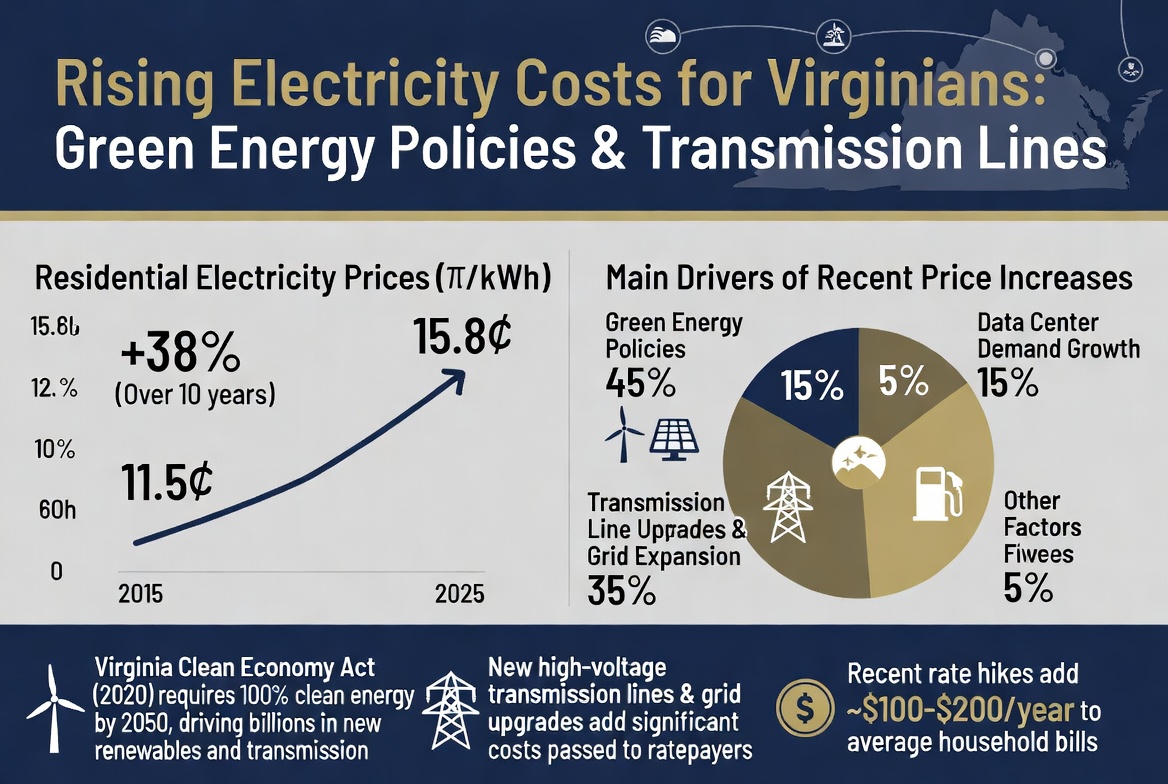
Virginia residential electricity prices have risen steadily. According to EIA data and state analyses:~2015–2016: roughly 11–12 ¢/kWh
2021: ~11–13 ¢/kWh (monthly averages)
2024–2025: 15–16 ¢/kWh (recent figures range 14–16 ¢/kWh depending on month/utility)
That represents roughly a 30–40% increase over the past decade, with sharper acceleration since 2021 (~13% year-over-year in some periods). Virginia rates remain below the national average (~17–18 ¢/kWh), but the gap is narrowing.
Causes? A mix. Data centers already consume ~25% of Virginia’s electricity and could reach 46% by 2030, driving massive grid upgrades and new generation needs (JLARC report). Utilities like Dominion cite data-center demand as a key factor in recent rate cases.
However, a Lawrence Berkeley National Lab study of 2019–2025 found data centers were not the primary driver nationally—grid infrastructure investments, natural gas prices, and storm recovery played bigger roles.
In Virginia, the Virginia Clean Economy Act (green energy transition) and coal/nuclear fleet dynamics are also debated factors. Data centers currently pay their full cost of service, but future system-wide costs are likely to be socialized to all ratepayers.
How Many More Are Coming?
Hundreds. Virginia has ~400–600 operating data centers (exact counts vary by source), with 200–300+ planned or under construction statewide. Major projects include multi-gigawatt campuses in Prince William, Loudoun, and emerging areas like the Shenandoah Valley. The pipeline could add tens of millions of square feet and double (or more) power demand in the coming decade.
Bottom Line
Data centers deliver jobs, tax revenue, and economic growth—but they also bring visible local impacts on air quality, noise, and the power grid. As AI demand pushes the industry forward, Virginia policymakers, utilities, and communities are wrestling with how to balance growth with livability and affordability. Newer Tier 4 generators, on-site renewables/batteries, and stricter permitting may help, but the diesel backup reality isn’t going away anytime soon.
Appendix: Sources and Links
- Washington Post (May 28, 2026): “As data centers boom, Virginians breathe the exhaust of 10,000 diesel generators” → https://www.washingtonpost.com/business/2026/05/28/data-centers-boom-virginians-breathe-exhaust-10000-diesel-generators/
- JLARC Report on Data Centers in Virginia (2024/2025 updates) → https://jlarc.virginia.gov/landing-2024-data-centers-in-virginia.asp
- Piedmont Environmental Council data center map & generator analysis → https://www.pecva.org/region/loudoun/existing-and-proposed-data-centers-a-web-map/
- EIA Electric Power Monthly (residential price tables) → https://www.eia.gov/electricity/monthly/
- Virginia Electricity Profile (EIA) → https://www.eia.gov/electricity/state/virginia/
- Better Data Center Project & Environment America reports on diesel generators
- Mordor Intelligence Northern Virginia Data Center Market Report (2026)
- Additional context from Synergy Research, Baxtel, and local DEQ permitting data
Energy News Beat – Delivering straight talk on energy, power, and the realities behind the grid.
The post Data Centers in Virginia Are Booming—and Using 10,000 Diesel Generators appeared first on Energy News Beat.