Energy News Beat
Greece has once again highlighted the practical and commercial limits of the European Union’s sanctions regime against Russian energy. As the world’s leading maritime nation, Athens successfully pressed for exemptions on restrictions targeting the shipping of Russian LNG to third countries in the latest (21st) sanctions package. Greek officials argued that broader bans would primarily harm European shipowners—particularly specialized ice-class LNG carriers operated by companies like Dynagas—while doing little to curb Russian export revenues, as non-EU competitors would simply step in.
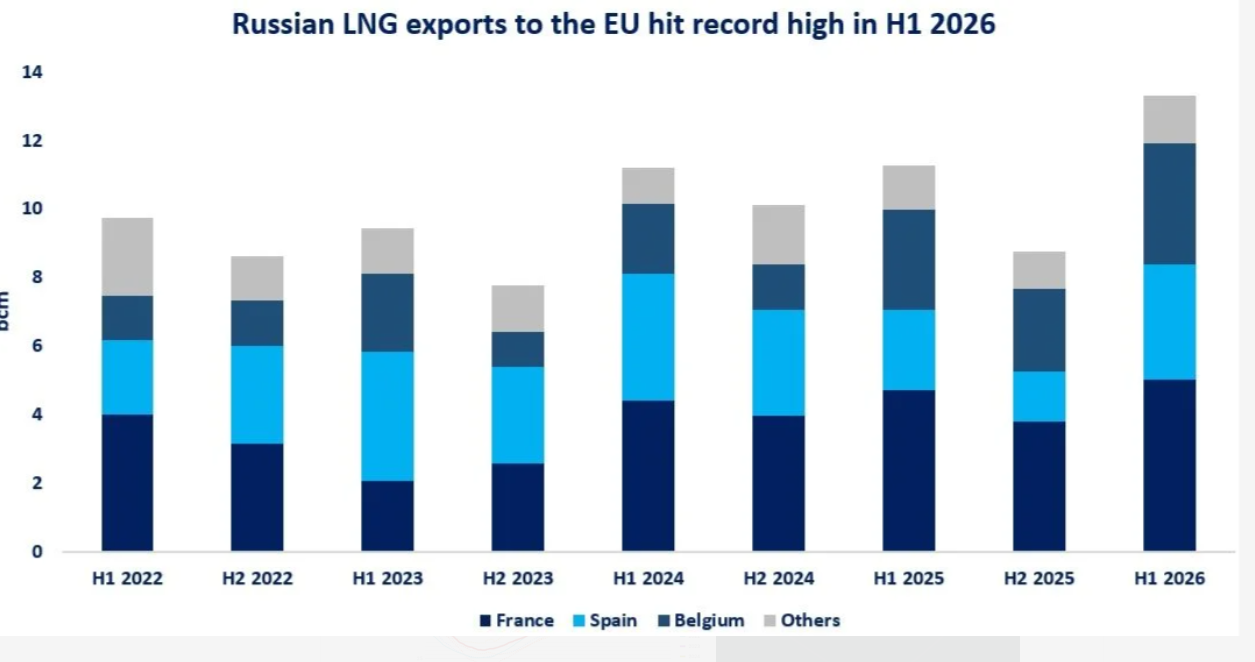
This stance underscores a deeper contradiction. While the EU has phased out most Russian pipeline gas and set a full ban on Russian LNG imports for January 1, 2027 (with earlier restrictions on new and short-term contracts), European buyers continue to absorb the overwhelming majority of available Russian LNG volumes. In the first half of 2026, the EU took approximately 97% of exports from Russia’s flagship Yamal LNG project—136 of 140 cargoes totaling 9.97 million tonnes out of a global 10.25 million tonnes—according to Kpler data analyzed by Urgewald. Asia (primarily China) received just four cargoes. This represented a 16% year-on-year increase in EU-bound volumes, with estimated payments of €5.96 billion. France, Belgium, and Spain accounted for the bulk of these imports.
These figures come close to (and in the case of Yamal, exceed) claims that Europe has taken around 90% of Russian LNG exports this year. Yamal remains the dominant source of Russian LNG reaching Europe; overall Russian seaborne LNG continues to flow heavily westward despite diversification efforts and higher transport costs to Asia.
The timing amplifies the pressure. European natural gas storage levels remain well below seasonal norms during the critical summer refill season. As of around July 21–22, 2026, EU storage stood at approximately 54% of capacity (around 615 TWh), significantly lower than the prior year and the five-year average (shortfalls of 10%+ year-on-year and larger versus historical norms have been widely reported). Injection rates have lagged, raising risks of missing comfortable end-of-October targets (even the more flexible 80% threshold looks challenging without stronger LNG inflows). Germany’s levels have been particularly low, near 45–46%.
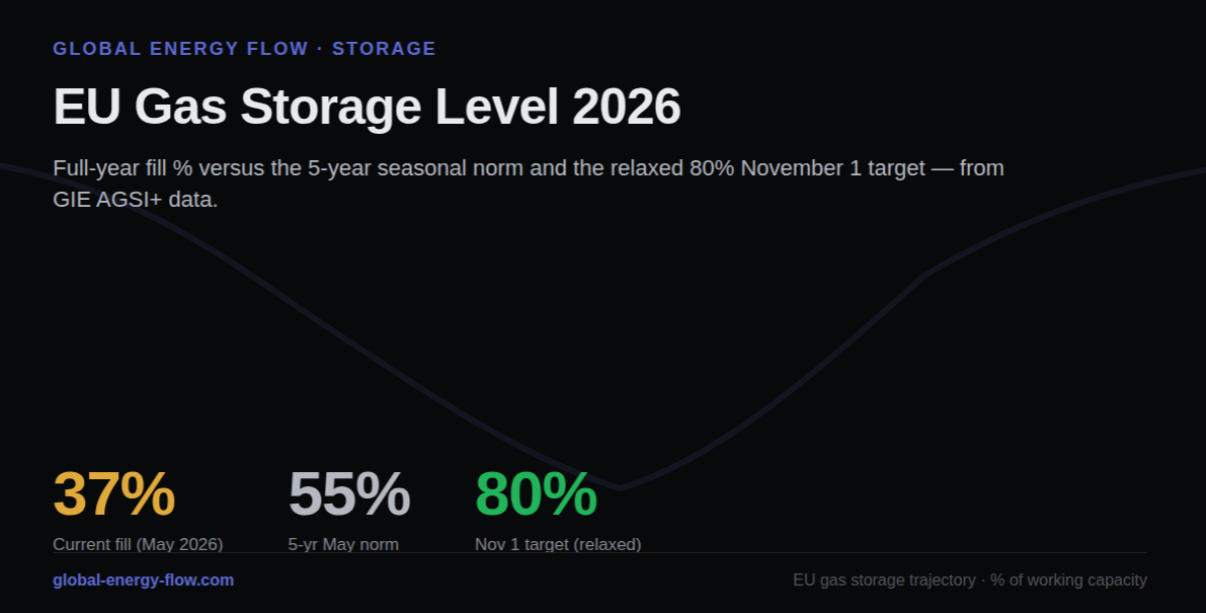
The timing amplifies the pressure. European natural gas storage levels remain well below seasonal norms during the critical summer refill season. As of around July 21–22, 2026, EU storage stood at approximately 54% of capacity (around 615 TWh), significantly lower than the prior year and the five-year average (shortfalls of 10%+ year-on-year and larger versus historical norms have been widely reported). Injection rates have lagged, raising risks of missing comfortable end-of-October targets (even the more flexible 80% threshold looks challenging without stronger LNG inflows). Germany’s levels have been particularly low, near 45–46%.
Compounding the tightness, QatarEnergy has extended force majeure declarations on LNG cargoes, with reports indicating disruptions and tanker chartering arrangements extending into mid-October 2026. This follows Iranian strikes that damaged capacity at Ras Laffan (removing ~17% of Qatar’s LNG output for years) and subsequent operational issues. Full normalization of Qatari supply—critical for Europe and Asia—is delayed, tightening the global LNG market further and increasing competition for available cargoes.
The combination of low storage, delayed Qatari volumes, and competition from recovering Asian demand makes affordable, reliable gas harder to secure at scale. Spot prices have already shown volatility. In this environment, the economic logic of cheaper pipeline Russian gas (where residual flows continue via certain routes) and continued reliance on Russian LNG under existing contracts becomes more apparent to market participants, even as political rhetoric emphasizes diversification and the 2027 ban. Long-term contracts and infrastructure realities mean Europe cannot simply switch off these supplies without cost or risk.
Greece’s intervention exposes the hypocrisy: sanctions are calibrated to avoid self-inflicted damage to European commercial strengths (shipping competitiveness), while the continent remains a primary buyer of Russian LNG volumes that help fund Moscow. Full isolation would require not just import bans but tighter controls on logistics, insurance, and third-country re-exports—measures that risk further commercial blowback and incomplete enforcement, as vessels can reflag and routes adapt. Until Europe accepts higher energy costs, accelerated domestic production/renewables, or genuine alternative supply scaling that matches winter demand without Russian volumes, the limits and selective application of the sanctions regime will remain visible.
What would fully “expose” or force a reckoning on this hypocrisy? Sustained high prices, storage shortfalls heading into winter 2026/27, or clear evidence that sanctions fail to reduce Russian revenues while raising European costs and ceding market share. Greece has simply made the commercial trade-offs explicit.
If you were to ask Yoda about this, he would respond, “Hypocrisy massive EU is ” spoken in his best voice imitation.
Appendix: Sources and Links
- OilPrice.com article: https://oilprice.com/Energy/Energy-General/Greece-Exposes-the-Limits-of-Europes-Russia-Energy-Sanctions.html
- Euronews coverage of Greek position and sanctions: https://www.euronews.com/my-europe/2026/07/17/shameless-greece-and-lng-emerge-as-major-roadblock-in-new-russia-sanctions and https://www.euronews.com/my-europe/2026/07/23/eu-agrees-new-sanctions-against-russia-as-greece-secures-lng-exemption
- Politico on sanctions package: https://www.politico.eu/article/greece-derail-eu-russia-sanctions-plan/
- Urgewald/Kpler analysis of Yamal LNG (H1 2026, 97% to EU): https://www.urgewald.org/en/media/eu-paid-estimated-eu596-billion-russian-arctic-lng-first-6-months-2026
- Related reporting: https://www.intellinews.com/russian-refining-down-to-record-lows-lng-exports-to-europe-at-record-highs-454508/ and https://europeangashub.com/russian-lng-imports-into-the-eu-hit-record-high-in-h1-2026.html
- AGSI+/GIE storage data and analyses: https://agsi.gie.eu/ (latest ~54% as of late July 2026); supporting reports from Energy Aspects, Carbon Pulse, ACER, Wood Mackenzie, and national trackers
- QatarEnergy force majeure extensions (into autumn/October reporting): Reuters/X reports and coverage such as https://www.agbi.com/oil-and-gas/2026/07/force-majeure-on-qatarenergy-lng-extends-to-fourth-month/ and related Bloomberg/Reuters references
- Additional context on EU LNG/Russian share: IEEFA European LNG Tracker, ACER reports, and Kpler-based analyses
Data current as of late July 2026 reporting; market conditions remain fluid.
The post Greece Exposes the Hypocrisy and Limits of Europe’s Russia Energy Sanctions appeared first on Energy News Beat.