Energy News Beat
In the wake of the ongoing 2026 Strait of Hormuz crisis, a growing number of tankers and commercial vessels are deliberately switching off their Automatic Identification System (AIS) transponders—commonly known as “going dark”—to navigate the world’s most critical energy chokepoint.
There is a difference between “Going Dark” and a Tanker in the Dark Fleet” – A Dark Fleet Tanker is used for avoiding sanctions, and Iran has about 289 Dark Fleet Tankers, and there are about 1584 Dark Fleet tankers that are self-insured and not using Lloyd’s of London or normal insurance carriers.
What was once a routine transit for roughly 130 ships per day carrying about 20% of global seaborne oil and significant volumes of LNG has been reduced to a fraction of normal levels, with only around 24 or fewer daily transits in recent weeks amid heightened geopolitical risks, attacks on shipping, and Iranian control assertions.

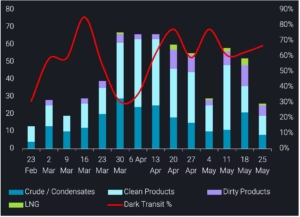
Maritime intelligence firm Vortexa has documented hundreds of dark transits through the Strait since March 1, 2026. In May alone, 65.2% of outbound laden vessels transited dark, up significantly from earlier months. Notably, the share of dark outbound-laden transits by non-Iranian operators rose from 37% in March to 56% in April, indicating that the practice is expanding beyond traditional sanctioned routes to include more conventional Gulf oil and product flows. This “dark activity” severely limits real-time visibility into cargo origins, destinations, and volumes, complicating global energy market analysis and sanctions enforcement.
Why Ships Are Going Dark
The primary drivers are security and commercial risks stemming from the U.S.-Iran tensions that escalated on February 28, 2026. Iran has asserted greater control over the Strait, leading to attacks on vessels, mine threats, and demands for transit “tolls” exceeding $1 million in some cases. Standard war-risk insurance from Western providers like Lloyd’s of London has become prohibitively expensive or unavailable, forcing many operators to either halt operations or seek alternative coverage.
Lloyd’s List Intelligence reports that shadow (or “dark/ghost”) fleet vessels—older tankers often flagged in obscure jurisdictions and insured outside traditional Western P&I clubs—now dominate the limited transits. These vessels, historically used to evade sanctions on Iranian (and previously Russian) oil, account for roughly 50-80% of recent tanker and gas carrier movements through the Strait. They frequently employ deceptive practices such as AIS blackouts, ship-to-ship (STS) transfers, and flag-hopping.
Cross-Checking Tanker Destinations, Loadings, and Fleet Status
Recent data from shipping trackers (Kpler, LSEG, Lloyd’s List, and UANI) shows that the few vessels successfully transiting—often dark—carry a mix of crude oil, petroleum products, and LNG primarily from Persian Gulf producers to Asian markets:
Eagle Veracruz (VLCC): Loaded ~2 million barrels of Saudi Arabian crude in late February at Ras Tanura (or similar Saudi terminal). Exited Hormuz with transponders off; destination Quanzhou, China (Fujian province). Not identified as a shadow fleet.
Nissos Keros (VLCC): Loaded ~1.8 million barrels of Das crude from the United Arab Emirates. Heading to Visakhapatnam, India (Hindustan Petroleum refinery). Transited dark.
Hua Lin Wan (COSCO-operated tanker): Loaded naphtha (refined product) from Kuwait in early March. Destination Huizhou, China (Guangdong province). Chinese-flagged; transited dark.
Broader patterns from Vortexa and Lloyd’s List confirm:
Primary destinations: Asia (China, India, and to a lesser extent Japan/South Korea), accounting for ~89% of historical Hormuz crude flows. Some Iranian crude routes involve STS transfers off Malaysia en route to China.
Loading countries/ports: Saudi Arabia (Ras Tanura), UAE (Das), Kuwait, Qatar (for LNG), and Iran (Jask terminal or offshore for shadow fleet). Pre-crisis, ~20 million barrels per day of oil/products and significant LNG (mostly Qatari) moved through the Strait.
Cargo mix: Crude oil (majority), petroleum products (e.g., naphtha), and LNG. Shadow fleet transits heavily feature Iranian-origin crude, while some non-shadow vessels carry compliant Gulf crude/products.
Are they part of the Dark/Ghost/Shadow Fleet?
Many—but not all—yes. The shadow fleet (also called ghost or dark fleet) consists of vessels insured by non-Western providers (often Russian, Chinese, or state-backed entities) rather than established Lloyd’s of London-affiliated clubs. These tankers specialize in sanctioned trades and routinely go dark to avoid detection. Lloyd’s List analysis shows they now comprise the majority of Hormuz transits, with UANI tracking dozens of Iranian ghost fleet tankers that have exited the Gulf laden with crude despite the crisis. However, recent examples like the Saudi- and UAE-loaded VLCCs above appear to be mainstream operators turning off AIS due to war risks rather than belonging to the traditional shadow fleet.
Chevron’s Perspective: Chartered Tankers and Insurance Realities
Chevron CEO Mike Wirth has repeatedly highlighted these challenges in recent interviews, including comments as recent as today. The company has six tankers operating under charter in the Persian Gulf. Because these vessels are owned by third-party companies (not Chevron), the decision to transit the Strait rests with the owners and their insurers—not Chevron.
Wirth emphasized concerns over crew and cargo safety, noting that expiring war-risk coverage and the threat of attacks make transits untenable for most commercial operators. Chevron refuses to pay any Iranian-imposed tolls, upholding freedom of navigation principles, and is exploring pipeline alternatives while awaiting U.S. naval escorts or improved security.
Wirth warned that physical oil shortages are already emerging globally as surplus stocks and shadow fleet capacity are absorbed, with economies (especially in Asia) facing slowdowns if flows remain constrained.
Outlook and Implications
As fragile ceasefires are negotiated and U.S. forces attempt to restore safe passage, the rise in dark transits underscores the Strait’s vulnerability. Reduced visibility hampers market transparency, sanctions enforcement, and insurance assessments. While shadow fleet operators continue to move Iranian oil to China, even compliant Gulf producers are increasingly forced into the darkness to keep supplies flowing.
The Energy News Beat Channel will continue monitoring AIS data, Vortexa insights, and Lloyd’s List reports for updates on this fluid situation.
- Vortexa Insights on Dark Hormuz Transits (referenced via analysis and team cross-checks; original at https://www.vortexa.com/insights/dark-hormuz-transits).
- Reuters: “Three oil, LNG tankers exit Hormuz with transponders off” (May 28, 2026) – https://www.reuters.com/business/energy/three-oil-lng-tankers-exit-hormuz-with-transponders-off-2026-05-28/.
reuters.com
- Bloomberg / Independent: Chevron CEO comments on six chartered tankers (May 29, 2026) – https://www.the-independent.com/news/world/middle-east/chevron-ceo-mike-wirth-strait-hormuz-b2986026.html.
the-independent.com
- Lloyd’s List: Shadow fleet dominates Hormuz crossings – https://www.lloydslist.com/LL1156563/Shadow-fleet-dominates-Hormuz-crossings-as-Iran-ramps-up-bypass-loadings.
lloydslist.com
- Atlantic Council: Shadow fleet report (April 22, 2026) – https://www.atlanticcouncil.org/in-depth-research-reports/the-shadow-fleet-is-undermining-the-maritime-order-more-brazenly-than-ever/.
atlanticcouncil.org
- U.S. Energy Information Administration (EIA): World Oil Transit Chokepoints – https://www.eia.gov/international/analysis/special-topics/world_oil_transit_Chokepoints.
eia.gov
- Additional context from Lloyd’s List Intelligence, Kpler, UANI Ghost Fleet tracking, and public Chevron statements (May 2026).
All data cross-verified as of May 29, 2026. Energy markets remain highly sensitive to developments in the Strait of Hormuz.
The post Tankers and Ships Going Dark to Transit the Strait of Hormuz appeared first on Energy News Beat.