Energy News Beat
In a sharp escalation of regional conflict, Saudi Aramco’s critical oil infrastructure has come under direct assault, with drone and missile strikes hitting key facilities on the kingdom’s eastern and western coasts. Combined with a pullback by major marine insurers at Lloyd’s of London on wartime coverage for Saudi-linked tankers in the Red Sea, these events threaten to remove substantial volumes of both crude oil and refined products from global markets.
The Latest Strikes on Aramco Facilities
On July 25, 2026, Yemen’s Houthis (Ansar Allah) claimed responsibility for missile and drone strikes on the Aramco Jazan (Jizan) refinery complex on Saudi Arabia’s Red Sea coast. The attack ignited fires at the facility, with thick smoke and ongoing blazes confirmed by ground videos, AFP verification, and satellite data including NASA FIRMS imagery showing hotspots at storage tanks and pipelines through July 26–27. Saudi civil defense issued alerts and evacuated ships from the nearby port. The Jazan refinery, a major Aramco project, has a processing capacity of 400,000 barrels per day (bpd) of crude into products including gasoline, ultra-low sulfur diesel, benzene, and paraxylene. Houthi statements framed the strikes as retaliation for Saudi actions in Yemen. Claims also referenced impacts or related targeting near Yanbu.
Then, on July 27, 2026, drones struck Saudi Aramco’s Abqaiq facility—the world’s largest crude oil stabilization plant—along with the East-West Pumping Station. Reports describe a massive fire, with NASA FIRMS satellite imagery confirming extensive fire activity. Saudi Arabia blamed Iran-backed resistance groups in Iraq, initiated emergency flaring at multiple production sites, and reserved the right to respond. Abqaiq processes and stabilizes the bulk of Saudi crude (removing hydrogen sulfide and preparing it for transport or refining), with a capacity of up to 7 million bpd—historically accounting for more than half of Saudi output and roughly 5–7% of global oil supply.
These follow earlier 2026 incidents, including a March drone strike on the Ras Tanura refinery (capacity ~550,000 bpd), which prompted a precautionary shutdown, and other reported hits on facilities such as SAMREF in Yanbu and processing sites affecting LPG and NGLs.
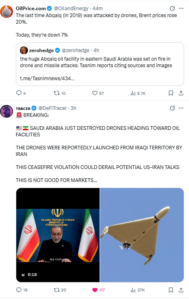
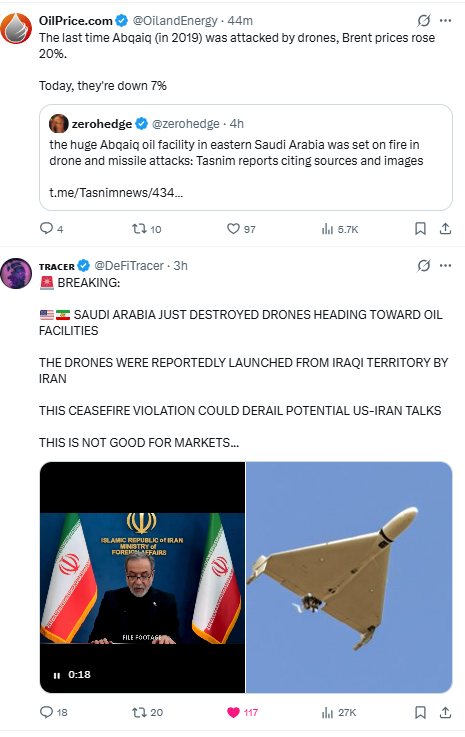
From OilPrice.com: “The last time Abqaiq (in 2019) was attacked by drones, Brent prices rose 20%; today they are down 7%.
Potential Oil Offline: Crude and Refined Products
Exact outage volumes depend on the severity and duration of damage, which remain under assessment as of the latest reports. However, the scale of the targeted assets points to significant risk:
- Abqaiq and associated infrastructure: A major disruption here mirrors the 2019 Abqaiq-Khurais attacks, which temporarily took ~5.7 million bpd offline (over half of then-Saudi production). Emergency flaring already signals production cutbacks. Even partial damage to stabilization capacity or the East-West Pumping Station (critical for moving crude west via the East-West Pipeline) could idle millions of barrels per day of crude that would otherwise be shipped or refined. The pipeline itself has a nameplate capacity of around 7 million bpd.
- Jazan refinery: Full or prolonged offline status removes up to 400,000 bpd of refined products (diesel, gasoline, and others) from the market. Storage tank and pipeline fires raise the prospect of extended downtime beyond simple processing unit damage.
Saudi crude production has already been constrained in 2026 amid broader regional conflict (figures around 6.5–7 million bpd in recent months, well below pre-conflict capacity near 12 million bpd). Exports have shifted heavily toward Red Sea outlets as an alternative to the Strait of Hormuz. Any sustained Abqaiq or pipeline impact compounds existing reductions in shipped crude. Refined product shortfalls would tighten regional and global product markets more immediately due to lower inventory buffers compared with crude.
Lloyd’s of London and the Red Sea Insurance Freeze
Compounding the physical attacks, major marine insurers in the Lloyd’s of London market have restricted or suspended war-risk insurance for Saudi-linked vessels and cargoes in the Red Sea. Reports indicate underwriters (including references to Ascot and Navium) notified brokers they will not sell new war cargo coverage for ships with “Saudi touchpoints”—including Saudi-flagged, owned, or operated vessels, those en route to/from Saudi ports, or even foreign-flagged ships that previously docked at Saudi facilities. Some existing policies face cancellation.
This follows Houthi announcements of a naval blockade targeting Saudi ports, attacks on Saudi tankers near Jizan, and elevated war-risk premiums (which had already risen sharply, in some cases to 0.75–3% of vessel value depending on the southern Red Sea route). Without war-risk cover, commercial tankers generally cannot operate: letters of credit, port entry, and financing become problematic. The practical effect is a near-blockade on loadings from Saudi Red Sea terminals such as Yanbu and Jizan.
How Much Does the Insurance Pullback Remove?
Saudi Arabia has leaned heavily on the Red Sea route as a Hormuz bypass. The East-West Pipeline can move up to ~7 million bpd westward; a substantial portion supplies domestic western refineries and petrochemicals, with the balance exported primarily from Yanbu. Loadings from Red Sea terminals rose dramatically earlier in 2026—quadrupling at points to around 4 million bpd of crude (with peaks reported near or above that level and Yanbu handling the bulk). Additional large volumes of refined products (diesel, gasoline, jet fuel, naphtha, fuel oil, LPG) and petrochemicals also move through these ports.
If insurance remains unavailable, the bulk of these Red Sea crude exports (potentially 3–5 million bpd depending on current utilization) plus associated refined products become effectively stranded or forced into costly, longer workarounds (e.g., limited SUMED pipeline capacity of ~2.3–2.5 million bpd, Cape of Good Hope reroutes adding weeks and higher costs, or reliance on remaining Gulf options under separate constraints). Combined with physical damage risks at Abqaiq/Jazan, the net removal from the market could easily reach several million barrels per day of crude plus hundreds of thousands of barrels of products—amplifying tightness already evident from earlier 2026 disruptions.
Markets have so far shown muted immediate price reactions in some reports, but the dual pressure of infrastructure attacks and insurance withdrawal removes a key contingency route that Saudi Arabia and global buyers had counted on. Further damage assessments, repair timelines, alternative insurance arrangements (or state self-insurance), and any military responses will determine the duration and ultimate scale of the outage.
Energy News Beat will continue monitoring satellite imagery, official Saudi statements, tanker tracking, and insurance market developments.
Appendix: Sources and Links
- Hormuz Letter X post (primary on Abqaiq, July 27, 2026): https://x.com/HormuzLetter/status/2081737513983467753
- Reports on Jazan/Houthi attack (July 25, 2026): Militarnyi, Ansarollah claims, NASA/FIRMS and satellite references via various aggregators; Facebook/verified video reports (e.g., Maryam Ishani posts).
- Jazan refinery capacity: Aramco/Americas.Aramco, SaudiPedia, MEES (400,000 bpd).
- Abqaiq capacity and historical context: EIA, Wikipedia (Abqaiq–Khurais), Bloomberg/WSJ historical (up to 7 million bpd; 2019 disruption ~5.7 million bpd).
- Lloyd’s/insurance restrictions: Financial Times reporting (July 2026), Yemen Press Agency, Hodhod Yemen News, Insurance Journal/Reuters on premiums and Houthi blockade effects.
- Red Sea/Yanbu/East-West volumes and capacity: OilPrice.com analysis, GCaptain/Bloomberg (quadrupling to ~4 million bpd), Reuters, BNEF, Lloyd’s List.
- Broader production/export data: Trading Economics, Reuters/JODI, IEA Oil Market Report (July 2026).
- Earlier 2026 incidents (Ras Tanura etc.): Reuters, Al Arabiya, ICIS.
All figures on potential offline volumes are estimates based on nameplate capacities and historical precedents; actual realized outages will depend on damage extent and operational responses.
The post Saudi Arabia Under Attack – What does this mean to the Oil Markets? appeared first on Energy News Beat.