Energy News Beat
In late June 2026, President Donald Trump publicly singled out ExxonMobil, Chevron, Shell, and BP, accusing the “big Oil Companies” of failing to lower gasoline prices at the pump in line with falling crude oil costs. In comments to the media and on Truth Social, he argued that with oil prices dropping sharply, Americans should be paying around $2.25 per gallon, and that drivers were being “gouged.” He instructed the Department of Justice to investigate.
The frustration over pump prices is understandable.
Drivers feel every swing at the station. But before launching investigations into alleged price gouging, it would be wise to examine the real, often underappreciated costs of operating U.S. refineries—especially when they are running at the high utilization rates that keep fuel flowing to American families and businesses.
U.S. refiners have been operating near the upper limits of their capacity. Weekly utilization rates have frequently hovered in the mid-to-high 90s percent range in 2026, well above long-term averages. These high run rates are not a sign of excess profits or market manipulation; they reflect an industry working hard to meet strong demand while navigating geopolitical disruptions, inventory dynamics, and the inherent complexities of turning crude into gasoline, diesel, and other products.
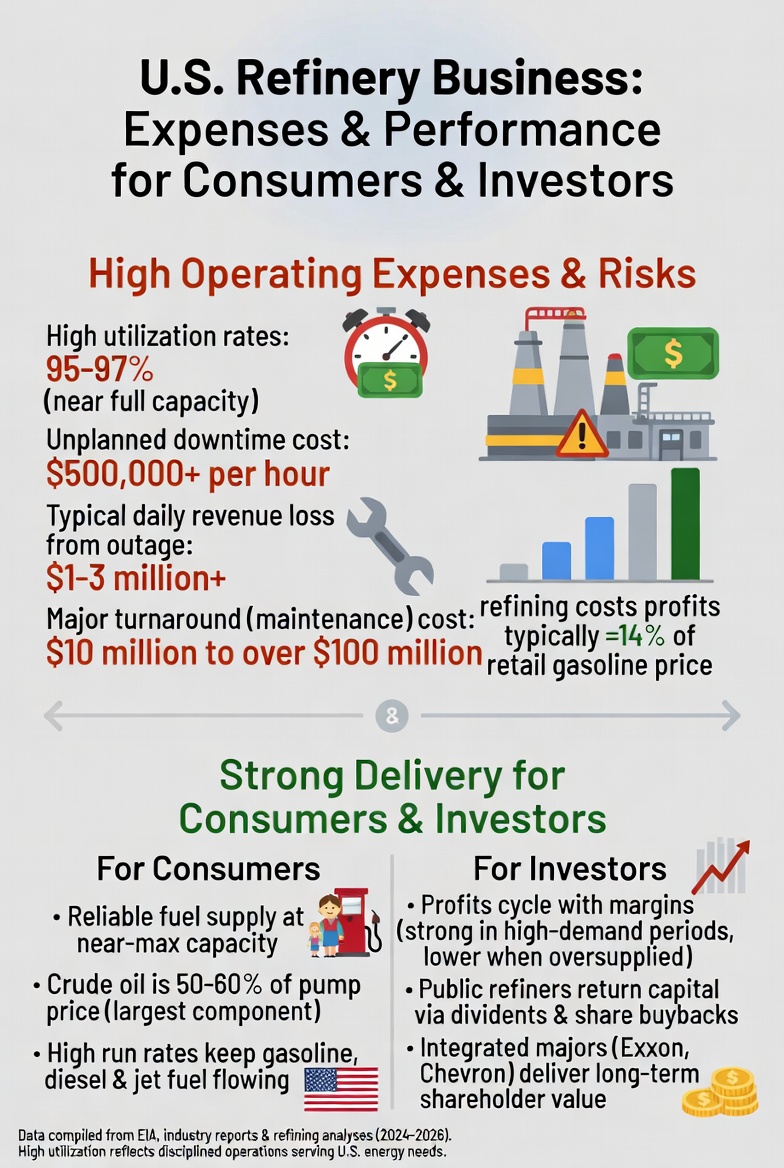
Running a modern refinery at high utilization is capital-intensive, technically demanding, and financially risky. Unplanned downtime in oil and gas refining commonly costs $500,000 or more per hour in lost production alone. For a typical mid-sized facility processing 150,000–200,000 barrels per day, daily revenue losses from an outage can easily reach $1–3 million or higher, depending on prevailing margins. A single major unit turnaround can cost tens of millions of dollars in direct expenses, with delays adding $1–3 million per day in lost opportunity. Large-scale turnarounds routinely exceed $100 million when factoring in labor, materials, contractors, and lost production.
These figures are not abstract. Planned maintenance on key units such as fluid catalytic crackers or crude distillation columns occurs every three to five years and requires years of advance planning, thousands of specialized contractors, and weeks or months offline. High sustained run rates increase mechanical stress and wear, raising the risk of unplanned events and the eventual cost of deferred maintenance. When utilization is already near 95–97 percent, there is little spare capacity in the system. An outage does not just hurt the individual refinery—it tightens overall supply and can amplify price responses in the market.
Gasoline prices at the pump do not move in perfect lockstep with crude oil for several well-documented reasons. Crude is typically the largest but not the only component of the final retail price. Refining costs, transportation, distribution, marketing, state and federal taxes, seasonal blend requirements, and inventory lags all play roles. Stations often sell fuel purchased days or weeks earlier.
Refining margins (crack spreads) can expand or contract based on product demand, inventory levels, and global supply disruptions—factors that have been elevated at times due to events affecting refining capacity and product flows elsewhere in the world. The American Petroleum Institute has correctly noted that retail fuel prices “don’t move in lockstep with crude oil,” particularly during periods of disruption affecting supply, refining, and inventories.
Far from being villains, U.S. refiners deserve recognition for fiscal responsibility and reliable service under challenging conditions. They operate some of the most complex industrial facilities on the planet, manage enormous capital investments, maintain rigorous safety and environmental standards, and keep products moving even when margins are volatile and geopolitical risks are high. By running at high utilization rates, delaying some non-critical maintenance where safe and feasible, and optimizing operations, they have helped supply both domestic and international markets. This is not gouging—it is disciplined management of a high-stakes business that underpins modern life.
Investigations into pricing practices can serve a legitimate purpose if evidence of true collusion or illegal behavior emerges. But starting from the premise that any lag between crude declines and pump-price declines equals misconduct overlooks the operational realities and the substantial costs refiners must recover to remain viable. Understanding those costs—downtime expenses measured in hundreds of thousands of dollars per hour, multi-million-dollar daily opportunity losses, and massive turnaround budgets—provides essential context.
American refiners are delivering a vital service: keeping the nation’s transportation, agriculture, manufacturing, and emergency response systems fueled. They do so while navigating high utilization demands, equipment reliability challenges, and market volatility. That performance merits congratulations for fiscal responsibility and operational excellence, not premature suspicion.
Policymakers who take the time to examine the true costs of refining will be better positioned to craft policies that support affordable, reliable energy rather than inadvertently discouraging the very investments that keep supply strong.
The real cost to consumers is the overreaching government policies.
- OilPrice.com – “Trump Singles Out Exxon, Chevron, Shell, and BP Over High Gas Prices” (June 25, 2026): https://oilprice.com/Latest-Energy-News/World-News/Trump-Singles-Out-Exxon-Chevron-Shell-and-BP-Over-High-Gas-Prices.html
- Reuters / related coverage of Trump’s DOJ investigation comments (June 2026).
- American Petroleum Institute statements on gasoline price dynamics and response to the investigation (via contemporaneous reporting).
- EIA data on U.S. refinery utilization rates (weekly and monthly series, 2026).
- Industry analyses of unplanned downtime costs in oil & gas/refining (including estimates of $500,000+ per hour and multi-million daily losses).
- EIA report “Refinery Outages: Description and Potential Impact on Petroleum Product Prices” (2007) – detailed discussion of turnaround costs, lost revenue examples (e.g., Valero St. Charles FCC turnaround), and utilization effects: https://www.eia.gov/analysis/requests/2007/sroog200701.pdf
- Additional reporting and data on refining margins, inventory lags, and why pump prices adjust asymmetrically to crude oil changes (various industry and Federal Reserve analyses).
- Prior detailed discussion of high-run-rate downtime, revenue loss, and maintenance economics compiled from industry sources including EnerStar Solutions, MaxGrip, Aberdeen Group references, and refining sector reports.
The post President Trump Should Look at the Refinery Costs Prior to Ordering an Investigation appeared first on Energy News Beat.