Energy News Beat
Wind and solar are key, but not in existing grid deployments. This article was first run on the Energy News Beat Substack.
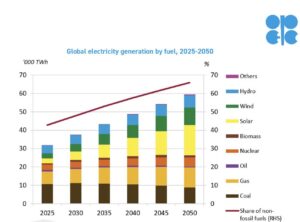
Global electricity generation is set for a massive expansion. According to OPEC’s World Oil Outlook (matching the chart data for 2025–2050), total generation rises from about 32,017 TWh in 2025 to roughly 59,500 TWh by 2050—an increase of more than 85%.
The accompanying OPEC chart, “Global electricity generation by fuel, 2025-2050,” illustrates the scale and the shifting mix. Stacked bars climb steadily while the non-fossil share (right-hand axis) trends upward from the low-to-mid 40% range toward the mid-to-high 60s by mid-century.
Coal remains a large absolute contributor early on but declines in both volume and share. Gas grows in absolute terms. Nuclear expands modestly. Solar and wind deliver the bulk of the incremental supply, with hydro also rising. Oil stays marginal.
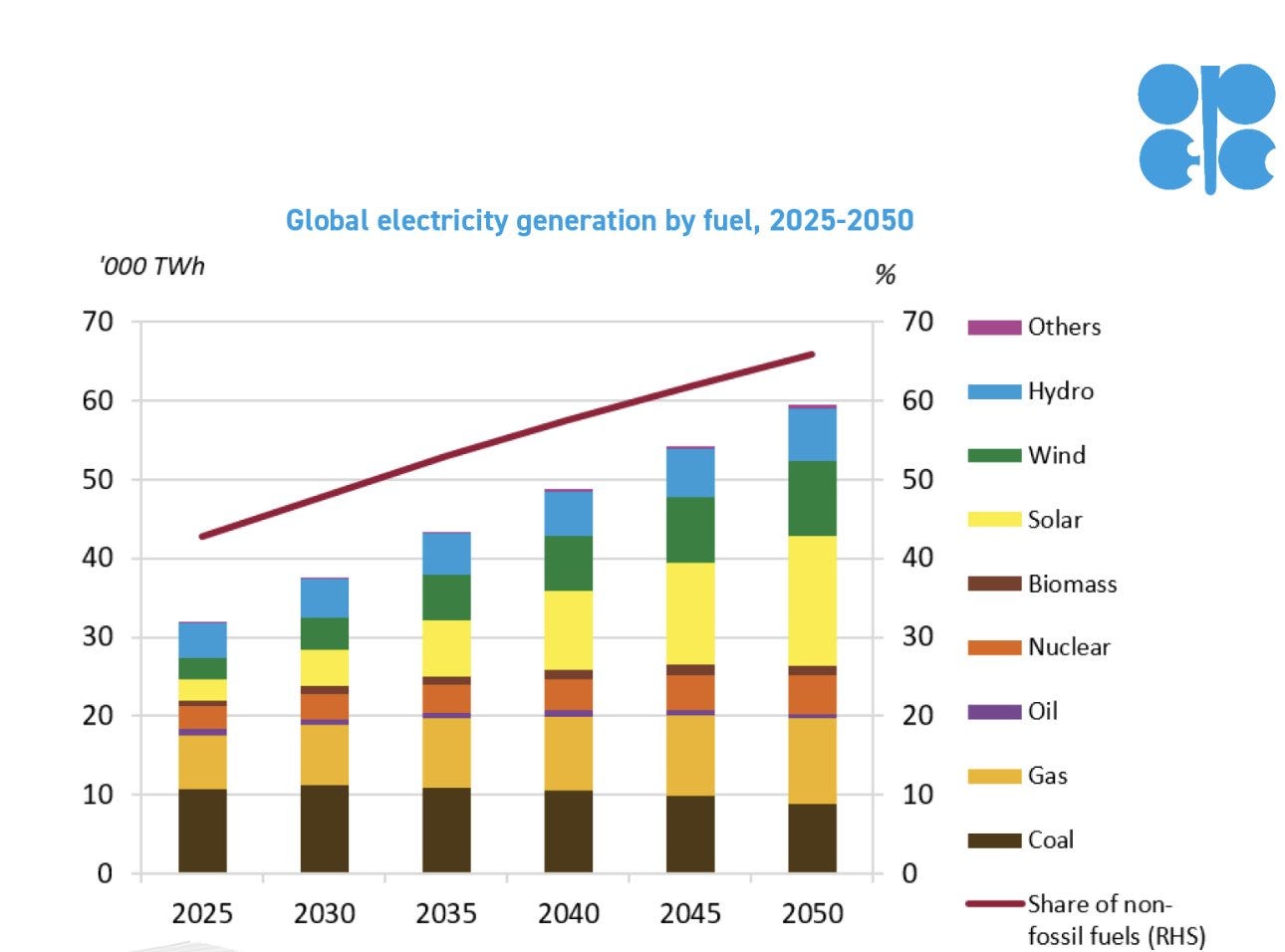
Exact figures from the Outlook’s generation table (TWh) show the trajectory:
- Coal: 10,758 (2025) → 8,904 (2050)
- Gas: 6,782 → 10,728
- Oil: 781 → 620
- Nuclear: 2,860 → 4,875
- Solar: 2,667 → 16,355
- Wind: 2,746 → 9,628
- Hydro: 4,458 → 6,644
- Biomass: 816 → 1,294
- Others: 149 → 426
Renewables (including hydro and biomass) rise from roughly 34% to nearly 58% of the mix. The surge is driven by residential/commercial demand, industry, transport electrification, and especially data centers and AI—sectors that require reliable, high-volume power around the clock.
Roughly 75% of the growth occurs in developing countries, with nearly 60% concentrated in developing Asia. Regional final electricity consumption projections underscore this: India grows at ~4.6% annually, Other Asia at ~4.1%, Africa at ~4.2%, while OECD regions expand more modestly (1.4–2.2%). China remains the largest single market but grows more slowly than South and Southeast Asia.
Energy density and the cost of the mixThe challenge is not merely adding terawatt-hours; it is doing so affordably and reliably. Energy (or power) density—watts delivered per square metre of land or infrastructure—matters enormously for both cost and feasibility.
Nuclear power typically delivers power densities of hundreds of watts per square metre (often cited in the 100–1,000+ W/m² range when including the plant footprint). Modern gas and coal plants also achieve high densities (hundreds of W/m²). Hydro can be dense at the dam site but low overall once reservoirs are counted. Utility-scale solar photovoltaic systems generally fall in the 4–10 W/m² range once spacing and access are included; wind is lower still (commonly 0.5–1.5 W/m² or less when accounting for turbine spacing).
Low-density intermittent sources require far more land, materials, transmission lines, and—critically—backup capacity or storage to deliver firm power. When system-level costs (overbuilding, batteries, grid reinforcements, curtailment, and firming with gas or other dispatchable plants) are included, the all-in cost of a high-variable-renewable system rises sharply. Consumers ultimately pay those costs through higher electricity prices, reliability risks, or both.
Dense, dispatchable sources—nuclear for baseload, gas for flexible firming, and hydro where geography allows—deliver more energy per unit of capital, land, and materials. Prioritising them keeps the overall system cheaper and more resilient.
An over-reliance on the lowest-density options without commensurate investment in dense firm power risks exactly the outcome the headline warns against: costs for consumers through the roof.
Regional priorities and needs
Demand growth is highly uneven, so the optimal mix varies by geography, existing infrastructure, resource endowments, and development stage.
Developing Asia (India, Other Asia, and still-substantial Chinese demand) accounts for the largest absolute growth. Rapid industrialization, urbanization, and data-center build-out demand firm power.
Nuclear expansion (including small modular reactors), natural gas, and hydro should form the backbone. Coal will decline more slowly here than in OECD markets because of existing fleets and affordability needs; pairing it with efficiency and eventual carbon management is pragmatic. Solar and wind can scale where land and grid conditions allow, but they must be backed by dense sources to avoid price spikes and blackouts.
Africa needs both rapid energy access and industrial power. Hydro potential remains significant in several basins. Gas (domestic or imported) and nuclear (especially SMRs suited to smaller grids) offer dense, scalable options. Solar is abundant and useful for distributed access, but continent-wide reliability for industry and cities requires firm capacity.
Middle East already has strong gas resources and is adding solar and nuclear. Gas remains the flexible workhorse; nuclear provides long-term baseload; solar complements daytime demand. Oil’s role in power continues to shrink.
Latin America benefits from substantial existing and potential hydro. Gas and nuclear can fill gaps and support growth in industry and data centers. Biomass also plays a regional role.
OECD Americas, Europe, and Asia-Pacific see more moderate growth, heavily influenced by data centers and electrification. Nuclear restarts and new builds, gas for flexibility, and existing hydro form the most cost-effective core. High penetrations of wind and solar are already straining grids and prices in several markets; further expansion without dense firming capacity risks elevating consumer costs further.In every region the principle holds: the more the system leans on low-density intermittent generation without matching dense, dispatchable capacity, the higher the total system cost becomes.
OPEC’s Outlook itself stresses that all energy sources and technologies will be required. The practical implication is clear—maximize the contribution of the densest, most reliable options first. That path delivers the required doubling-plus of electricity supply at the lowest cost and highest reliability for consumers worldwide.
Not every area on the planet needs the same power source.
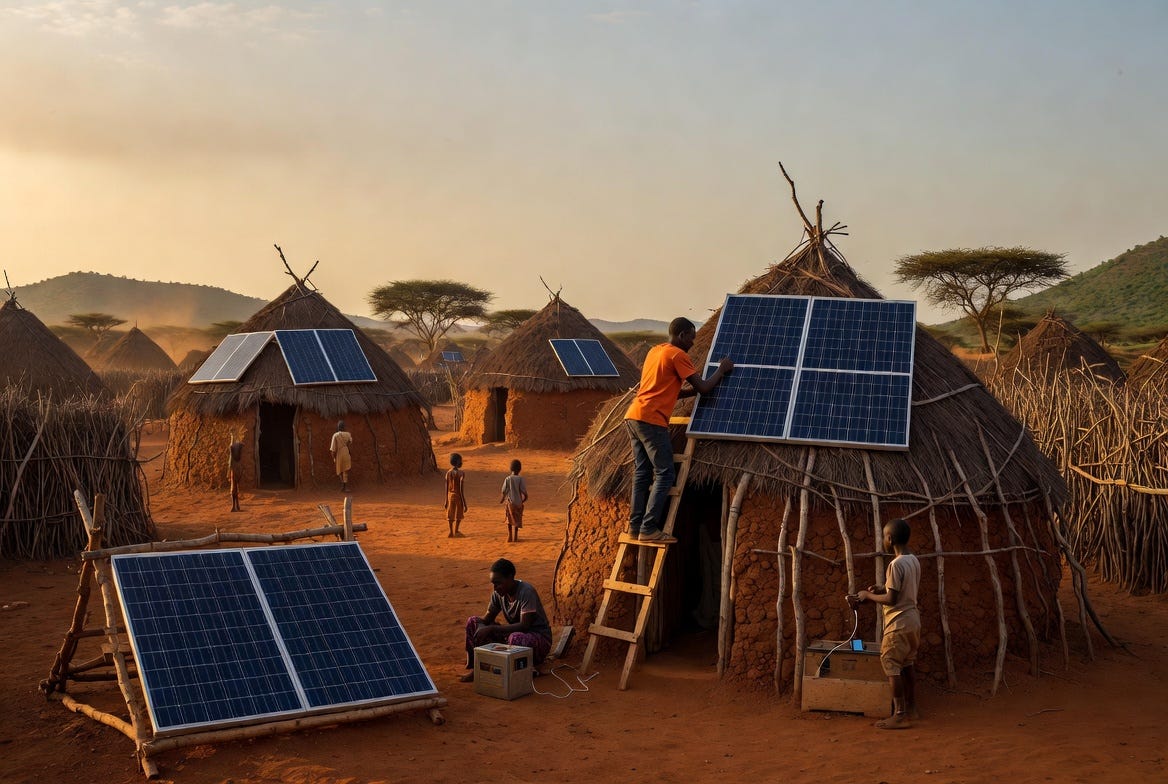
This is where smaller edge deployment with no grids already in place will have a huge solar advantage. One size does not fit all on the grid. The Blue states thinking that wind and solar should be rolled out at scale need to look at life without subsidies, and only roll out wind and solar where they are the edge projects, and not the main grid enterprise agents.
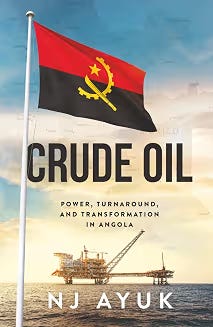
I am working to interview NJ Ayuk JD about his new book “Crude Oil”. We are just getting the calendars right. Africa needs huge natural gas build-outs in the main areas, and lower-cost deployments, but the International Monetary Fund only seems to loan money for Chinese wind and solar projects that do not build a resilient grid. It does not seem fair that the West has had 100 years to build out a grid, but we are forcing them to do what does not work at scale. – Just does not make sense.
Resource nationalism and energy poverty have long plagued Africa. In this well-researched work, NJ Ayuk, Chairman of the African Energy Chamber, presents Angola as a model of reform.
He shows how African nations can apply free-market principles to their oil and gas industries. These reforms aim to attract investment, boost energy exploration, reform institutions, encourage local entrepreneurship, and address unreliable electricity and unsafe cooking fuel.
The complications and additional costs to the grid are underreported, and one of the key reasons we need to realign the Levelized Cost of Electricity to the Levelized Cost of Energy. We are working on more articles on this.
We need to deliver the lowest kWh to everyone on the planet with the least impact on the environment. So let’s use wind and solar at the edge, and not build the backbone under our current technology. Our Blue States have forgotten how to ask experts who are not paid by the lobbyists. – just saying.
We are about to see a global energy crisis due to the constriction of oil and LNG, fertilizer, and all of the refined products.
It is about to get messy, and as Todd Royal, Author, and Nuclear Expert, just said, “If we spent the $10.3 trillion on wind and solar, the US could have had 174 new nuclear reactors, and 1,700 to spread around the world”. -Todd Royal.
NJ Ayuk is the Chairman of the African Energy Chamber, and he does not want handouts, but rather low-cost energy to help build industry so that we can eliminate energy poverty for everyone.
I am with NJ, and let’s also eliminate handouts for power companies putting wind, solar, and storage on an existing grid.
So when we look at the natural park systems and don’t question why we should not feed the bears because they get fat and lazy, shouldn’t we do the same to energy companies?

Thank you to all of our great subscribers, patrons, and sponsors!
Oh, and meet Kelo Watt – the Energy News Beat Buffalo –
This is what I would like to do to subsidize additional costs imposed on consumers.

Appendix: Sources and Links
- OPEC World Oil Outlook (interactive chapter with generation table and regional demand data): https://publications.opec.org/woo/chapter/157/2942
- OPEC World Oil Outlook main page and downloads: https://www.opec.org/world-oil-outlook.html and https://publications.opec.org/woo
- OPEC World Oil Outlook 2025 PDF references: https://www.opec.org/assets/assetdb/woo-2025.pdf (and related asset links)
- Our World in Data – Land use of energy sources per unit of electricity: https://ourworldindata.org/land-use-per-energy-source
- Supporting power-density comparisons (Vaclav Smil and related analyses): various academic and review sources synthesising median power densities for nuclear, fossil, solar, and wind (typically nuclear and thermal plants orders of magnitude higher than wind/solar on a system basis)
- Additional regional and demand context drawn from OPEC Outlook tables on final electricity consumption by region and sector (including data centres/AI).
The chart referenced in this article is the OPEC figure “Global electricity generation by fuel, 2025-2050.” All projections are taken directly from the cited OPEC materials.

The post OPEC Report says global electricity demand is projected to rise from 32 TWh in 2025 to 60K TWh by 2050 appeared first on Energy News Beat.