Energy News Beat
Global oil markets are navigating heightened volatility as geopolitical tensions, ongoing conflicts, militant attacks, environmental constraints, and regulatory hurdles converge on several of the world’s most critical maritime and pipeline chokepoints. Brent crude prices have shown sharp swings, with peaks well above $90 during periods of acute disruption (including levels around or exceeding $94 in volatile trading) before moderating amid partial recoveries.
These pressures are forcing rapid adaptations in shipping routes, insurance costs, and national energy strategies, while accelerating long-term efforts to diversify away from vulnerable single points of failure.
Strait of Hormuz: The World’s Most Critical Oil Artery Under Recent Siege
The Strait of Hormuz, between Iran and Oman, normally handles around 20–21 million barrels per day (bpd) of crude oil, condensate, and products — roughly 20% of global petroleum liquids consumption and about a quarter of seaborne oil trade.
In early 2026, the US-Iran conflict (beginning late February) led to severe disruptions, with flows dropping dramatically or halting at times as Iran effectively restricted or threatened passage. Post-ceasefire agreement in mid-June 2026, shipments have rebounded in surges — at times reaching 4.8–20 million bpd in 24-hour periods — but remain below pre-war baselines and face lingering risks from incidents and uncertainty.
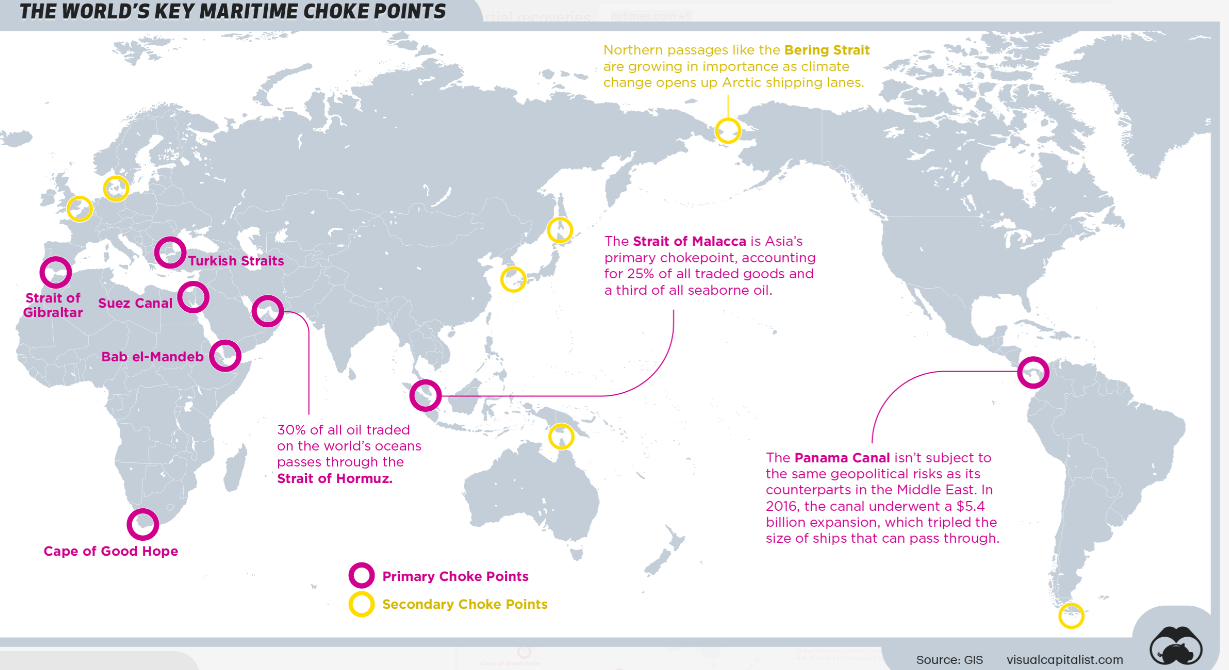
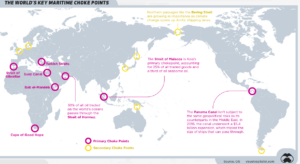
Global maritime chokepoints map highlighting the Strait of Hormuz, Suez Canal/Bab el-Mandeb, Panama Canal, and others. (Source: Visual Capitalist / GIS data)
Alternative pipelines (Saudi East-West, UAE’s Habshan-Fujairah, and others) can bypass part of the flow (combined capacity ~7 million bpd), but the majority remains exposed.
Bab el-Mandeb Strait and Suez Canal: Persistent Red Sea Disruptions
Houthi attacks in the Red Sea, ongoing since late 2023, have halved or more oil and product flows through the Bab el-Mandeb Strait and Suez Canal/SUMED pipeline corridor.
- Bab el-Mandeb: ~4.2 million bpd in the first half of 2025 (down sharply from ~9.3 million bpd in 2023).
- Suez Canal + SUMED: ~4.9 million bpd in 1H 2025 (down from ~8.8 million bpd in 2023).
Many operators reroute around the Cape of Good Hope, adding 10–14 days and significantly higher fuel, insurance (war risk premiums), and freight costs. LNG transits through the Red Sea have been almost entirely eliminated.
These disruptions have persisted into 2025–2026 with periodic renewed attacks, keeping traffic well below pre-crisis norms.
Panama Canal: Drought Recovery but Lingering and New Pressures
The Panama Canal, which carries ~2.3 million bpd of petroleum liquids (mostly refined products, with some crude and LNG) in FY2025, faced severe drought-related restrictions in 2023–2024 that slashed transits.
By 2026, water levels in Gatún Lake recovered strongly (near or above historical highs in early periods), allowing higher drafts and more daily slots. However, overall transits remain below pre-drought peaks, with LNG carriers particularly slow to return — down as much as 73% or more in some periods due to a structural shift to the longer Cape route for predictability.
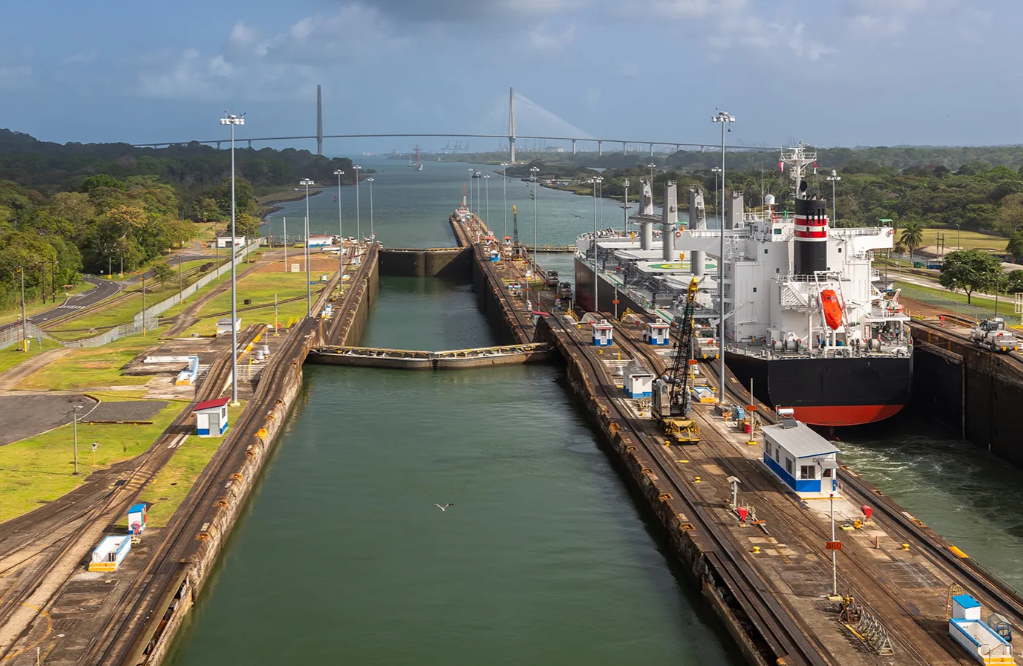
Panama Canal transit scene showing vessels in the locks. Water management remains a recurring concern amid seasonal dry periods and potential climate influences.
Increased demand for alternative routes during Hormuz disruptions temporarily boosted some traffic, but the canal’s vulnerability to water variability continues to factor into long-term routing decisions.
Caspian Sea and Broader Russian/Regional Export Stress
Kazakhstan’s primary export route — the Caspian Pipeline Consortium (CPC) line to the Black Sea (~1.3–1.7+ million bpd capacity) — has faced repeated disruptions from weather (storms), maintenance, field outages (e.g., Tengiz), and attacks on tankers and terminals. Russian regulatory changes have at times halted foreign tanker loadings at Black Sea ports.
The Baku-Tbilisi-Ceyhan (BTC) pipeline has dealt with contamination issues affecting Azerbaijani and third-party (including Kazakh/Turkmen) crude.
Additionally, declining water levels and sedimentation in the Caspian Sea itself have reduced maximum vessel drafts and overall shipping capacity in recent years, constraining intra-Caspian and terminal access for oil exports.
Russian seaborne crude exports have remained robust or hit recent highs (~3.9–4.2 million bpd averages) partly because Ukrainian strikes on refineries forced more crude onto export markets. However, these flows face sanctions pressure, shadow fleet risks, and attacks on ports and infrastructure.
Impact on Energy Security Plans: Acceleration of Diversification
The simultaneous stress on multiple chokepoints — Hormuz (conflict), Red Sea (militant attacks), Panama (environmental), and Caspian/Black Sea routes (weather, attacks, regulations) — is prompting governments and companies to accelerate energy security measures aimed at bypassing or reducing reliance on these narrow passages:
Pipeline and alternative route expansion:
- Greater use and investment in existing bypass pipelines (e.g., Saudi, UAE). Discussions around new land or alternative sea routes for Caspian and Gulf oil. Rerouting via the Cape of Good Hope has become a de facto (costly) backup.
- Strategic reserves and supply flexibility: Drawdowns from strategic petroleum reserves (SPR) during price spikes; efforts to diversify import sources (e.g., more US, Latin American, or African crude for certain markets).
- Domestic production and diversification push: Accelerated development of non-Middle East or non-Caspian supplies, including US shale, Canadian oil sands, Brazilian pre-salt, and increased Russian/Chinese pipeline deals bypassing sea routes.
- Renewables, efficiency, and transition acceleration: Heightened urgency around reducing oil demand through electrification, renewables scaling, nuclear restarts/expansion, and efficiency measures — effectively fast-tracking aspects of energy transition policies in Europe, Asia, and elsewhere to lessen exposure to volatile fossil fuel chokepoints.
- LNG and product route shifts: Structural changes in LNG routing (more Cape of Good Hope) and product trade patterns.
Geopolitical and diplomatic efforts: Renewed focus on de-escalation, sanctions relief or waivers (as seen with Iran post-ceasefire), and bilateral deals for secure supply corridors.
These pressures are likely to speed up implementation of national energy strategies worldwide. Countries dependent on imported energy are prioritizing resilience — whether through “friend-shoring,” stockpiling, or faster decarbonization — to mitigate future shocks from any single chokepoint failure.
Outlook
While markets have adapted through rerouting and price signals, the convergence of risks at Hormuz, the Red Sea, Panama, and Caspian-linked routes highlights the systemic fragility of global energy logistics. Short-term price volatility (with Brent swinging through the $70s–$90s+ range amid events) and higher logistics costs are the immediate effects. Longer-term, expect sustained policy momentum toward diversified, resilient, and lower-carbon energy systems designed explicitly to reduce dependence on these vulnerable arteries.
We see this as a temporary spike, and demand destruction has kicked in, but replacing the 1.4 billion barrels of oil missing from the market and strategic oil reserves around the world is a strong demand curve for decades.
Energy security is no longer just about supply volume — it is increasingly about route security and systemic redundancy.
- EIA World Oil Transit Chokepoints (latest data on volumes): https://www.eia.gov/beta/international/regions-topics.php?RegionTopicID=WOTC (or search EIA chokepoints)
- Reuters/Bloomberg/Kpler reporting on Hormuz flows and Iran conflict recovery (June 2026): Multiple articles including https://www.reuters.com/business/energy/crude-shipments-through-hormuz-highest-since-war-amid-concerns-over-iran-exit-2026-06-25/
- Red Sea/Bab el-Mandeb/Suez impacts (UNCTAD, S&P Global, Kpler, etc.): https://www.spglobal.com/energy/en/news-research/latest-news/shipping/070925-factbox-red-sea-transits-in-renewed-focus-following-houthis-first-attacks-in-2025 and related
- Panama Canal status (Lloyd’s List, ACP data 2025–2026): https://www.lloydslist.com/LL1154177/Panama-Canal-has-plenty-of-water-but-transits-still-below-pre-drought-levels
- Caspian/Kazakhstan CPC and BTC issues: Reuters, S&P Global Commodities at Sea reports (e.g., July 2025–2026 articles on contamination, attacks, regulations)
- Russian seaborne exports: Bloomberg tanker tracking data (June–July 2026 reports)
- Broader chokepoint analysis: Rystad Energy, CFR, Nature Communications papers on systemic risks
- Oil price context: FT, FRED/EIA, GuruFocus, and news reports on 2026 volatility and peaks during conflict
All data reflects the most recent available information as of mid-2026. Markets and situations remain fluid.
The post Oil up to $94 with Geopolitical Choke Points Under Stress appeared first on Energy News Beat.