
Energy News Beat
Iraq is rapidly expanding alternative oil export routes to reduce its heavy dependence on the Strait of Hormuz, aligning with long-standing strategies by Saudi Arabia and the United Arab Emirates. Even as some reports suggest potential easing of disruptions in the waterway, Baghdad is treating diversification as a permanent strategic priority rather than a temporary fix.
Iraq normally exports around 3.6 million barrels per day (bpd), with approximately 3.4 million bpd historically flowing through southern Gulf terminals vulnerable to Hormuz chokepoints
Immediate Workaround: Overland Trucking to Syria
Since disruptions intensified earlier in 2026, Iraq has turned to overland routes through Syria to the Mediterranean port of Baniyas. Fuel oil shipments by tanker truck began in April 2026. Iraq’s State Oil Marketing Organization (SOMO) contracted for 650,000 metric tons per month (roughly equivalent to 150,000 bpd, depending on density) from April to June. Initial crude oil exports via truck are targeted at 50,000 bpd starting in early July, alongside naphtha.
Hundreds of tanker trucks have been crossing daily. Mid-April reports showed 500–700 trucks per day via the al-Tanf/al-Waleed crossing, with Baniyas initially handling around 300 trucks (under 60,000 bpd capacity). Capacity has since expanded; Syria’s Baniyas port can now unload an average of 900 tanker-trucks per day.
Syria is actively expanding unloading infrastructure at Baniyas, including new areas and facilities, to support higher volumes of Iraqi crude, naphtha, and fuel oil. Iraqi fuel oil shipped via this route has reached markets in Europe and Africa.
Pipeline Revival and Expansion Plans
Iraq is also advancing pipeline infrastructure to make these northern and western routes more sustainable and scalable:
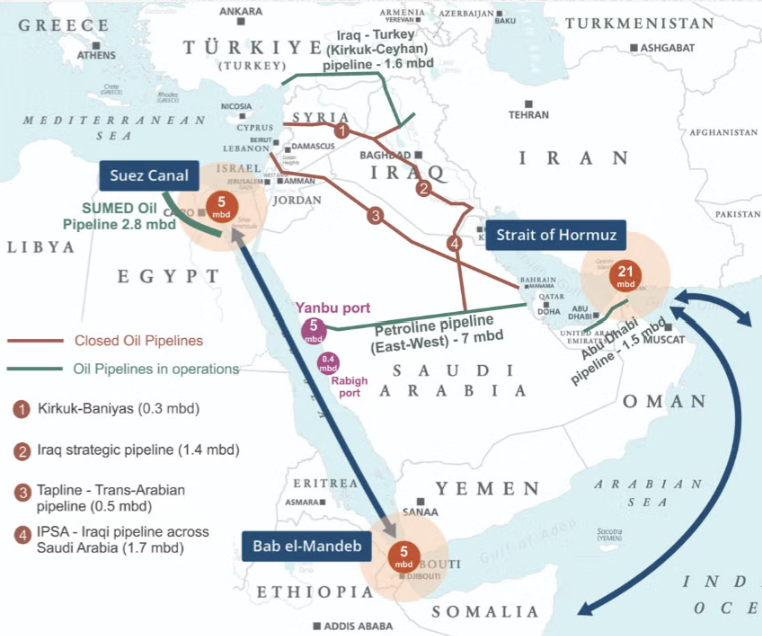
Kirkuk–Baniyas pipeline (Iraq–Syria): The existing line has a historical/design capacity of up to 300,000 bpd. Syria and Iraq are working on reviving war-damaged sections to eventually replace or supplement trucking. Joint technical committees are assessing restoration or new routing, with preliminary estimates suggesting significant investment and multi-year timelines.
Kirkuk–Ceyhan pipeline (Iraq–Turkey): Exports have been ramping up. Recent figures show flows around 200,000–300,000 bpd, with plans to increase significantly. The Iraqi cabinet has approved accelerating shipments through the Kurdistan–Turkey network, targeting more than triple current levels (from ~220,000 bpd toward 770,000 bpd in phases).
Basra–Haditha pipeline: This is the most ambitious project. Iraq is fast-tracking the ~685–700 km pipeline from southern fields (Basra) to Haditha in the north, with a planned capacity of 2.25–2.5 million bpd. Cost estimates range from $4.6–5 billion. The line will connect southern production to northern export infrastructure (Turkey via Ceyhan and potentially Syria), creating a major Hormuz bypass. Work has advanced in 2026 with direct bidding processes approved.
Combined northern routes (Turkey pipelines + Syria trucking/pipelines) are targeted to reach ~650,000 bpd in the near term. Officials have referenced broader ambitions exceeding 1 million bpd through these outlets as infrastructure develops.
Map illustrating key Iraqi oil export routes, including the Basra–Haditha pipeline and connections to Turkey and Syria (illustrative of current planning).Strategic Continuity — Even If Hormuz Reopens
Iraqi officials have been explicit: diversification is not just a crisis response. Oil Ministry spokesperson Saleem al-Rikabi stated that the government attaches “the highest importance to diversifying crude export routes, particularly through Syrian territory.” Plans for Syria routes and broader northern infrastructure will continue regardless of Hormuz conditions.
This mirrors Saudi Arabia’s East-West Petroline (to Yanbu on the Red Sea) and the UAE’s Habshan–Fujairah pipeline, both designed to provide redundancy against Hormuz vulnerabilities.independent.co.uk
Regional map showing alternative oil routes bypassing the Strait of Hormuz, including pipelines used or planned by Gulf producers.
Challenges and Outlook
Trucking remains costly, logistically complex, and less efficient than pipelines, with security risks along routes. Full pipeline projects will take years to complete and require substantial investment and international partnerships (including with Chinese firms for some segments).
Nevertheless, momentum is clear. Iraq is moving from emergency trucking (tens of thousands of bpd initially) toward hundreds of thousands of bpd via expanded trucking and pipelines in the short-to-medium term, with multi-million bpd potential once the Basra–Haditha link and revivals are operational.
By investing in these alternatives, Iraq is joining Saudi Arabia, the UAE, and others in building resilience against single-point chokepoints — preparing for a future where Hormuz disruptions, whether temporary or prolonged, have less impact on its economy.
Appendix: Sources and Links
- Original referenced article: Iraq Is Keeping Its Syria Oil Route—Even If Hormuz Reopens (OilPrice.com)
- Reuters (June 19, 2026): Iraq to export crude, naphtha through Syria after Hormuz shock
- FDD analysis (May 5, 2026): Iraq Is Envisioning New Oil Pipelines — But They Are Likely a Pipe Dream
- Enab Baladi (June 2026): Iraq Boosts Oil Exports Through Syria
- Enerdata (April 10, 2026): Iraq plans 2.25 mb/d export route bypassing Strait of Hormuz
- Additional reporting from Reuters, Rudaw, Arab News, and Iraqi official statements via multiple outlets (April–June 2026).
This article is based on the latest available reporting as of mid-June 2026. Volumes and timelines are subject to ongoing developments in infrastructure, security, and regional geopolitics.
The post Iraq is joining other Gulf States and Countries in planning on life with a Closed Hormuz appeared first on Energy News Beat.