Energy News Beat
European Union natural gas storage inventories stood at just 57.15% of capacity as of August 2, 2026 (645.965 TWh), according to Gas Infrastructure Europe’s Aggregated Gas Storage Inventory (AGSI+). This marks the lowest level for early August in records dating back to at least 2009–2011, leaving the region with a thinner-than-usual buffer ahead of the winter heating season.
Bloomberg reported the figure at 57.1% at the start of August, describing it as the lowest share of utilized capacity for this date in nearly two decades. Utilities and traders normally inject gas into depleted fields and salt caverns during the summer when prices are lower, building stocks for winter demand. This year, that process has stalled.
Why Storage Is So Low
The primary driver is elevated prices triggered by the war in the Middle East, including disruptions linked to the Strait of Hormuz crisis earlier in 2026. High costs have made summer stockpiling uneconomical for many market participants. Seasonal spreads have often been negative or insufficient to incentivize injections, while competition with Asian buyers for LNG cargoes has intensified.
Additional pressure came from prolonged extreme heat across Europe in June and July 2026. Higher electricity demand for air conditioning boosted gas-fired power generation, reducing the net volumes available for storage. Europe entered the 2026 injection season (starting around April 1) at only about 28% full—well below the levels of the prior three summers—after a colder-than-expected end to the previous winter.
Country-level differences are stark. As of early August 2026, Italy was relatively strong at around 76%, Poland near 85%, while Germany lagged at roughly 47% and the Netherlands even lower.
How 2026 Compares to Recent Years
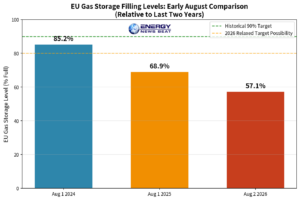
Current levels sit significantly below the past two years:
- Early August 2024: approximately 85.2% full
- Early August 2025: 68.9% full
- Early August 2026: 57.1% full
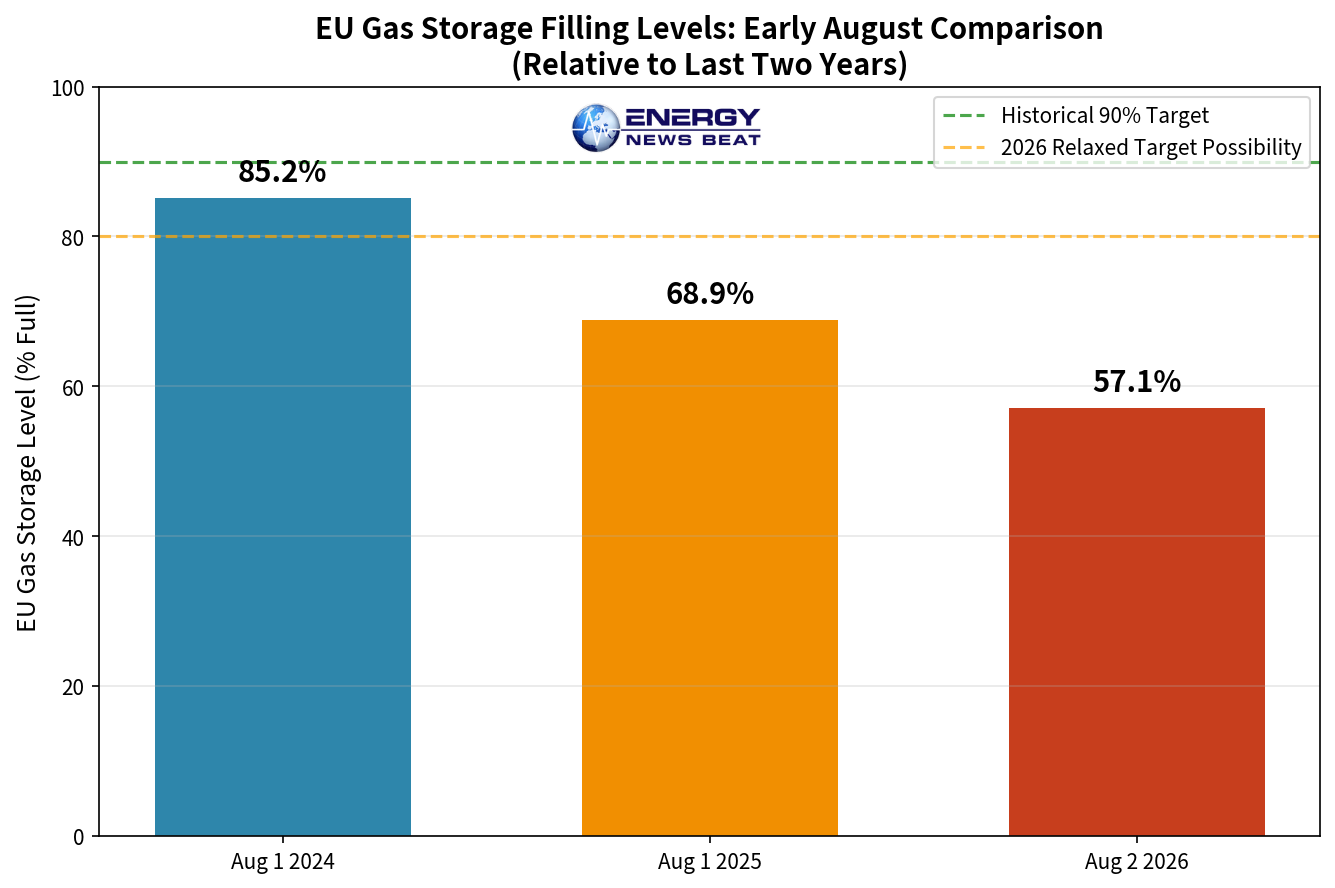
In both 2023 and 2024, the EU reached its 90% target by mid-to-late August. In 2025, progress was slower but still well ahead of the current trajectory. The chart below illustrates the sharp year-on-year deterioration relative to the last two years.Imagine
Broader multi-year trajectory charts from market analysts confirm the same pattern: 2026 is tracking well below the recent historical range and the five-year seasonal norm (which was closer to 67% in mid-July in prior cycles).
Limited Upside Hope for Winter
Under current EU rules (extended and made more flexible in 2025), member states must reach 90% full at some point between October 1 and December 1, with up to 10 percentage points of flexibility (and potentially more) under difficult market conditions. Some analyses suggest a de facto relaxed focus nearer 80% may apply this year.
However, the path looks challenging. Stocks currently hold roughly 62 bcm. Reaching even 75–80% would require substantial additional injections in the remaining summer and early autumn months. Injection rates have been modest, prices remain elevated (TTF around €57–59/MWh in early August 2026, up sharply year-on-year), and geopolitical risks persist. Some forecasts, including from Gazprom, suggest Europe may struggle to reach 75% before the heating season begins.
Governments face a dilemma: force higher injections through mandates or subsidies (raising costs for consumers and industry) or accept a thinner buffer that leaves the system more vulnerable to cold weather, further supply disruptions, or LNG competition. Demand destruction from high prices and continued efficiency gains provide some cushion, but the margin for error is narrower than in the high-storage years of 2023–2025.
Europe has proven resilient since the 2022 energy crisis, diversifying away from Russian pipeline gas toward LNG (especially from the US and Norway) and reducing overall consumption. Yet the combination of a low starting point, high prices, and geopolitical friction means the winter gas buffer is at elevated risk with limited near-term upside.
Appendix: Sources and Links
- Bloomberg: “Europe Gas Buffer at Risk as Levels Hit 18-Year Seasonal Low” (August 3, 2026) – https://www.bloomberg.com/news/articles/2026-08-03/eu-s-winter-gas-buffer-at-risk-as-storage-levels-hit-18-year-low
- Gas Infrastructure Europe AGSI+ Transparency Platform (primary data source) – https://agsi.gie.eu/
- Caliber.az / TASS-based reporting on early August 2026 levels – https://caliber.az/en/post/europe-s-gas-storage-hits-record-low-for-early-august
- Historical comparisons (Aug 1, 2024 & 2025 levels) – https://gmk.center/en/posts/electricity-prices-in-europe-increased-significantly-in-july/
- Oxford Institute for Energy Studies: “European Storage Refill in Summer 2026” – https://www.oxfordenergy.org/wpcms/wp-content/uploads/2026/07/European-Storage-Refill-in-Summer-2026.pdf
- Global Energy Flow storage trajectory analysis – https://global-energy-flow.com/storage/trajectory/
- European Commission / Council gas storage regulation updates and targets – https://www.consilium.europa.eu/en/infographics/gas-storage-capacity/ and related EC pages
- Trading Economics / TTF price data – https://tradingeconomics.com/commodity/eu-natural-gas
- Swiss Federal Energy Office EU storage dashboard (AGSI-sourced) – https://energiedashboard.admin.ch/gas/eu-gasspeicher
- Additional context from Bruegel gas tracker and ENTSOG/GIE platforms
Data current as of early August 2026; storage figures update daily on AGSI+.
The post Europe Gas Buffer Hits 18-Year Seasonal Low with Little Upside Hope appeared first on Energy News Beat.