Energy News Beat
An Asia-bound supertanker carrying Saudi crude has taken the longer, more expensive route out of the Red Sea through the Suez Canal rather than risk the Bab el-Mandeb Strait, even as other vessels—particularly those with Chinese links—continue to test the waterway amid Houthi threats and a declared blockade on Saudi-linked shipping.
The very large crude carrier (VLCC) Olympic Luck, Greek-owned and loaded with Saudi oil (likely requiring partial discharge via Egypt’s SUMED pipeline system because fully laden VLCCs cannot fully transit the canal), exited via Suez into the Mediterranean late Sunday and is now headed toward Asia after what appears to be a diversion. Similar cautious moves have been noted with vessels such as the Denmark-owned products tanker Torm Innovation (loaded at Yanbu and originally signaling Japan) and earlier LNG carrier Gas King. The DHT Gazelle has also been positioned toward the canal route while carrying Yanbu crude destined for the Philippines.
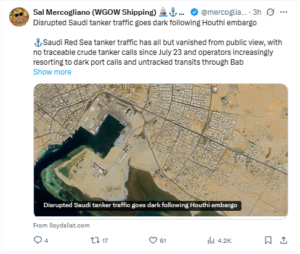
Meanwhile, other ships continue to risk the Bab el-Mandeb. Chinese-flagged or Cosco-managed VLCCs carrying Saudi crude—including the Xin Long Yang and Cosnew Lake (combined roughly 4 million barrels)—have exited southward through the strait in recent days, and traffic involving Iranian-friendly or non-Western operators (Chinese, Pakistani, Russian cargoes) has persisted in some cases. Smaller commodity vessels, product tankers, and bulk carriers have also crossed, though overall traffic has slowed sharply (reports of as few as 11–14 vessels in a day). Some Western or Greek vessels have gone “dark” (AIS transponders off) to transit. Cosco Shipping has managed vessels involved in both U-turns northward toward Suez and successful southbound exits; earlier in the broader Middle East tensions, Cosco directed ships in or bound for high-risk Gulf areas toward safer waters, reflecting heightened caution across its fleet.
Insurance Pressures from Lloyd’s and Others
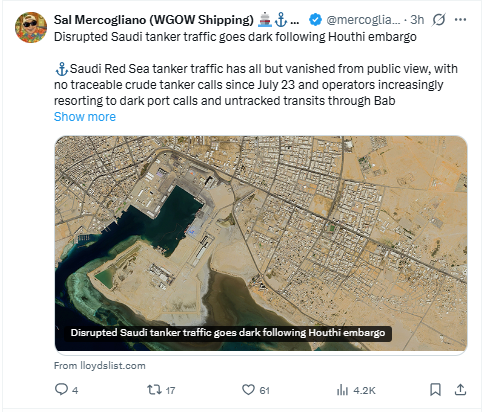
Major marine insurers, including those operating through the Lloyd’s of London market, have restricted or effectively pulled back war-risk coverage for Saudi Arabia-linked ships operating in the Red Sea. This follows earlier waves of cancellations or 72-hour notices in the Persian Gulf/Hormuz region tied to the wider U.S.-Iran conflict, where P&I clubs and reinsurers reacted to elevated risks. The Red Sea restrictions force higher premiums or outright unavailability for many Western owners, pushing diversions around Africa via the Cape of Good Hope or the Suez/Mediterranean leg and raising freight and insurance costs significantly. Safety concerns and coverage gaps—not just physical attacks—are driving reduced Western-flagged traffic.
Cargo shipping more broadly remains disrupted. Container and general cargo operators have long favored Cape diversions since the 2023–2025 Houthi campaign; the latest Saudi-focused blockade threats compound delays, higher costs, and schedule unreliability for Asia-Europe trade that normally uses the Suez-Bab el-Mandeb corridor.
Analyst Warnings vs. Today’s Prices
Several weeks ago—specifically around the Houthi naval blockade declaration against Saudi Arabia on or about July 20–21, 2026—analysts warned that a successful closure or severe disruption of the Bab el-Mandeb could push oil prices above $115–$120 per barrel. John Paisie of Stratas Advisors cited potential climbs past those levels amid shortages, higher freight/insurance, and broader economic strain. Other voices (Rystad, Kpler’s Matt Smith, Energy Aspects, UBS-linked commentary) highlighted the risk of a sharp rebound if Hormuz remained constrained while Red Sea Saudi flows (recently 3–4.5+ million bpd from Yanbu, heavily Asia-bound) were choked, with some extreme scenarios floated higher still. Physical tightness and refining margin spikes (especially diesel) were flagged as near-term consequences.
Yet as of July 27, 2026, WTI crude futures are trading in the low $80s (around $81–$83, with sharp daily declines of 7–9% reported in recent sessions after earlier spikes toward or above $100). Brent is in the mid-to-high $80s (roughly $85–$89 range, also down sharply). Physical delivery markets have shown tighter differentials and some grades nearing $110 in recent days amid Red Sea attacks, slow Hormuz transit, and other disruptions (e.g., Black Sea/CPC issues), but the paper benchmarks have not sustained the $120 levels warned of.
What’s Going On in the Oil Markets?
- Several factors explain the disconnect:
- Incomplete disruption: The strait is not fully closed. Chinese, Pakistani, and some other vessels continue transiting Bab el-Mandeb with Saudi cargoes. Western owners largely avoid or divert, but Asia-bound volumes are not entirely halted.
- Workarounds and buffers: Saudi crude can move via the East-West pipeline to Yanbu, then north through Suez/SUMED (with capacity limits and partial unloading for VLCCs) or the long Cape route. Existing floating inventories and the multi-week lag inherent in seaborne delivery (Gulf-to-Asia typically 4–6 weeks under normal conditions) mean physical shortages at refineries have not fully materialized yet—though they are beginning to appear.
- Market positioning and de-escalation signals: Prices had already risen on Hormuz constraints and Houthi threats (Brent briefly >$100). Sharp recent drops coincide with reports of pauses in some U.S.-Iran exchanges, continued (if limited) tanker movements, and the market digesting that full simultaneous Hormuz + Bab el-Mandeb closure has not occurred. High freight rates and insurance costs are absorbing some of the risk premium rather than pure crude price spikes.
- Demand and other supply: Global demand softness in places, non-Middle East production, and strategic stock releases or rearrangements provide offsets, even as the combined chokepoint risks represent one of the largest potential supply shocks in decades.
Physical markets are showing more stress than futures in spots—delayed cargoes, higher differentials, and refining margin volatility—consistent with the lag effect. Once the “grace period” of tankers already at sea ends, tighter physical conditions could reassert upward pressure if diversions persist.
How Long to Realign Tankers?
Re-routing is already underway and can scale relatively quickly for individual voyages (ships simply change course), but full market realignment takes longer. Cape of Good Hope diversions add roughly 2–4 weeks (or more) to Asia-bound voyages from the Red Sea compared with the normal Bab el-Mandeb exit, and full circumnavigation from the Gulf adds substantially more time and fuel. SUMED pipeline capacity is finite, limiting the efficient Suez option for VLCCs. Fleet utilization rises, freight rates stay elevated, and owners need time to reposition empty tonnage, adjust chartering, and secure alternative insurance. Historical Red Sea diversions (2023–2025) showed markets adapting over weeks to a couple of months, with structurally higher costs lingering. Sustained dual-chokepoint pressure could keep the global tanker market tighter for months, supporting freight rates even if crude prices moderate. Asian refiners are already exploring longer-haul Saudi cargoes and alternative sourcing.
The situation remains fluid. Continued Houthi attacks, insurance availability, and any de-escalation (or escalation) in the wider Iran-related conflict will determine whether prices grind higher on physical tightness or stabilize as workarounds hold. For now, the market is pricing partial risk rather than the full $120 scenario analysts outlined when the blockade threats first intensified.
Appendix: Sources and Links
- OceanCrew / related reports on Olympic Luck and Suez exit: https://oceancrew.org/news/asia-bound-tanker-exits-red-sea-via-suez-as-others-risk-strait
- gCaptain tanker tracking and dark exits: https://gcaptain.com/tanker-exits-red-sea-dark-as-china-ship-heads-toward-strait/
- Reuters on tanker U-turns and Chinese exits: https://www.reuters.com/world/middle-east/two-tankers-carrying-saudi-crude-make-u-turns-red-sea-after-houthi-warning-2026-07-21/ ; related Chinese supertanker coverage
- Reuters analyst price impact assessment (July 20, 2026): https://www.reuters.com/business/energy/houthi-red-sea-blockade-would-lift-oil-prices-workarounds-could-limit-impact-2026-07-20/
- FT on ship insurers restricting war coverage for Saudi-linked Red Sea cargoes: https://www.ft.com/content/52aa89e9-f014-498e-8415-2c435a1c858d
- Lloyd’s List and related insurance market reporting on war-risk exclusions and P&I club actions (Gulf and Red Sea context)
- Arab News / MarineLink / TradeWinds on Cosco-managed VLCCs exiting Red Sea
- Current price references (WTI ~$81–83, Brent ~$85–89 range as of July 27, 2026 sessions): CNBC, Investing.com, Trading Economics, OilPrice.com, Bloomberg energy pages, CME/NYMEX data
- Physical market tightness notes: Reuters physical oil prices coverage (July 24, 2026)
- Kpler, Energy Aspects, Stratas Advisors, Rystad commentary via Reuters/Guardian/Al Jazeera on flows (~3–4.5 mb/d Yanbu), voyage delays, and price scenarios
- Additional context on Hormuz/Red Sea chokepoints and pipeline capacity: IEA, EIA World Oil Transit Chokepoints analyses
(Note: Shipping data primarily from LSEG, Kpler, and AIS tracking as reported in the above outlets. Prices are futures/front-month and can move intraday; physical differentials vary by grade and location.)
The post Asia-Bound Tanker Exits Red Sea Via Suez as Others Risk Strait appeared first on Energy News Beat.