Energy News Beat
Turkey faces heightened risk of disrupted natural gas supplies from Iran following the U.S. Treasury’s launch of an intensified economic isolation campaign against Tehran on August 24, 2026. As a key U.S. ally and Iran’s third-largest trading partner, Ankara must navigate secondary sanctions threats that could complicate or sever one of its major pipeline gas sources, according to a Bloomberg report published August 25.
The long-term supply contract, signed in the 1990s and operational since 2001, provided for up to about 9.6 billion cubic meters (bcm) per year via the Tabriz-Ankara (or Bazargan-Dogubayazit) pipeline. It expired at the end of July 2026 without a publicly announced renewal, amid the ongoing regional conflict that began earlier in the year. Flows have continued on an interim or force-majeure basis in recent periods, but payment channels face growing pressure from restored UN sanctions, monitoring of Turkish banks (including fallout from the Halkbank case), and the absence of natural gas from limited U.S. sanctions relief measures that covered some oil and petrochemicals.
Import volumes from Iran
Actual deliveries have typically run below the contractual ceiling due to Iran’s domestic prioritization (especially in winter), technical issues, pipeline attacks, and prior sanctions friction. 2024: approximately 7.0–7.04 bcm.
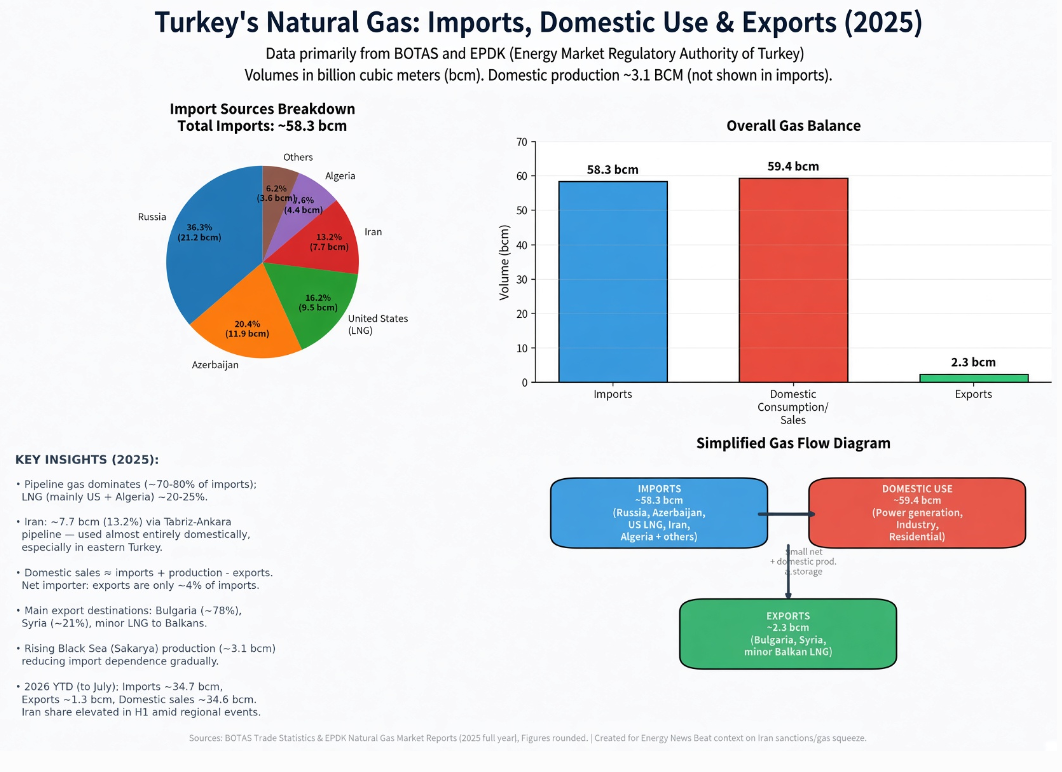
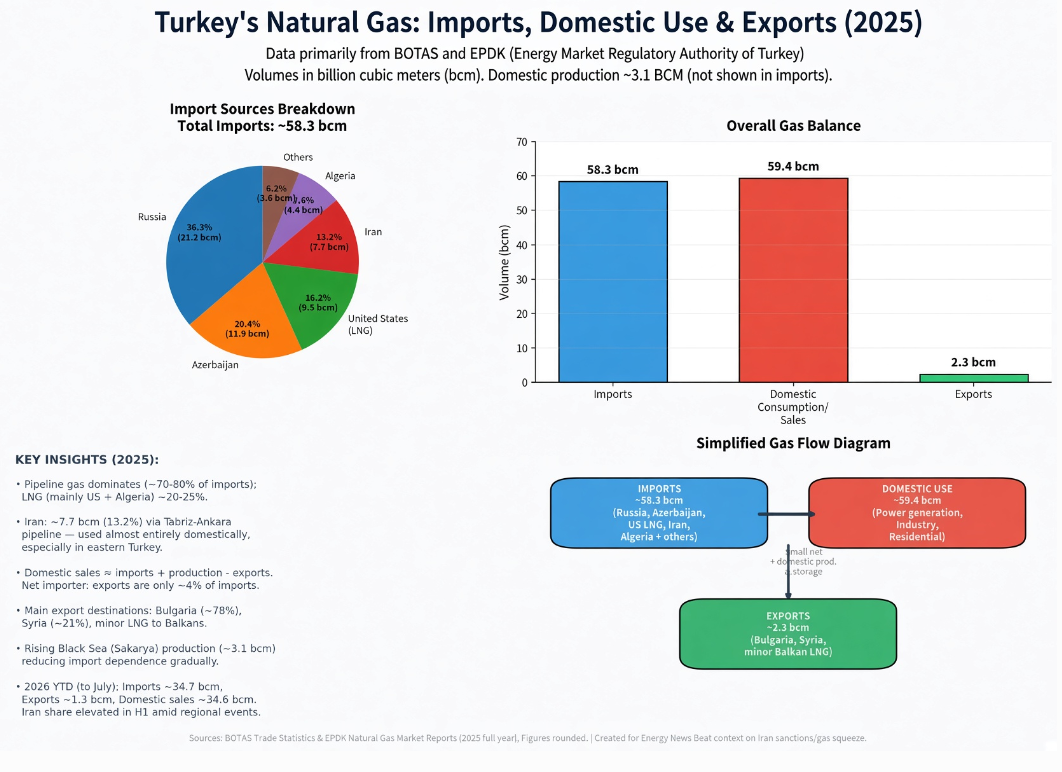
2025: around 7.7 bcm (roughly 13.2% of Turkey’s total natural gas imports of about 58–59 bcm), with some European statistical sources citing over 8 bcm. Iran ranked as Turkey’s fourth-largest supplier that year, behind Russia, Azerbaijan, and the United States (via LNG).
First half of 2026: about 4.5 bcm, reflecting a sharp rebound (roughly 34–40% year-on-year in some spring months) after the conflict escalated. In June 2026 alone, imports reached 883 million cubic meters, or nearly 29% of that month’s total.
Turkey’s overall imports in 2025 were approximately 58–59 bcm (BOTAŞ and EPDK data), with domestic consumption in a similar range or slightly higher (around 59–61 bcm in some estimates). Domestic production remains modest but rising (primarily Black Sea Sakarya field, exceeding 3 bcm in 2025 and targeted to grow further).
Domestic use versus exports
Iranian pipeline gas is used almost entirely for Turkey’s internal market. It enters the system in the east and helps meet demand in eastern Anatolia and the national grid (power generation, industry, residential, and commercial sectors). Turkey is a heavy net importer; its own exports are small relative to imports—about 2.3 bcm in 2025 (mainly pipeline gas to Bulgaria and Syria, plus minor LNG volumes to the Balkans) and roughly 1.3 bcm in the first seven months of 2026.
There is no evidence that Iranian molecules are systematically re-exported to third countries. Turkey’s limited exports and transit role primarily involve Russian gas (TurkStream), Azerbaijani gas (TANAP/Southern Gas Corridor), and growing LNG re-exports or swaps as it pursues regional hub ambitions. Eastern infrastructure is oriented toward absorbing Iranian volumes domestically rather than routing them westward.
Potential impacts on Turkey, the EU, and other markets
Turkey will likely feel localized and cost-related pressure rather than an immediate nationwide shortage. Iranian gas has been among the more competitive pipeline sources and lands directly in the east, where alternatives require more costly reverse flows or LNG trucking/regasification. Ankara has significantly diversified: expanded LNG import capacity and long-term deals (including substantial U.S. volumes), Azerbaijan pipeline supplies, renewed or flexible Russian arrangements, rising domestic output, and storage (Silivri and Tuz Gölü facilities with multi-bcm capacity that have been reported full or well-stocked at points in the recent period). Analysts have noted that Turkey can offset Iranian volumes through LNG and other pipelines, though at higher cost and with greater exposure to global spot prices—especially in the second half of 2026 before some new long-term LNG cargoes ramp fully in 2027.
Direct impact on the EU is limited. Iranian gas does not flow onward to Europe through Turkey in meaningful volumes. Any Turkish shift toward more LNG could modestly tighten the global LNG market and add marginal upward pressure on European prices during periods of already elevated demand or constrained supply (exacerbated by broader Middle East disruptions). Turkey’s hub role—transiting Russian and Azerbaijani gas and potentially re-exporting LNG—remains intact and could even expand if Ankara accelerates diversification. Other markets face different exposures: Iraq relies more heavily on Iranian gas for electricity generation and has seen prior disruptions; Armenia also imports Iranian volumes.
Broader context includes elevated energy import costs for Turkey from the wider conflict (estimates of several billion dollars in additional oil and gas bills in 2026) and the new U.S. secondary sanctions push targeting enablers across sectors such as finance, shipping, and trade. Bilateral Turkey-Iran trade has hovered in the several-billion-dollar range, with energy a key component. Ankara has historically balanced relations carefully and continued flows even after reported Iranian missile incidents earlier in the conflict.
In summary, Turkey faces a real but manageable risk of reduced or more expensive Iranian gas supplies. Its diversification progress provides buffers, yet eastern regional logistics, payment frictions, and higher replacement costs could still create a squeeze, particularly if secondary sanctions aggressively target remaining commercial channels. Continuous monitoring of pipeline flows post-contract expiry, and any waiver or interim payment arrangements, will be critical in the coming weeks and months.
- Bloomberg: “Turkey Braces For Potential Gas Squeeze as US Targets Iran Trade,” August 25, 2026. https://www.bloomberg.com/news/articles/2026-08-25/turkey-braced-for-potential-gas-squeeze-as-us-targets-iran-trade
- BOTAŞ official trade statistics (imports, exports, domestic sales). https://www.botas.gov.tr/pages/trade/301
- Türkiye Today: “Türkiye’s Iran gas contract nears expiry as imports jump 40% during war,” July 28, 2026. https://www.turkiyetoday.com/business/turkiyes-iran-gas-contract-nears-expiry-as-imports-jump-40-during-war-3224851
- EPDK / EMRA sector reports and country breakdowns (various 2025–2026 monthly and annual data, including June 2026). https://www.epdk.gov.tr (specific download links referenced in reporting)
- Tehran Times / Eurostat-cited data on 2025 volumes. https://www.tehrantimes.com/news/523669/Iran-s-gas-exports-to-Turkey-rise-to-over-8b-cubic-meters-in
- Forbes: “Turkey’s Iran Gas Deal Ends In July. The Real Test Is The Payment Rail,” June 29, 2026. https://www.forbes.com/sites/guneyyildiz/2026/06/29/turkeys-iran-gas-deal-ends-in-july-the-real-test-is-the-payment-rail/
- OilPrice.com: “The Biggest Victims Of Trump’s Economic D-Day On Iran,” August 24, 2026. https://oilprice.com/Energy/Energy-General/The-Biggest-Victims-Of-Trumps-Economic-D-Day-On-Iran.html
- CNBC: “Trump targets Iran’s trade lifelines — here are the countries most exposed,” August 25, 2026. https://www.cnbc.com/2026/08/25/us-iran-secondary-sanctions-china-india-uae-hormuz-trade-.html
- U.S. Department of the Treasury: “Treasury Launches Unprecedented Campaign Against Iranian Regime on Economic D-Day,” August 24, 2026. https://home.treasury.gov/news/press-releases/sb0613
- Columbia SIPA Center on Global Energy Policy analyses on Iranian gas exports and contracts. https://www.energypolicy.columbia.edu/irans-natural-gas-paradox-vast-resources-limited-export-capacity/
- Wikipedia / Global Energy Monitor summaries of Tabriz–Ankara pipeline capacity and history. https://en.wikipedia.org/wiki/Tabriz%E2%80%93Ankara_pipeline
- Additional corroborating reports from S&P Global, Ember, Euronews, and Turkish media on volumes, diversification, and hub ambitions (2025–2026).
The post Will Turkey be impacted by a potential gas squeeze as new Iran sanctions kick in? appeared first on Energy News Beat.