Energy News Beat
Iran has ruled out direct negotiations with the United States for now, citing repeated violations of a short-lived interim peace memorandum of understanding signed in June, while President Donald Trump has signaled a patient, restrained approach focused on economic pressure rather than immediate new military action. The standoff continues to leave the Strait of Hormuz—the critical chokepoint for roughly one-fifth of global oil trade—largely disrupted more than five months into the conflict that began in late February 2026.
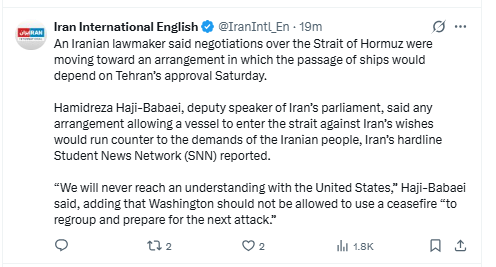
Iranian Foreign Minister Abbas Araghchi stated that Tehran would not resume direct talks “as long as the American violation of the Memorandum of Understanding continues and the U.S. does not make amends for its violations.” Messages are being exchanged only through intermediaries. Oman, acting as mediator, described ongoing talks with Iran as occurring in a “positive and constructive atmosphere” and urged parties to avoid undermining diplomacy. An Iran-Oman arrangement for a temporary shipping route through the strait had been described as “very close” or in the final stages, but Tehran has conditioned any broader reopening on far-reaching demands.
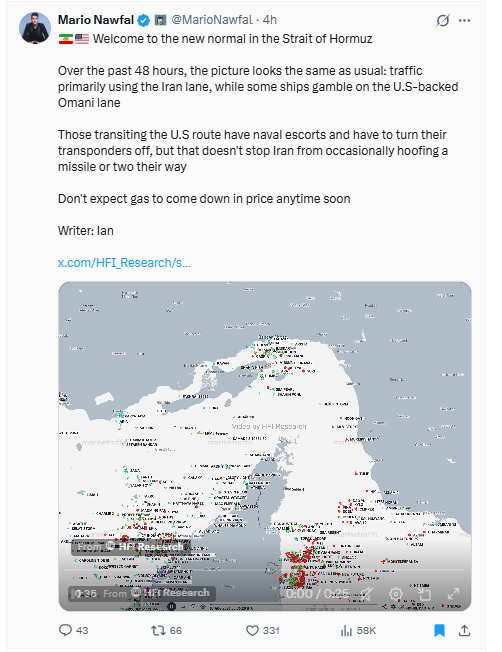
On Saturday, Iran’s Supreme National Security Council, via secretary Mohammad Baqer Zolghadr (also a Revolutionary Guard commander), outlined six sweeping conditions: an end to U.S. threats and military action; a permanent end to the war and aggression against Iran and its allies in Lebanon, Palestine, Yemen, and Iraq; lifting of the U.S. naval blockade of Iranian ports and withdrawal of U.S. naval and air forces from around Iran; full compensation for war damages; sanctions relief; and unconditional release of frozen Iranian assets. Iran’s Revolutionary Guards reinforced the position Sunday, saying they would maintain the effective blockade “until the enemy accepts all our conditions,” describing the strait as “a theatre of war for us and not just a waterway.” Limited escorted cargo movements continue, but commercial traffic remains far below normal. Recent data showed only about 33 vessels transiting in a recent multi-day period (down from 50 the prior week) and just six outbound crude tankers in one reported stretch.
Trump, for his part, has dialed back immediate military rhetoric.
In comments to Axios on Sunday, he said the U.S. is “low-keying it.” “We are only semi-negotiating with them. We are just watching Iran with its huge inflation and the fact they have no money.” He noted Iran’s economic distress—exacerbated by the U.S. naval blockade—and that oil prices around the mid-to-high $70s to low $80s mean American consumers feel less pain. “It will work out. It always works out. It’s like a chess game,” he added. This contrasts with earlier threats of major strikes and reflects a strategy of waiting for economic pressure to soften Tehran’s stance.
Activity in the Strait of Hormuz and Bab el-Mandeb
The Strait of Hormuz has seen repeated Iranian threats, attacks on commercial vessels (including Qatari LNG carriers and Saudi tankers in prior months), and enforcement of preferred routes or screening. Traffic has been severely suppressed at times—down to single digits or low teens of vessels per day versus pre-war averages exceeding 100–130—prompting U.S. responses, blockades, and efforts by Gulf exporters to find workarounds. Explosions and reported strikes near the waterway have periodically raised threat levels to “severe.”
In the Bab el-Mandeb Strait and Red Sea, Yemen’s Iran-aligned Houthis have escalated by declaring a blockade on Saudi-linked shipping and conducting attacks. They claimed drone/missile strikes on Saudi tankers (including vessels such as Encelia, Layla, and others in late July) and a drone strike on Saudi Aramco’s Jizan refinery over the weekend (fire extinguished, no injuries reported by Saudi authorities). Crossings have declined, with tanker and Saudi-linked traffic particularly affected, though Chinese-linked vessels have often transited without incident under apparent arrangements. The dual-chokepoint pressure compounds risks, as the two waterways together handle a substantial share of global oil and trade flows. Houthi actions against Saudi-backed forces in Yemen have also intensified regional tensions.
Oil Prices and Analyst Views
Brent crude has traded in the low-to-mid $80s recently (settling around $83.55 on August 7 after gains on uncertainty, with earlier sessions seeing jumps of $1–$3 on headlines about bans, fees, or stalled deals). Prices remain elevated relative to some pre-war levels due to the prolonged disruption, though they have retreated from peaks near or above $100 earlier in the conflict. Gulf crude and condensate exports have run roughly 40% below pre-war levels at times.
Analysts generally see continued upside risk if the Hormuz disruption and related tensions persist, with potential for further rises, while a credible reopening deal could pressure prices lower. Citi raised its third-quarter Brent forecast to $80 from $75, citing the longer-than-expected war and shipping disruptions, while keeping a $70 fourth-quarter view and $65 average for 2027; it still expects eventual resolution. Goldman Sachs has indicated Brent could stay in the $80–$90 range pending confirmation of a deal or significant escalation, with risks of climbing toward $120 if the strait stays closed for an extended period. Other voices note the market’s sensitivity to headlines, fee proposals (Iran seeking 5–7% of cargo value in some reports versus lower Omani ideas and U.S. preference for none), and the binary nature of an open versus closed strait. Some earlier or more bullish scenarios have flagged much higher levels (potentially $120+ averages or spikes toward $140–$180 in severe prolonged blockage cases), though demand destruction and other factors have capped extremes so far. The longer the draw on commercial reserves continues without normalization, the greater the near-term support for prices.
The situation remains fluid. Limited shuttle operations and mediation via Oman offer narrow channels, but Iran’s maximalist conditions and rejection of direct talks, paired with Trump’s economic waiting game, suggest no imminent full reopening of Hormuz. Markets will continue watching for any breakthrough—or further Houthi or Iranian actions—that could shift the supply risk premium.
Appendix: Sources and Links
- Bloomberg: “Iran Rejects US Talks as Trump Displays Patience for Hormuz Deal” / “Wait for Hormuz Deal Stretches On as Iran Says Terms Must Be Met” – https://www.bloomberg.com/news/articles/2026-08-09/wait-for-hormuz-deal-stretches-on-as-iran-says-terms-must-be-met?srnd=phx-industries-energy
- World Oil (Bloomberg): “Iran rejects U.S. talks as Hormuz reopening remains stalled” – https://www.worldoil.com/news/2026/8/9/iran-rejects-u-s-talks-as-hormuz-reopening-remains-stalled/
- OilPrice.com: “Iran Says Hormuz Stays Closed Until U.S. Meets Six Sweeping Demands” – https://oilprice.com/Latest-Energy-News/World-News/Iran-Says-Hormuz-Stays-Closed-Until-US-Meets-Six-Sweeping-Demands.html
- CTV News / AFP: “‘We’re low-keying it’: Trump backs off on striking Iran” – https://www.ctvnews.ca/world/mideast-conflict/article/were-low-keying-it-trump-backs-off-on-striking-iran/
- Axios: “Trump to Axios: ‘We are low keying it’ with Iran” – https://www.axios.com/2026/08/09/trump-iran-interview
- Politico (AP): “Iran makes dramatic new demands around Strait of Hormuz” – https://www.politico.com/news/2026/08/08/iran-makes-dramatic-new-demands-around-strait-of-hormuz-01030116
- The Independent: “Iran-US war latest: Tehran demands compensation from Trump to reopen Strait of Hormuz” – https://www.independent.co.uk/news/world/middle-east/iran-us-war-live-trump-hormuz-israel-oman-b3029908.html
- Economic Times / AFP: “Iran Guards say won’t reopen Hormuz without US meeting all Tehran’s conditions” – https://m.economictimes.com/news/defence/iran-guards-say-wont-reopen-hormuz-without-us-meeting-all-tehrans-conditions/articleshow/133065034.cms
- Business Times: “Brent climbs US$1 on uncertainty over end to Iran war” – https://www.businesstimes.com.sg/companies-markets/energy-commodities/brent-climbs-us1-uncertainty-over-end-iran-war
- Reuters / EnergyNow: Oil price reports and commentary on Hormuz uncertainty – various (e.g., https://energynow.com/2026/08/oil-prices-in-the-dark-as-negotiations-continue/)
- The Vibes / Citi: “Citi raises brent forecast as prolonged US-Iran war keeps oil markets on edge” – https://www.thevibes.com/articles/business/125966/citi-raises-brent-forecast-as-prolonged-us-iran-war-keeps-oil-markets-on-edge
- India Today: “Bab el-Mandeb attacks: Houthis threaten shipping, Saudi tankers and Yemen truce” – https://www.indiatoday.in/world/story/houthi-attacks-bab-el-mandeb-global-shipping-saudi-tankers-yemen-ptag-2966035-2026-08-07
- Windward / maritime intelligence reports on Hormuz and Bab el-Mandeb traffic and attacks
- Additional background from Reuters, NYT, Guardian, Times of Israel, and maritime tracking (Kpler, MarineTraffic, UKMTO/JMIC) on vessel attacks, traffic volumes, and Houthi actions throughout the conflict period.
The post Iran Rejects US Talks, and Trump is Showing Restraint appeared first on Energy News Beat.