Energy News Beat
Global oil refineries outside active conflict zones are operating near or at maximum capacity, with almost no remaining buffers to absorb further shocks. Saudi Aramco CEO Amin Nasser made the point clearly this week: the system is stretched thin, leaving “little shock absorbers or buffers” against higher fuel prices.
A combination of the ongoing war in the Middle East (centered on Iran and disruptions through the Strait of Hormuz) and intensified Ukrainian strikes on Russian energy infrastructure has forced significant refining capacity offline while pushing surviving plants to run flat out. The result is tighter markets for refined products—gasoline, diesel, and jet fuel—than for crude oil itself. Europe’s diesel benchmark has traded above $150 per barrel, and average U.S. retail gasoline prices remain stuck above the politically sensitive $4-per-gallon level.
Global Capacity Versus Demand: A Narrowing Margin
World refining distillation capacity stood at roughly 103–106 million barrels per day (mb/d) entering 2026, according to OPEC and IEA assessments. OPEC puts base capacity at about 103.3 mb/d as of January 2026; the IEA had estimated around 105.7 mb/d in 2024, with slow growth projected to reach 108.3 mb/d by 2030.
Net capacity additions remain modest—averaging just over 400 kb/d annually in recent IEA forecasts, or roughly 1 mb/d per year in OPEC’s medium-term outlook for 2026–2030. Most new capacity is concentrated East of Suez (India, China, Middle East, Africa). The Atlantic Basin (U.S., Europe) continues to see closures and little greenfield investment. In 2026 alone, gross additions are expected near 1–1.5 mb/d, partially offset by shutdowns.
Global refinery throughput has been running in the low-to-mid 80s mb/d in quieter periods, but disruptions have pulled effective runs lower. The IEA has forecast 2026 crude throughputs contracting by about 2 mb/d year-on-year in some scenarios, averaging near 82 mb/d amid the conflicts. Utilization rates outside war zones are elevated: U.S. refineries operated at 97.2% of operable capacity in the week ending July 24, 2026; Shell reported 102% utilization in Q2; Chevron posted record throughput above 1 mb/d.
Product demand remains resilient. Middle distillates (diesel) are particularly tight heading into seasonal restocking, while gasoline and jet fuel markets show little slack. Refining margins have hit multi-year or record highs—Shell’s indicative margin reached $24/bbl in Q2, TotalEnergies’ European marker nearly tripled year-to-date—driving strong earnings even as crude itself traded above $100/bbl at peaks.
War Damage: The Immediate Capacity Crunch
Ukrainian long-range drone and missile strikes have hit the majority of Russia’s major refineries. Independent estimates put 30–50% of Russian primary refining capacity offline at peaks in mid-2026, with Russian runs falling to as low as 3.6 mb/d in July—the lowest in more than two decades and roughly one-third below seasonal norms of 5.3–5.6 mb/d. Facilities from Omsk (Russia’s largest) to Moscow, Tuapse, and others have suffered repeated damage; repairs are slow, and some units face months of downtime.
The Iran-centered Middle East conflict has removed additional capacity—estimates of peak offline refining in the region reached around 3.5 mb/d earlier in 2026—while constraining crude flows through Hormuz. Asian throughput has been pressured, and China temporarily restricted product exports. Combined, these events have removed several million barrels per day of effective global refining capacity at various points, far outpacing normal maintenance or planned turnarounds.
Inventories Offer Little Cushion
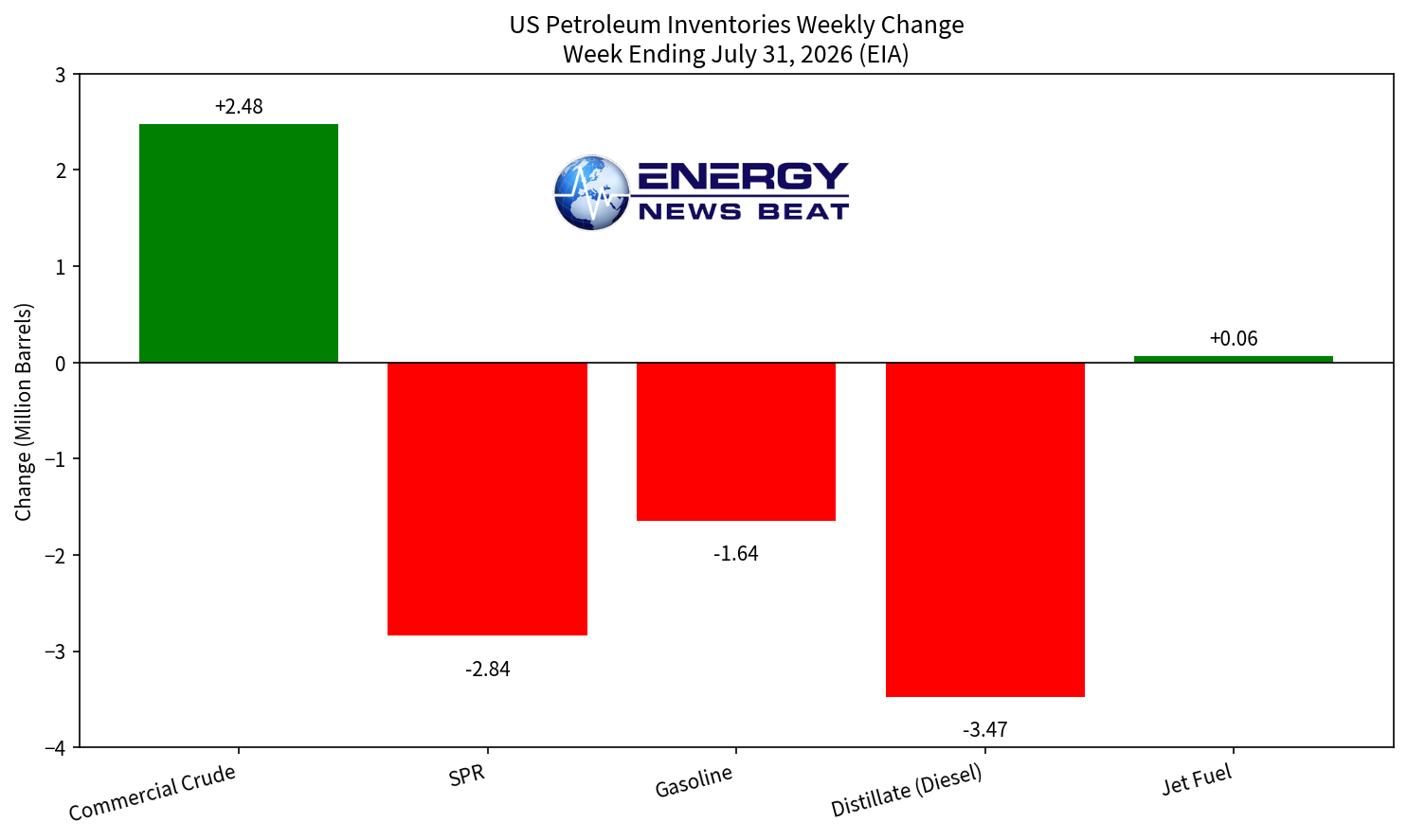
U.S. Energy Information Administration data for the week ending July 24, 2026, show commercial crude oil stocks (excluding the Strategic Petroleum Reserve) at 404.5 million barrels—about 6–7% below the five-year average and down sharply from year-ago levels. Total motor gasoline inventories stood near 211 million barrels (roughly 6–7% below the five-year average), while distillate fuel oil inventories were about 110.6 million barrels (9–10% below the five-year average). Overall U.S. crude-plus-products stocks totaled approximately 1.526 billion barrels, down more than 7% from a year earlier.
Aramco has highlighted that the broader system has drawn down more than 2.6 billion barrels of oil inventories since the escalation of Middle East hostilities in February 2026—equivalent to nearly a month of normal global production. Replenishing those stocks would take many months even if flows normalized quickly.
Why New Refineries Are Scarce—and Why Profit Accusations Miss the Point
Almost no major greenfield refineries are under construction in the OECD, and global net additions remain historically slow. Regulatory hurdles, environmental opposition, long lead times (often a decade), and uncertain long-term demand for refined products have deterred investment. Companies instead focus on upgrades, petrochemical integration, and capacity creep at existing sites. In the U.S., operators such as Valero and PBF have emphasized that even reopening idled units is costly, and no significant new domestic capacity is planned despite elevated prices.
President Trump has publicly criticized major oil companies—specifically naming ExxonMobil and Chevron—for “making too much money” amid the disruptions, urging them to lower retail prices and share windfalls with consumers. Exxon reported $14.5 billion in Q2 profit and Chevron roughly $12 billion, both sharply higher year-over-year, driven in large part by strong refining margins and the product-price spikes tied to the conflicts.
That framing overlooks the realities of the business. Refineries require continuous, multi-million-dollar annual maintenance and capital spending simply to stay operational and meet evolving fuel specifications. War-related damage elsewhere in the system and heightened geopolitical risk only increase those costs. Companies must also deliver returns to investors; without competitive returns on capital, the industry will not fund the new capacity the world still needs to keep product markets balanced as demand grows in Asia and elsewhere. High margins in a temporary shortage are precisely the signal that attracts (or at least sustains) the investment required to expand the system over time. Punishing those returns risks accelerating closures and further tightening the very bottleneck now driving prices higher.
Refining has become the near-term bottleneck for oil prices and fuel availability. Crude can still move, albeit with higher costs and longer routes; turning that crude into usable products is the constrained step. Until conflict-related outages ease, inventories rebuild, and the slow pipeline of new capacity materializes, the global refining system will remain stretched—with limited buffers against the next disruption.
Appendix: Sources and Links
- Bloomberg – “Aramco Sees Oil Refineries Running Flat Out as Buffers Run Thin” (August 4, 2026): https://www.bloomberg.com/news/articles/2026-08-04/aramco-sees-oil-refineries-running-flat-out-as-buffers-run-thin
- OilPrice.com – “Middle East War Triggers New Global Refining Boom” (August 4, 2026): https://oilprice.com/Energy/Energy-General/Middle-East-War-Triggers-New-Global-Refining-Boom.html
- IEA Oil 2025 report (capacity and throughput forecasts): https://iea.blob.core.windows.net/assets/c0087308-f434-4284-b5bb-bfaf745c81c3/Oil2025.pdf
- OPEC World Oil Outlook (refining capacity tables and utilization projections): https://publications.opec.org/woo/chapter/157/2945
- U.S. EIA Weekly Petroleum Status Report (week ending July 24, 2026; released July 29, 2026): https://www.eia.gov/petroleum/supply/weekly/ and highlights PDF data showing utilization 97.2%, stocks levels.
- Reuters and Bloomberg reporting on Russian refining damage and runs (multiple 2026 articles, including July–August coverage of Omsk and overall offline capacity): e.g., https://www.reuters.com/business/energy/russias-largest-oil-refinery-halts-processing-after-drone-attack-sources-say-2026-07-07/; https://www.themoscowtimes.com/2026/08/03/russian-oil-refining-falls-to-24-year-low-after-ukrainian-drone-strikes-bloomberg-a93404
- Reuters – “Iran, Ukraine wars deliver worst hit in years to oil refining output” (May 2026): https://www.reuters.com/business/energy/iran-ukraine-wars-deliver-worst-hit-years-oil-refining-output-2026-05-13/
- Newsweek, The Guardian, ABC News, Yahoo Finance – coverage of President Trump’s August 2026 comments on Exxon and Chevron profits: e.g., https://www.newsweek.com/trump-slams-exxon-and-chevron-iran-war-windfalls-can-he-do-anything-12282666; https://www.theguardian.com/business/2026/aug/04/donald-trump-oil-companies-war-iran-us-exxonmobil-chevron
- Additional supporting data: Shell Q2 2026 utilization and margins; Industrial Info Resources on U.S. refining investment (no greenfield); Aramco Q2 2026 results and CEO comments on inventories (https://www.aramco.com/en/news-media/news/2026/aramco-announces-second-quarter-and-half-year-2026-results).
The post Refineries Globally Are Running Flat Out as Buffers Have Dwindled appeared first on Energy News Beat.