Energy News Beat
The Bank of England is moving further away from thermal coal. From October 2026, it will no longer accept bonds issued by companies deriving revenue from thermal coal mining as eligible collateral in its lending operations. Commercial banks borrowing from the Bank (including major UK institutions) will not be able to post those bonds. The Bank frames the change as risk management: thermal coal faces growing financial risks as economies adjust toward net-zero emissions, so related assets are too risky for its balance sheet. It will also apply discounts (“haircuts”) to bonds in other relevant high-emission sectors.
This is the latest step in the Bank’s multi-year effort, dating back at least to adjustments in its Corporate Bond Purchase Scheme in 2021, to support an orderly transition to net zero while protecting public money and maintaining its primary monetary policy mandate. The policy is stricter than that of the European Central Bank and aligns with a broader trend in which more than 200 globally significant financial institutions have adopted formal restrictions on thermal coal. The Bank announced it quietly on its website rather than with a high-profile statement.
Meanwhile, global coal use tells a different story.
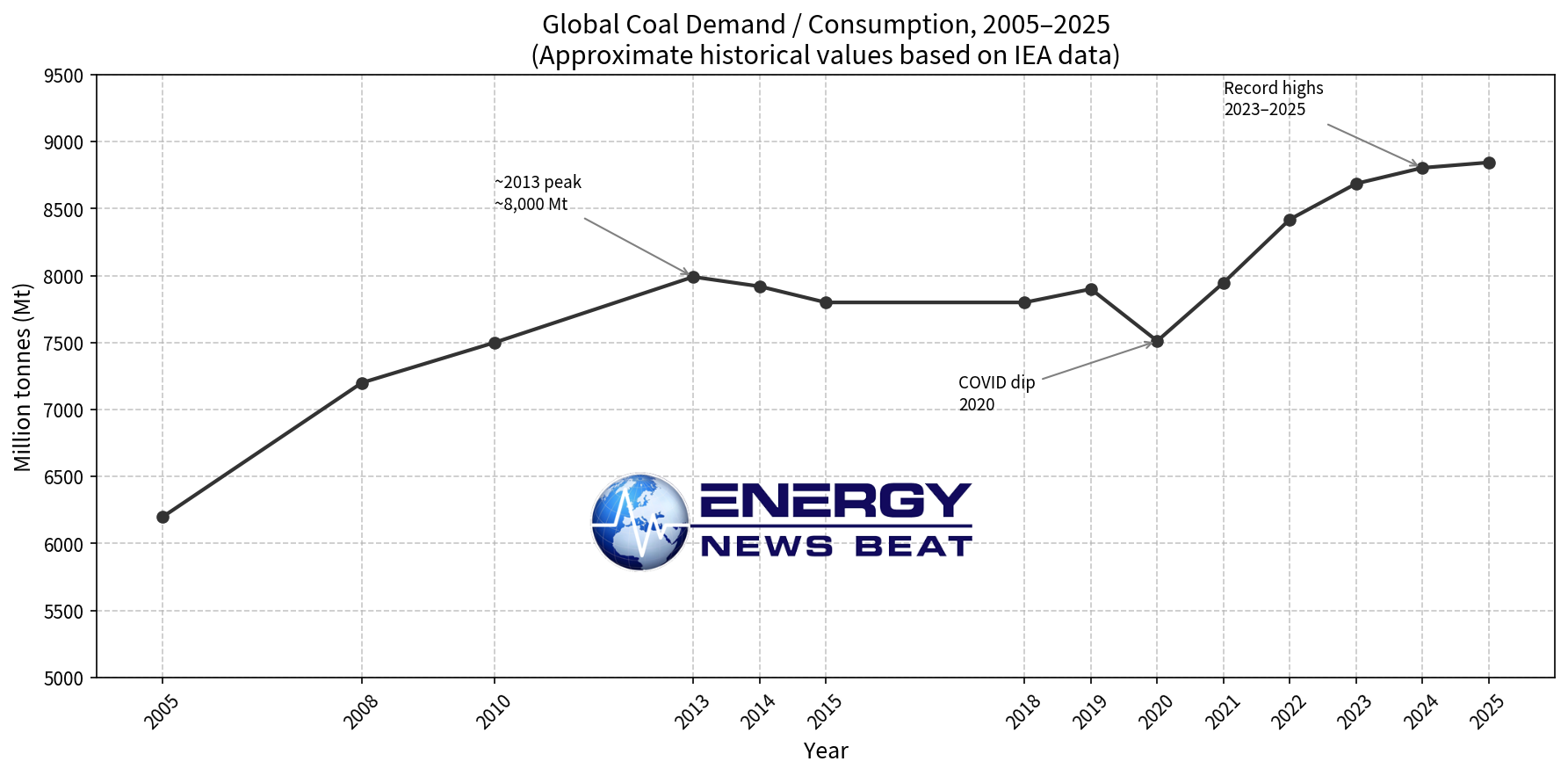
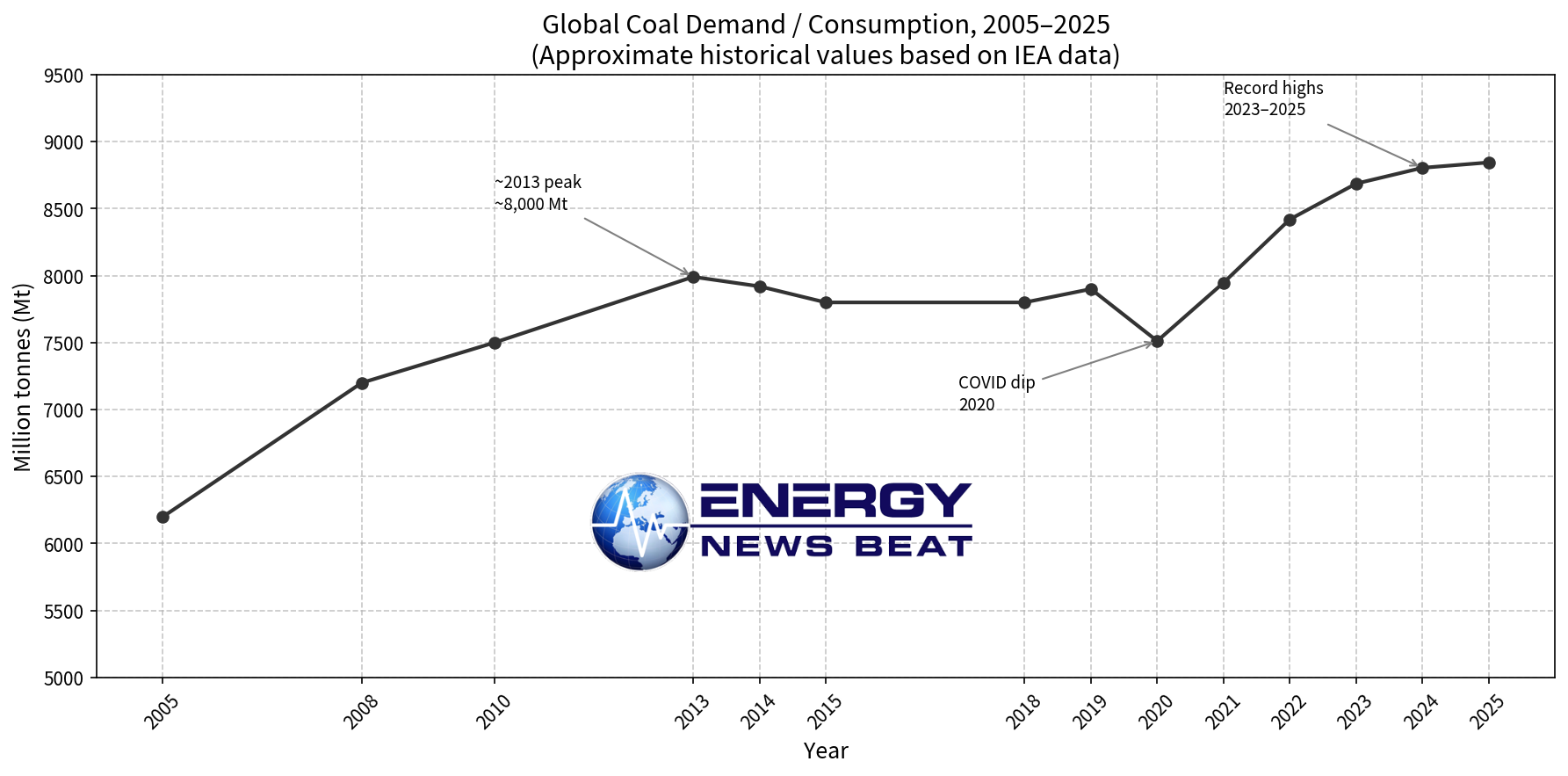
Global coal consumption over the last 20 years
Global coal demand has risen substantially since the early 2000s. Around 2000 it stood near 5,000 million tonnes (Mt). By the early 2020s it had climbed sharply; it reached a record 8,687 Mt in 2023 (up roughly 2.5% year-on-year) and an estimated all-time high of about 8.77–8.8 billion tonnes in 2024. Demand has more than doubled over roughly three decades and increased on the order of 60% or more from 2000 levels.
Growth has been overwhelmingly concentrated in Asia. China accounts for roughly 55–56% of global consumption (around 4.9 billion tonnes recently). India is the second-largest and continues to expand rapidly. ASEAN countries (notably Indonesia and Vietnam) are also adding demand. In advanced economies, the picture is the opposite: coal use has halved from its mid-2000s peak in many places. The United States and European Union have seen steady declines driven by gas competition, renewables growth, retirements, and policy.
Recent IEA analysis shows demand growth slowing after the post-COVID rebound (strong increases in 2021–2023), with a projected plateau near 8.87 billion tonnes by 2027 under current policies. Power generation remains the dominant driver, and coal still supplies a large share of global electricity (historically around one-third or more). Absolute consumption remains near historic highs even as its share of the energy mix has edged down in some years.
In short: Western financial institutions and governments are accelerating exit policies while developing Asia continues to rely on coal for affordable, dispatchable power to support economic growth, industrialization, and rising electricity demand.
Is the Bank of England’s net-zero push a continued bad move?
The world is demanding low-cost, stable, reliable power. Intermittent renewables have scaled rapidly and continue to grow, but they require backup, storage, and grid investments that raise system costs. Many emerging economies prioritize energy security and affordability over rapid decarbonization timelines that risk higher prices, industrial relocation, or energy poverty.
New high-efficiency, low-emissions (HELE) coal plants—particularly ultra-supercritical and advanced ultra-supercritical designs—offer a pragmatic bridge. These plants operate at higher temperatures and pressures, achieving thermal efficiencies of roughly 42–47% or higher, compared with older subcritical plants often in the 30–36% range. The efficiency gain translates into substantially lower CO₂ emissions per megawatt-hour (reductions on the order of 15–30% or more relative to conventional units, depending on the baseline). With further improvements or carbon capture, emissions can be reduced still more, though commercial-scale CCS deployment on coal remains limited.
These plants provide firm, dispatchable baseload or flexible power at costs that remain competitive in many regions with abundant domestic coal resources. They also support industrial processes (steel, cement, chemicals) that still rely heavily on coal. Excluding the sector entirely from central-bank collateral frameworks treats all coal as equally stranded and ignores technological differentiation and regional realities.
Critics of pure net-zero financial policies argue that unilateral Western divestment does little to cut global emissions when consumption simply shifts eastward (carbon leakage). High energy costs in Europe have already been linked by some observers to deindustrialization pressures and the relocation of manufacturing to higher-emission jurisdictions. Forcing the financial system to treat thermal coal as toxic collateral can raise the cost of capital for remaining producers, tighten liquidity for related bonds, and signal further retreat from fossil-fuel financing—even as physical demand persists.
The Bank of England’s move is consistent with its climate-risk mandate and the desire to protect its own balance sheet from transition risks. Yet if the global energy system continues to need large volumes of affordable firm power for decades, and if HELE or other cleaner coal technologies remain relevant, the policy risks being premature. It prioritizes modeled transition risks over observed demand and the practical need for energy that is both cleaner and low-cost.
What this means for the Bank of England long term
In the near term, the change is modest: it removes one category of collateral and applies risk-based haircuts elsewhere. It may nudge commercial banks to reduce residual coal exposure and reinforces the narrative that high-emission assets carry transition risk.
Longer term, the implications depend on how the energy transition actually unfolds:
- If rapid global decarbonization materializes and coal demand declines sharply after the mid-2020s plateau, the Bank will have protected its balance sheet and aligned with government net-zero goals.
- If demand remains elevated or declines only slowly (as recent IEA projections under current policies suggest), the exclusion could leave the Bank and UK financial system less engaged with a still-important part of the global energy economy. Higher domestic energy costs, industrial competitiveness challenges, and potential inflationary pressures from tighter energy supply could complicate the Bank’s core price-stability mandate.
- Reputation and influence risks also exist. Quiet implementation already reflects external political pressures (including shifting U.S. priorities). Overly aggressive climate-risk policies that diverge from physical energy realities risk accusations of mission creep or of accelerating economic costs without commensurate global climate benefit.
Central banks exist primarily to maintain monetary and financial stability. Incorporating climate considerations as risk factors is legitimate; treating them as a primary driver of collateral policy that effectively defunds a still-growing global fuel risks subordinating that mandate to a contested policy timeline.
The rest of the world is voting with its power plants and industrial boilers. Record or near-record coal use in Asia, continued construction of new capacity in several emerging markets, and the practical advantages of efficient coal generation for stable, low-cost electricity suggest that financial exclusion in London will not dictate the global energy mix. Pragmatic engagement with cleaner coal technologies, alongside genuine low-carbon alternatives that can deliver reliability at scale, remains a more realistic path than unilateral divestment.
Appendix: Sources and Links
- Felicity Bradstock, “The Bank of England Is Moving Away From Coal,” OilPrice.com, 1 August 2026: https://oilprice.com/Energy/Energy-General/The-Bank-of-England-Is-Moving-Away-From-Coal.html
- IEA, Coal 2024: Analysis and forecast to 2027: https://iea.blob.core.windows.net/assets/a1ee7b75-d555-49b6-b580-17d64ccc8365/Coal2024.pdf (and related IEA coal reports/data)
- IEA charts and demand updates on global coal consumption: https://www.iea.org/data-and-statistics/charts/global-coal-consumption-2000-2025 and subsequent Coal reports
- Enerdata World Energy Statistics – coal and lignite consumption: https://yearbook.enerdata.net/coal-lignite/coal-world-consumption-data.html
- Additional historical context from Energy Institute Statistical Review / Our World in Data compilations and secondary summaries of IEA/BP data
- Technical references on HELE / ultra-supercritical efficiency and CO₂ reductions (examples): MDPI Sustainability article on Advanced Ultra-Supercritical plants; CTC-N and industry summaries on pulverised coal higher-efficiency systems
- Bank of England market notices and related coverage on collateral eligibility and climate risk adjustments (June 2026 notices referenced in secondary reporting)
- Supporting context on financial-institution coal policies from IEEFA and TPI/LSE reports cited in the OilPrice article
All data and policy descriptions are drawn from the above publicly available sources as of early August 2026. Global coal figures are approximate where exact yearly series vary slightly by source and definition (thermal vs. total, Mt vs. energy units).
The post Net Zero has hit the Bank of England, and they cut all support for coal. But the rest of the world increases use of coal and low-cost energy. appeared first on Energy News Beat.