Energy News Beat
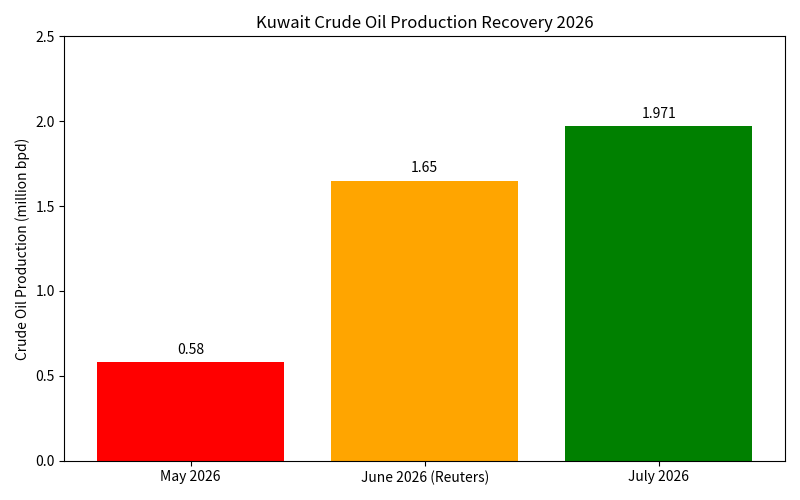
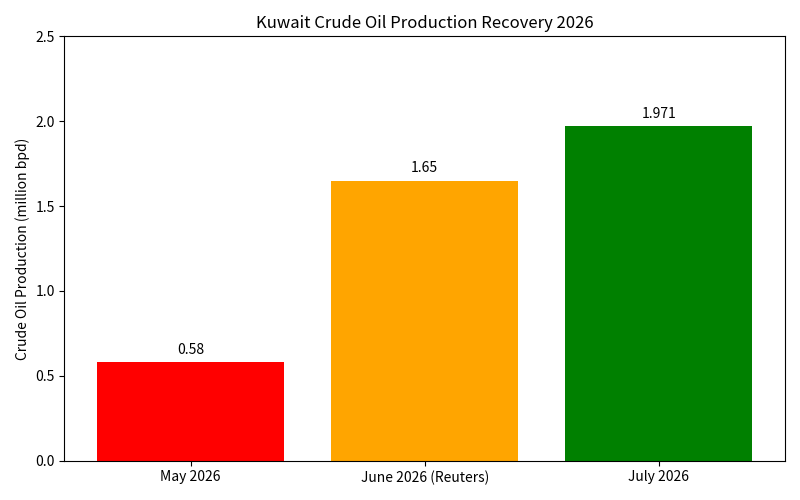
Kuwait’s crude oil production averaged 1.971 million barrels per day (bpd) in July 2026, up from about 1.65 million bpd in June, according to a source familiar with the matter. This brings output close to the 2 million bpd level and marks continued recovery after severe disruptions earlier in the year.
The rebound follows the U.S.-Iran interim peace agreement that eased the effective blockade and severe restrictions on the Strait of Hormuz. Kuwait Petroleum Corporation had lifted war-era force majeure notices in mid-June, enabling higher exports through the Gulf. Daily rates had already climbed as high as 1.9 million bpd in the final days of June.
This recovery occurs against the backdrop of ongoing OPEC+ quota increases and persistent shipping challenges in two critical chokepoints: the Strait of Hormuz and the Red Sea/Bab el-Mandeb.
Context: The 2026 Hormuz Shock and Partial Recovery
The U.S.-Israel conflict involving Iran sharply disrupted Gulf oil flows starting around March 2026. Production shut-ins peaked in the spring, with Kuwait output falling as low as roughly 0.58 million bpd in May (Reuters-aligned figures) or 0.74 million bpd (IEA estimates). Similar sharp declines hit Saudi Arabia, Iraq, and others as storage filled and exports stalled.
Traffic through the Strait of Hormuz has been highly fluid since the interim deal. Flows resumed unevenly, with tanker rushes reducing floating storage at times, but renewed hostilities (including reports around early July) have kept volumes volatile and difficult to track with high accuracy. Secondary sources, tanker-tracking firms, IEA, and OPEC data frequently diverge because AIS signals, loading reports, and actual transits do not align perfectly under the fluid conditions. Accurate real-time measurement of volumes remains challenging.
Red Sea risks compound the picture.
Houthi forces (aligned with Iran) have attacked Saudi energy infrastructure (including Yanbu and Jizan) and declared naval blockade measures targeting Saudi exports via Bab el-Mandeb. Ship traffic has slowed, with some tankers rerouting around Africa. These disruptions affect Saudi volumes that would otherwise use Red Sea terminals as an alternative to Hormuz.
OPEC+ Production Quotas vs. Reality
Seven core OPEC+ members—Saudi Arabia, Russia, Iraq, Kuwait, Kazakhstan, Algeria, and Oman—have implemented successive monthly production adjustments of approximately 188,000 bpd. These form the final phase of unwinding roughly 1.65 million bpd of additional voluntary cuts originally announced in 2023 (UAE having exited earlier). The increases cover June/July/August and are expected to complete the rollback with a similar step for September, after which a pause is widely anticipated.
On paper, the higher quotas aim to restore previously curtailed volumes. In practice, actual output has lagged far behind due to the conflict-related shut-ins, infrastructure constraints, and shipping risks.
Available data (primarily IEA for May–June 2026, supplemented by Reuters and OPEC secondary-source summaries) illustrate the gap:
Selected OPEC+ Crude Production (million bpd)
- Saudi Arabia: May ~6.44 (IEA); June ~7.34 (IEA). Still well below pre-conflict levels near 10+ million bpd and implied targets.
- Iraq: May ~1.48; June ~1.96 (IEA). Recovery underway but short of ~4.3+ million bpd capacity/targets.
- Kuwait: May ~0.58–0.74; June 1.37 (IEA) / 1.65 (Reuters source); July 1.971 (Reuters source). Approaching but not yet at full pre-crisis or quota levels near 2.6+ million bpd.
- Russia: May ~8.74; June ~8.86 (IEA). Relatively stable but facing separate constraints (see below).
Other notes: Total OPEC+ supply rose from ~30.3 million bpd in May to ~32.44 million bpd in June (IEA), still several million bpd below pre-war levels. OPEC secondary sources showed larger June gains for Kuwait (~+880 kb/d), Iraq, and others as exports restarted.
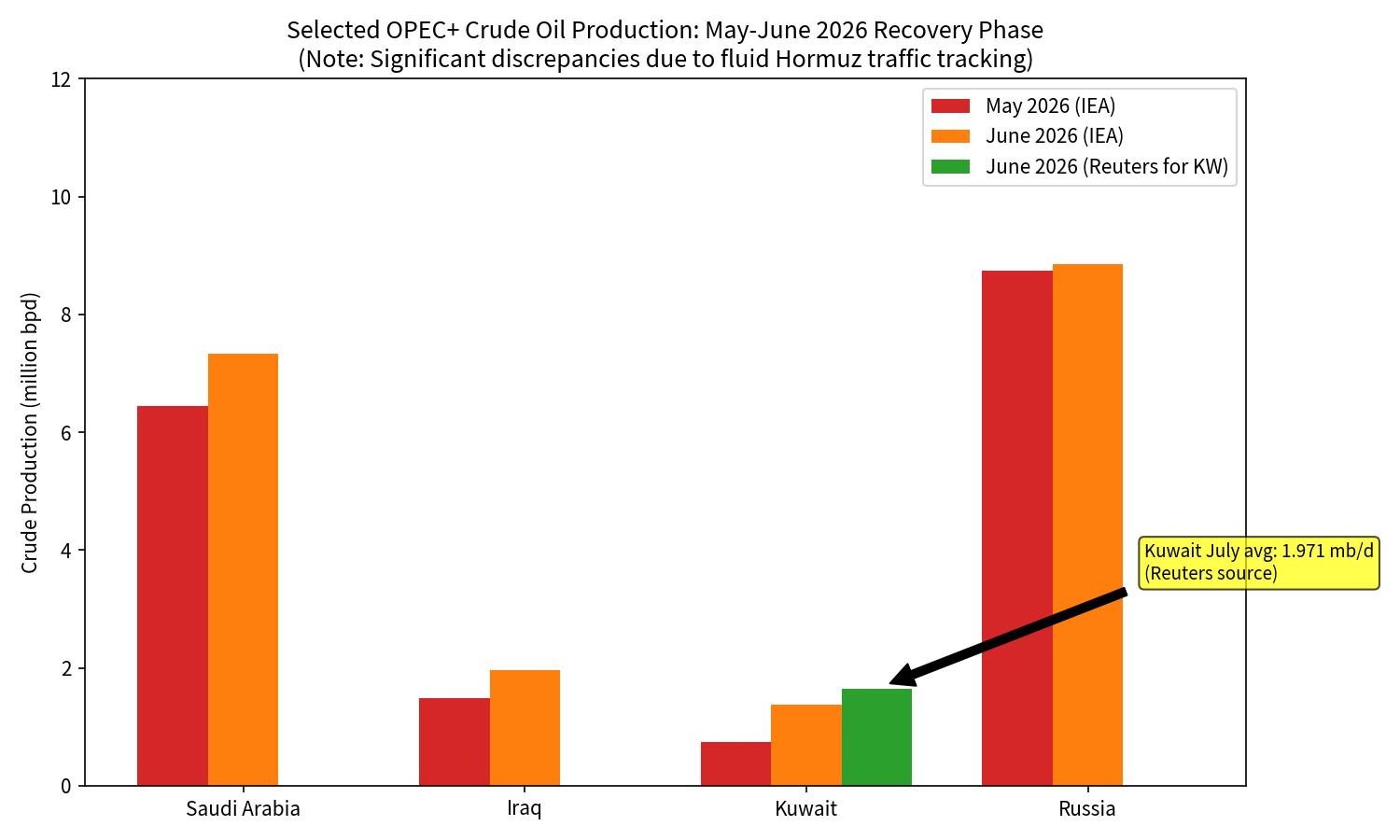
A fully consistent monthly series for every OPEC+ country across all of 2026 is not cleanly available in public secondary data. Discrepancies between IEA, OPEC secondary sources, and direct reporting (e.g., Kuwait June figures) underscore the tracking difficulties created by fluid Hormuz traffic and incomplete transparency during the conflict period. Pre-conflict baselines (early 2026) were significantly higher for the Gulf producers before the sharp spring drop.
Cross-Check: Can Increased Quotas Be Met Amid Traffic Problems?
The new higher quotas are largely notional for the near term. Gulf members (Saudi Arabia, Iraq, Kuwait) retain substantial spare capacity on paper, and Kuwait’s rapid July rise demonstrates that fields can ramp once export routes clear. However:
- Hormuz traffic remains fluid and intermittently constrained. Full, stable, high-volume transit is not yet guaranteed.
- Red Sea/Houthi threats limit Saudi’s alternative export options and raise insurance/risk premiums for the broader region.
- Logistics, storage, and refinery restart timelines create bottlenecks even when production can physically increase.
Most analysts and market participants view the quota hikes as adding “paper barrels” until Hormuz normalizes more fully. Energy commentator Javier Blas and others have noted that real output remains constrained by the Middle East conflicts.
Russia’s Separate Issues
Russia, included in the 188,000 bpd monthly increases, faces distinct challenges. Ukrainian drone strikes have hit refineries and export infrastructure (including Black Sea and Baltic ports such as Tuapse and Ust-Luga), reducing product exports sharply (record lows in some months) and forcing more crude into the market at times. Sanctions, shadow-fleet limitations, and Western service restrictions continue to complicate logistics and raise costs. Production has hovered in the 8.7–8.9 million bpd range recently—below implied targets near 9.7+ million bpd in some assessments—and official forecasts have been revised lower to reflect these pressures.
Russia can more readily meet incremental quota steps than the Gulf producers in the current environment, but sustained higher output still contends with infrastructure damage, tanker availability, and buyer/sanctions friction.
Outlook
Kuwait’s near-2 million bpd July figure is a positive signal of recovery potential. If Hormuz traffic stabilizes further and Red Sea risks ease, additional Gulf barrels can return. OPEC+ retains flexibility to pause, reverse, or accelerate the remaining steps based on market conditions. For now, the combination of fluid (and imperfectly trackable) Hormuz flows, Red Sea disruptions, and Russia’s ongoing operational issues means the group is unlikely to fully realize the newly increased quotas in the immediate months ahead. Global supply remains well below pre-conflict levels, supporting a cautious market balance.
Appendix: Sources and Links
- Marketscreener / original reference: https://www.marketscreener.com/news/kuwait-raises-crude-oil-output-to-near-2-million-bpd-in-july-source-says-ce7f50d8df8ff022
- Reuters (Kuwait June): https://www.reuters.com/business/energy/kuwait-raises-crude-production-165-mln-bpd-june-source-says-2026-07-02/
- Reuters-sourced July figures via multiple outlets (e.g., The Edge Malaysia, Dawn, Newsmax/X reports): Confirming 1.971 million bpd average.
- IEA Oil Market Report – July 2026: https://www.iea.org/reports/oil-market-report-july-2026 (production tables for May/June)
- IEA Oil Market Report – June 2026: https://www.iea.org/reports/oil-market-report-june-2026
- Peak Oil Barrel summary of OPEC MOMR July 2026: https://peakoilbarrel.com/opec-monthly-oil-market-report-july-2026/
- OPEC Monthly Oil Market Report page: https://www.opec.org/monthly-oil-market-report.html (July 2026 edition)
- OPEC press releases on production adjustments (examples): https://www.opec.org/pr-detail/1835609-5-july-2026.html ; https://www.opec.org/pr-detail/604-7-june-2026.html ; related 2026 statements
- Al Jazeera / AP on OPEC+ quota hikes: https://www.aljazeera.com/economy/2026/7/6/opec-countries-say-they-will-expand-monthly-oil-production
- Reuters on Red Sea/Houthi disruptions: https://www.reuters.com/world/middle-east/red-sea-shipping-slows-after-houthi-attack-saudi-arabia-data-shows-2026-07-27/
- CREA / Energy & Clean Air analyses on Russian exports (June/May 2026): https://energyandcleanair.org/june-2026-monthly-analysis-of-russian-fossil-fuel-exports-and-sanctions/
- Additional context on Russian production/export issues and sanctions impacts from Reuters and related trackers.
- EIA Short-Term Energy Outlook global oil section for broader context: https://www.eia.gov/outlooks/steo/report/global_oil.php
Data discrepancies across sources are themselves evidence of the tracking challenges created by fluid Strait of Hormuz conditions in 2026. All figures should be treated as estimates subject to revision.
The post Kuwait raises crude oil output to near 2 million bpd in July, source says appeared first on Energy News Beat.