Energy News Beat
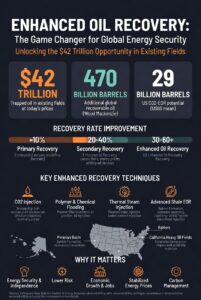
In an era of geopolitical uncertainty, maturing conventional fields, and rising global energy demand, the oil and gas industry stands at the threshold of a profound renaissance in energy security. The key? Enhanced recovery techniques—often called tertiary or enhanced oil recovery (EOR)—that unlock vast volumes of oil already discovered but left behind in existing reservoirs. These methods are not about chasing risky new frontiers; they are about maximizing what we already have, using proven technologies on mature infrastructure. As one recent analysis put it, without discovering another barrel, there is more than $42 trillion in crude oil trapped in existing fields at today’s prices, just waiting for advanced technology.
The Scale of the Opportunity
Traditional primary recovery (natural pressure and pumps) typically extracts only about 10% of the original oil in place (OOIP). Secondary methods like waterflooding or basic gas injection push that to 20–40%. EOR techniques can raise total recovery to 30–60% or more, depending on the reservoir and method.
Wood Mackenzie’s AI-powered analysis of global fields shows that improving recovery factors from the current industry average of ~29% to top-quartile performance could unlock an additional 470 billion barrels (with potential up to over 1 trillion barrels) from existing assets alone.
This is equivalent to decades of global supply without major new exploration. It directly addresses a looming production gap: 30 major oil and gas companies face a combined shortfall of ~22 million barrels of oil equivalent per day by 2040—roughly the output of two new Permian Basins.
Key Enhanced Recovery Techniques
Modern EOR goes far beyond basic waterflooding:
Gas Injection (especially CO₂-EOR): The dominant U.S. method (~60% of EOR production). CO₂ mixes with or swells the oil, reducing viscosity and mobilizing trapped hydrocarbons. It often pairs with carbon capture, utilization, and storage (CCUS), turning a climate solution into an economic driver.
Polymer Flooding & Chemical EOR: Polymers thicken injected water for better sweep efficiency; surfactants and other chemicals alter rock-fluid interactions.
Thermal Recovery (Steam Injection): Heats heavy, viscous oil to make it flow. Accounts for over 40% of U.S. EOR, especially in California.
Emerging Shale Applications: New approaches like surfactant-enhanced CO₂ “huff-and-puff” or advanced chemical methods target the low recovery rates (often 5–10%) typical of tight shale plays.
Hybrid & Digital-Enabled Methods: Real-time monitoring, AI-optimized injection, CHOPS (Cold Heavy Oil Production with Sand), and thermally enhanced polymers are boosting results in specific fields.
These techniques leverage existing wells, pipelines, and facilities—dramatically lowering capital intensity and timelines compared to greenfield exploration.U.S. Hotspots: Where the Renaissance Is Already UnderwayThe United States leads in many EOR applications thanks to mature fields, infrastructure, and supportive policies in key states.Permian Basin (Texas & New Mexico): The undisputed champion. CO₂-EOR has been commercial since the 1970s. The USGS 2022 national assessment estimates the technically recoverable CO₂-EOR potential across the U.S. at a mean of 29 billion barrels (range 25–32 billion), with the Permian (West Texas/Eastern New Mexico) holding ~38% of that potential.
ExxonMobil’s acquisition of Denbury brought the largest CO₂ pipeline network in the U.S. under one roof, supercharging future projects.
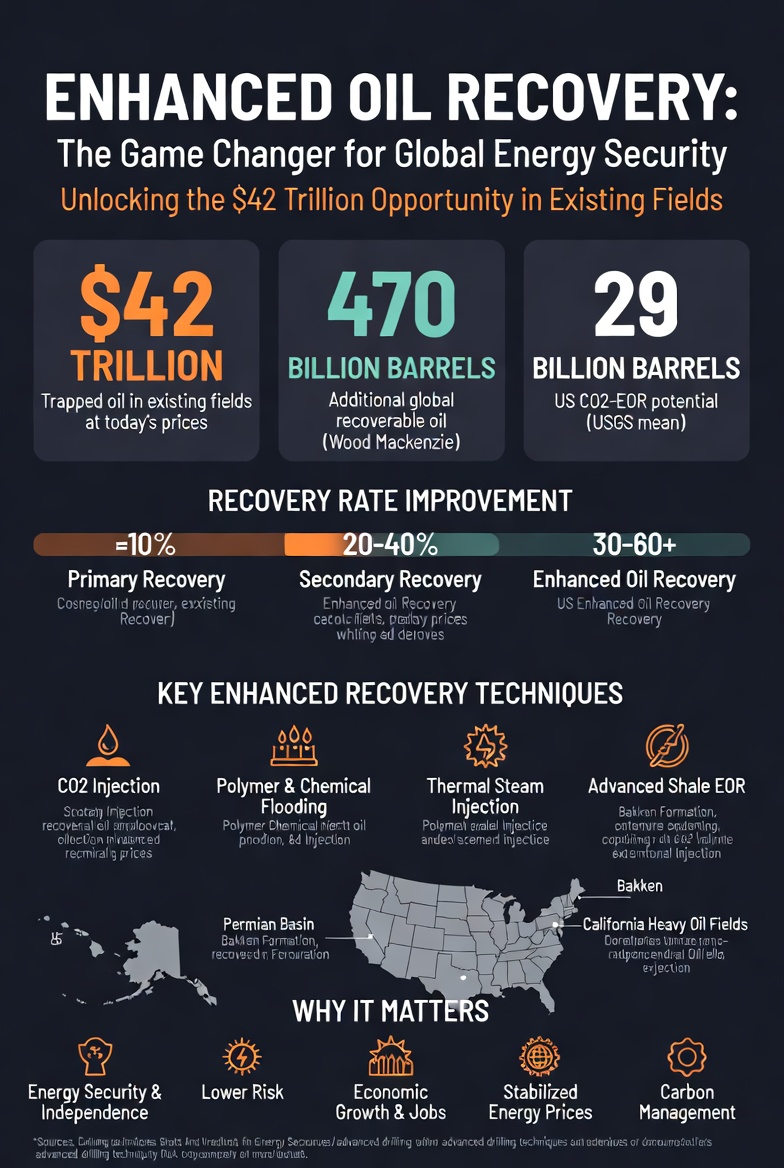
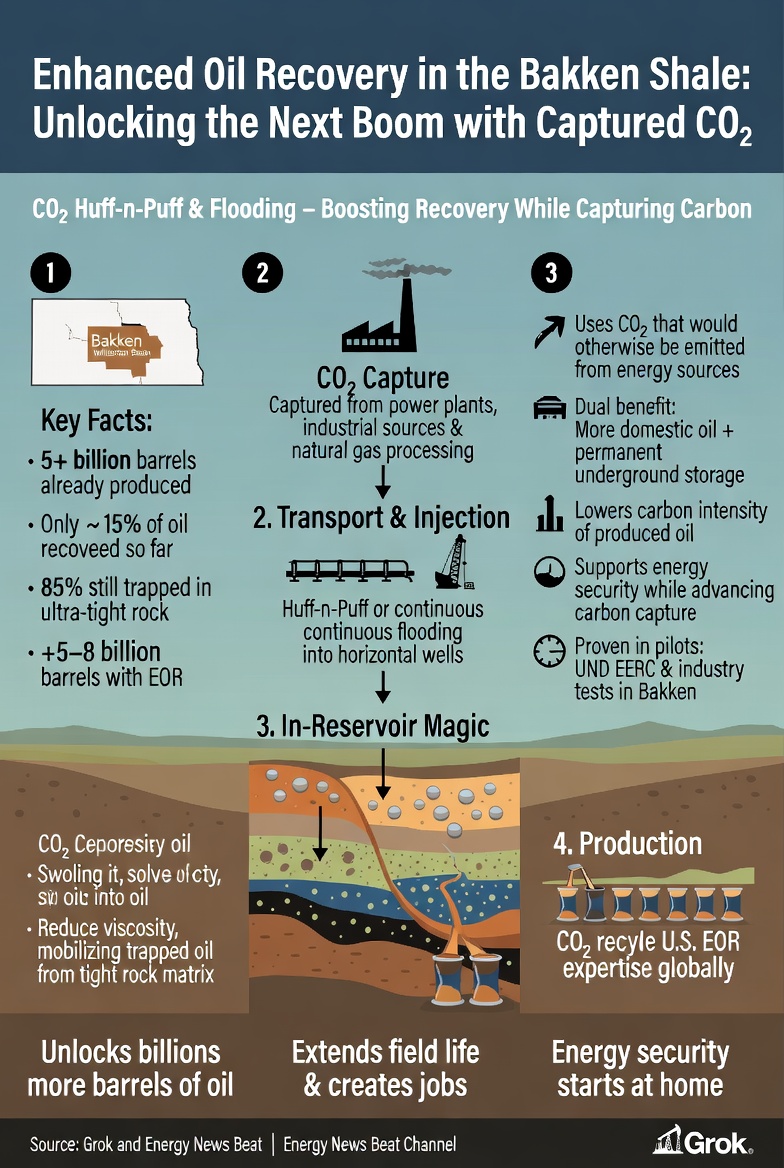
Bakken Formation (North Dakota): A prime emerging opportunity. Only ~15% of the resource has been tapped so far; state officials note that 85% remains trapped. North Dakota is aggressively pursuing CO₂-EOR pilots, with U.S. Department of Energy support. A second “Bakken boom” via enhanced recovery is explicitly on the table.
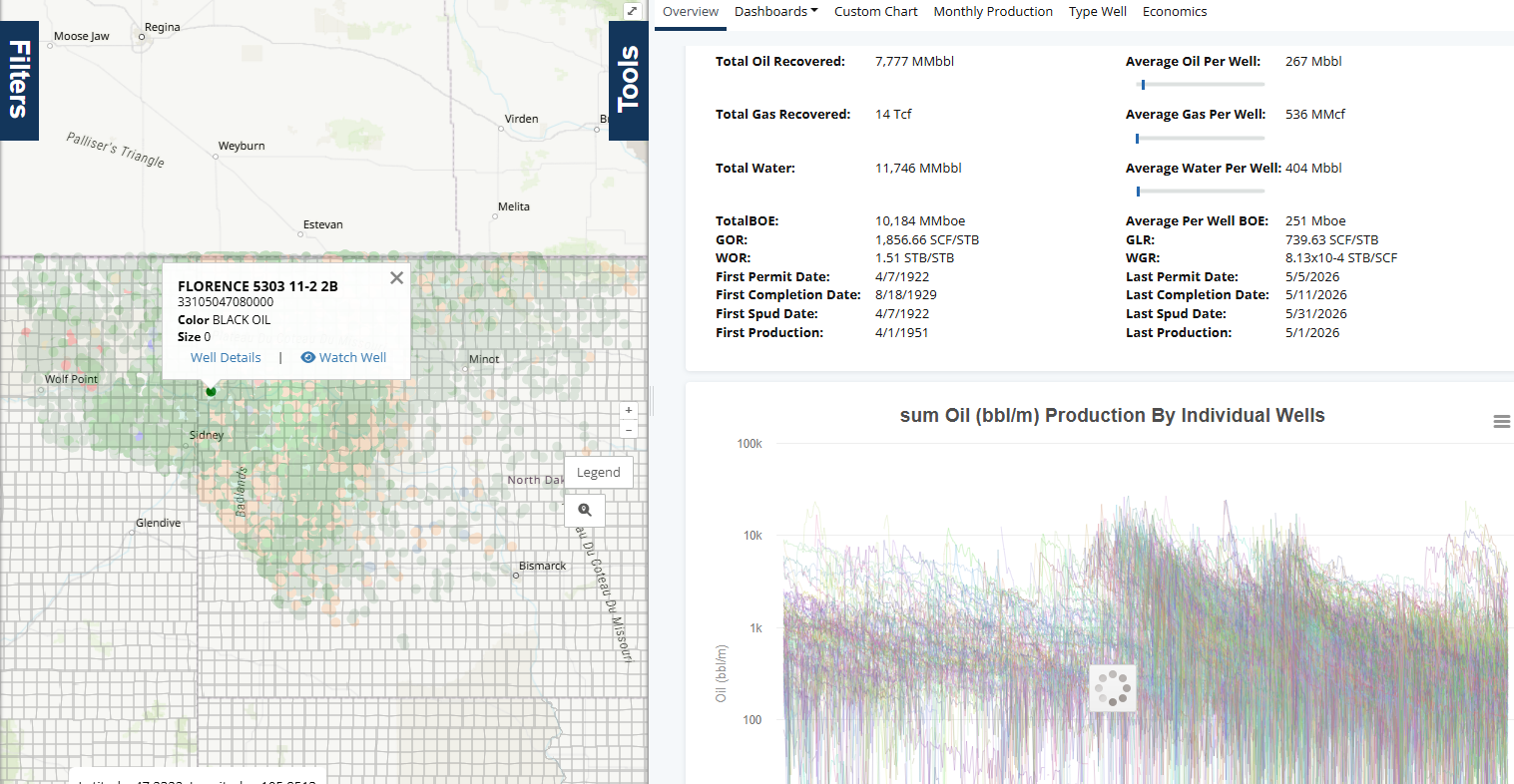
Interesting from the Bakken and welldatabase.com – 7,777 MMbbl recovered.
California: Long the leader in thermal EOR for heavy oil fields (e.g., San Joaquin Valley). Steam injection has been used commercially since the 1960s and still accounts for a huge share of national EOR output.
Other Significant Areas:
- Gulf Coast
- Midcontinent (Oklahoma, Kansas)
- Rocky Mountains and Northern Great Plains
The USGS assessment highlights these regions as having substantial CO₂-EOR upside, often in combination with carbon storage.
Investor Perspective
For investors, enhanced recovery represents lower-risk growth:
Majors and EOR specialists: Occidental Petroleum (major Permian CO₂ player), ExxonMobil (via Denbury and scale), and others with pipeline and injection expertise stand to benefit.
Service companies: Baker Hughes, Halliburton, and TechnipFMC see rising demand for polymers, digital monitoring, artificial lift, and well intervention technologies.
CCUS angle: 45Q tax credits and similar incentives make CO₂-EOR projects increasingly attractive, blending oil production with decarbonization goals.
Risks & opportunities: Oil price sensitivity remains, but existing infrastructure reduces breakeven points. Focus on companies with proven EOR track records, strong balance sheets, and exposure to federal incentives.
This is “the oil opportunity of the century”—a second boom built on assets already in the ground.
Consumer Perspective & Energy Security
For consumers, the implications are profound. Boosting domestic supply through EOR strengthens energy security by reducing reliance on imports from unstable or adversarial regions. It helps stabilize or moderate prices over time by increasing available barrels without the multi-year delays of new exploration and development.
In a world facing potential supply shortfalls, these techniques act as a powerful buffer.
Red States, Blue States, or National Imperative?
Enhanced recovery is already happening in both red and blue states, though activity is concentrated where geology, infrastructure, and policy align.Red states (Texas, North Dakota, Oklahoma, Wyoming, New Mexico) dominate current and near-term EOR growth due to pro-energy regulatory environments, existing CO₂ infrastructure, and political support. These states have led the shale revolution and are now positioned to lead the enhanced recovery renaissance.
Blue states like California already have decades of thermal EOR experience in heavy oil fields. While some blue states face stricter environmental reviews, the economic logic is powerful: higher domestic supply can ease energy costs and create jobs. CO₂-EOR’s CCUS co-benefit appeals to climate-conscious policymakers.
Will blue states “open up”? Many already have. Others may accelerate support if energy prices spike or security concerns intensify. Federal incentives (tax credits, DOE funding) and bipartisan interest in energy independence can bridge divides. Restrictive policies in some areas risk higher local energy costs and greater import dependence—the “roll down the road to higher prices” scenario.
In reality, this is not a partisan issue but a national one. Enhanced recovery benefits every American through greater supply security, economic activity in producing regions, and potential price moderation. States that embrace pragmatic, technology-driven approaches—regardless of political color—will capture the greatest advantages.
Conclusion: A Renaissance Built on What We Already Have
Enhanced drilling and recovery techniques are the quiet game changer the world needs. They transform mature fields into engines of renewed production, pair fossil energy with carbon management solutions, and deliver energy security without waiting for the next giant discovery.
The $42 trillion opportunity is hiding in plain sight—in the Permian, the Bakken, California’s heavy oil fields, and thousands of reservoirs worldwide. Investors who position themselves now, consumers who benefit from stable supply, and policymakers who prioritize pragmatism over ideology will shape the next chapter of global energy.
The renaissance is not coming—it is already beginning. The question is how quickly we choose to embrace it.
Appendix: Sources and Links
- OilPrice.com – “The $42 Trillion Oil Opportunity Hiding in Plain Sight” (detailed coverage of global EOR potential, Bakken, Trinidad example, and industry shifts): https://oilprice.com/Energy/Energy-General/The-42-Trillion-Oil-Opportunity-Hiding-in-Plain-Sight.html
- U.S. Department of Energy – Enhanced Oil Recovery overview (primary/secondary/tertiary recovery rates, techniques by category): https://www.energy.gov/hgeo/enhanced-oil-recovery
- USGS Circular 1489 (2022) – National Assessment of Carbon Dioxide Enhanced Oil Recovery and Associated Carbon Dioxide Retention (29 billion barrel mean potential): https://pubs.usgs.gov/circ/1489/cir1489.pdf
- Wood Mackenzie analyses on global recovery upside (470 billion+ barrels from existing fields via improved techniques): Multiple reports referenced via press releases and Horizons publications (2025).
- North Dakota / DOE Bakken EOR initiatives (recent pilots and state push for second boom): Various 2025–2026 reports and OilPrice coverage.
- Additional context from NETL, industry reports on CO₂-EOR, polymer flooding, and thermal methods in California and the Permian.
All data is current as of mid-2026. For the latest project updates, monitor DOE, state oil & gas commissions, and company filings.
The post Enhanced Recovery Techniques in Oil and Gas: The Game Changer for a Global Energy Security Renaissance appeared first on Energy News Beat.