Energy News Beat
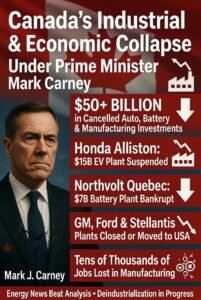
Canada’s manufacturing and industrial base is in freefall under Prime Minister Mark J. Carney’s leadership. A viral X post from @wealthmoose on May 14, 2026, lays out the stark reality with receipts: over $50 billion in planned investments have been canceled, moved, or evaporated in key auto, battery, and manufacturing projects across Ontario and Quebec.
These are not abstract figures. They represent lost factories, shuttered assembly lines, and communities hollowed out. The post highlights Carney’s own words on “clean energy” and “electrification” as the path to a “sustainable, prosperous economy” — delivered against a backdrop of collapsing heavy industry. The irony is impossible to ignore: policies sold as building a green future are instead accelerating deindustrialization.
The $50+ Billion Industrial Hit List (from the X Post)
Here are the major projects detailed:
Honda Alliston, ON → $15 billion EV and battery complex canceled/suspended indefinitely. Potential for 1,000+ new direct jobs (plus supply chain thousands); existing plant employs ~4,200 but future expansion lost.
Stellantis Brampton, ON → Production moved to Illinois; $500 million in government aid pocketed with no plant.
Stellantis Windsor Battery Plant → Stake sold for $100 (near-total write-off of planned investment).
GM CAMI Ingersoll, ON → Permanently closed; $2 billion retooling investment gone.
GM Oshawa, ON → Production shifted to Indiana; $280 million lost.
Ford Oakville, ON → EV production moved to USA; $2.3 billion gone.
Northvolt Quebec → Battery plant bankrupt; $7 billion evaporated (planned ~3,000 jobs lost).
Invista Kingston, ON → Moving to Texas; 500 jobs gone.
Umicore Ontario → Shifting to Poland & South Korea; $260 million gone.
Total investment lost: Over $50 billion.

Quantified Economic Impacts from These Losses + Broader Problems
These project failures are not isolated. Canada’s auto sector (which these plants anchor) directly employs ~125,000 workers and supports up to 500,000 indirect jobs across supply chains. It contributes over $17 billion annually to GDP and generates billions in tax revenue (corporate, payroll, and indirect).
Jobs: The listed projects alone represent thousands of direct jobs foregone or lost (Honda ~1,000+ new; Stellantis Brampton ~3,000 affected; Northvolt ~3,000 planned; Invista 500 explicit; plus GM/Ford/Umicore ripple effects). When multipliers are applied (manufacturing jobs typically support 3–4 indirect roles in logistics, parts, and services), the total job impact from the $50B+ losses runs into the tens of thousands. Broader manufacturing has shed 18,000 jobs in April 2026 alone, with auto production down sharply.
Revenue & Tax Revenue: Lost production and investment mean foregone export revenue (autos are a major Canadian export) and tax shortfalls. The auto sector historically generates billions in annual government revenue. These collapses compound revenue losses from delayed or canceled projects.
GDP Impact: A $50B+ hit to capital investment in high-multiplier manufacturing sectors (where each dollar invested can generate $1.5–2.5+ in broader economic activity) translates to significant GDP drag — easily several billion dollars annually once ripple effects hit supply chains, wages, and consumer spending. Canada’s overall real GDP growth is already anemic (forecasts ~1.1% for 2026 amid trade tensions and manufacturing weakness).
Other Problems: Energy Sector Devastation Under the Same Policies
The industrial collapse in autos/EVs is only part of the story. Carney’s net-zero agenda (building on prior Liberal policies) has hammered Canada’s energy superpower status:
Oil & Gas Emissions Cap: Parliamentary Budget Officer (PBO) analysis shows the cap will reduce production ~5%, costing $20.5 billion annually in GDP and 54,400 full-time equivalent jobs by 2032.
Canceled Energy Projects: Since 2015 (Trudeau-to-Carney continuity), over $660–670 billion in oil, gas, and resource projects have been canceled or indefinitely suspended. This has cost hundreds of thousands of jobs and tens of billions in annual tax revenue (royalties, corporate taxes, and personal income taxes from energy workers).
Broader Headwinds: Business investment per worker remains near historic lows. Manufacturing output is contracting. Unemployment is rising (6.9%+), and youth unemployment is especially hard-hit. Per-capita GDP stagnation and record deficits compound the pain.
Carney’s government responds with photo-ops, task forces, and billions in new subsidies — yet plants keep closing, and investments flee to the U.S., Poland, or elsewhere. The result: “managed decline” with a massive price tag for Canadian workers, taxpayers, and families.
Canada was once an energy and manufacturing powerhouse. Under Carney’s watch, it risks becoming neither. The numbers don’t lie. And they could lose Alberta, but an activist judge just blocked the will of the people, and it could get messy. The Carbon Tax and regulatory overreach he is placing on the Alberta oil and gas industry is horrific.
Appendix: Sources and Links
- Original X post by
@wealthmoose
(May 14, 2026): https://x.com/wealthmoose/status/2054961364251156627
- Honda Alliston $15B cancellation: Automotive News (May 5, 2026) https://www.autonews.com/ev/anc-honda-investment-canada-suspended-indefintely-0505/
- PBO Report on Oil/Gas Emissions Cap (GDP/jobs impacts): Referenced in economic analyses (Spring 2026).
- Canada’s auto strategy & plant moves (Stellantis, GM, etc.): PMO releases & news (Feb–May 2026) e.g., https://www.pm.gc.ca/en/news/news-releases/2026/02/05/prime-minister-carney-launches-new-strategy-transform-canadas-auto
- Manufacturing job losses & GDP slowdown: Statistics Canada / Financial Post (April–May 2026 reports).
- Energy project cancellations ($660B+ total): Canada Action / Fraser Institute analyses.
- RBC Auto Sector Outlook (125k jobs, risks): May 2026 briefing.
Energy News Beat will continue tracking these impacts. Real energy policy — not rhetoric — is what Canada needs to rebuild.
The post Canada’s Economic and Industrial Collapse under Mark J Carney appeared first on Energy News Beat.