Energy News Beat
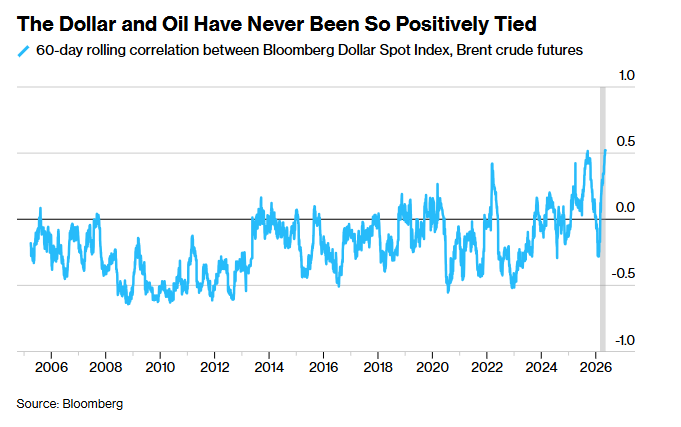
Eleven weeks into the Middle East conflict that has effectively shuttered the Strait of Hormuz and sent energy prices soaring, the correlation between the Bloomberg Dollar Spot Index and Brent crude futures has hit its highest level on record. This marks the strongest daily tandem movement between the greenback and oil in more than two decades, dating back to the launch of the dollar gauge in 2005.
Normally, the dollar and oil often move in opposite directions. A stronger dollar tends to weigh on commodity prices by making them more expensive for buyers using other currencies. But the Iran crisis has flipped the script. Supply disruptions, geopolitical risk premiums, and safe-haven flows have aligned the two assets in a rare positive correlation that analysts say is amplifying volatility across global energy and currency markets.
Markets React as Trump-Xi Summit Unfolds in Beijing
As of this afternoon (May 14, 2026), WTI crude is trading near $101 per barrel, while Brent hovers around the $104–$105 range — levels that reflect sustained pressure from the Hormuz disruptions. The dollar index (DXY) remains firm, underscoring the tight linkage highlighted in today’s Bloomberg report.

Source Bloomberg
Markets are watching closely as President Donald Trump meets with Chinese President Xi Jinping in Beijing today. The high-stakes summit — covering trade, Taiwan, and the Iran war — carries direct implications for energy flows. The White House reports that Xi expressed interest in purchasing more American oil and LNG to reduce China’s dependence on the blocked Strait of Hormuz. Both leaders reportedly agreed that the strait “must remain open” for global energy security, though concrete steps toward de-escalation remain limited.
China, the world’s largest buyer of Iranian oil despite U.S. sanctions, faces its own supply headaches. Recent U.S. sanctions on entities facilitating Iranian crude shipments to China add another layer of tension. Energy traders say any meaningful pivot by Beijing toward U.S. exports could support both oil prices and the dollar — reinforcing the very correlation now at record highs.
What Analysts Are Saying About Oil Prices
The Iran war has forced forecasters to repeatedly revise their outlooks upward:
The International Energy Agency (IEA) now projects a global oil market deficit of 1.78 million barrels per day in 2026, citing ~10.5 million bpd of Gulf production offline and infrastructure damage.
A Reuters poll of analysts in April (updated in recent weeks) sees Brent averaging $86.38 for the full year — though many firms, including HSBC, have since lifted targets toward $95 amid prolonged disruptions.
J.P. Morgan expects oil to remain in the low $100s for the rest of 2026, even if the strait reopens next month.
Goldman Sachs and others warn of gasoline prices climbing above $3.50/gallon in the U.S. and broader inflationary risks if the conflict drags on.
OPEC has slashed its 2026 oil demand growth forecast, reflecting the drag from high prices and slower economic activity in Europe and Asia. Yet bulls point to structural supply losses and the slow pace of any peace process as reasons prices could test $110+ in the near term.
Bottom Line for Energy Markets
The record positive dollar-oil link is more than a statistical curiosity — it signals how deeply the Iran conflict has reshaped global risk pricing. For U.S. producers, the environment remains supportive: elevated prices, potential new export demand from China, and a strong dollar that still favors American energy competitiveness.
As the Trump-Xi talks continue and the world waits for any breakthrough on the Strait of Hormuz, one thing is clear: the dollar and oil are joined at the hip, and the Iran war is keeping them that way.
Stay tuned to Energy News Beat for live updates from the markets and the Beijing summit.
Appendix: Links and Sources
- Bloomberg: “Dollar’s Link to Oil Most Positive Ever as Iran Crisis Drags On” (May 14, 2026) — https://www.bloomberg.com/news/articles/2026-05-14/dollar-s-link-to-oil-most-positive-ever-as-iran-crisis-drags-on?srnd=phx-industries-energy
bloomberg.com
- Reuters / White House updates on Trump-Xi summit and U.S. oil exports to China (May 13–14, 2026)
- IEA Oil Market Report – May 2026 (global deficit forecast)
- Reuters analyst poll on 2026 oil price forecasts (April/May updates)
- Trading Economics / CME data – WTI and Brent prices as of May 14, 2026
- CNBC / Asia Times reporting on Trump-Xi agenda and Hormuz discussions
- OPEC monthly report – downward revision to demand growth
All data and quotes drawn from publicly available reporting as of May 14, 2026. Energy News Beat will continue monitoring developments in real time.
The post The U.S. dollar and oil prices are moving in lockstep like never before — and the ongoing Iran war is the reason. appeared first on Energy News Beat.